Ballon Reappraises Mayor Lindsay

Event: The New Urbanism of Mayor Lindsay: The Downtown Scene
Location: Center for Architecture, 03.31.10
Speakers: Hilary Ballon, Ph.D. — Deputy Vice Chancellor, NYU Abu Dhabi, & University Professor of Art History and Archaeology, NYU
Organizers: AIANY; NYU Grey Art Gallery; Fales Library

Lindsay

John Lindsay campaigning for mayor in Jamaica, Queens, 1965.

Photograph by Katrina Thomas, courtesy of the photographer, via the Museum of the City of New York

Casual readers of Hilary Ballon’s title could be fooled twice: there’s nothing here about the 1960s “downtown scene” in the Warhol sense, and no references to The New Urbanism as advocated later by Andrés Duany, FAIA. But a new kind of urbanism (uncapitalized) was brewing in those heady days under Mayor John Lindsay. An approach to policy that brings architects into public service and recognizes the critical effects of design on the quality of life, these concepts are now familiar enough in city-planning circles to seem transparent. However, when Lindsay took office in 1966, in the twilight of the Robert Moses era, they were innovations. They are among the many changes that appear, through historical excavations of Hilary Ballon, Ph.D., to be valuable long after the Lindsay era was dead and buried. Ballon’s work on Moses (editing Robert Moses and the Modern City along with Kenneth Jackson) did a great deal to complicate and rescue the reputation of that pivotal figure; she is now bringing a comparably balanced perspective to a very different metropolitan icon.

Mentioning the phrase “quality of life” in the same breath with Lindsay’s name is a guaranteed provocation for those who associate him with transit and garbage strikes and rising crime rates. Lindsay’s leadership is overdue for a reappraisal; it’s about to get one not only from Ballon, but from the Museum of the City of New York, which will mount an exhibition called “The Lindsay Years” this May, along with a day-long symposium, a book edited by Sam Roberts of the Times, and a WNET documentary. Lindsay couldn’t deflect every social storm that battered NY, but some of his less-heralded accomplishments helped the city eventually become, once again, not only governable but worth inhabiting.

Lindsay took the heat for, among other things, a host of problems he’d inherited from predecessor Robert Wagner. Largely unrecognized in this picture is the paradigm shift he generated by making the design of public spaces an institutional priority. “Moses didn’t regard design as a matter of public policy,” Ballon noted. At the peak of his power, even some of the strongest legacies of “the good Moses,” such as his myriad playgrounds, took a cookie-cutter approach to design. Under Lindsay, whose campaign made urban design a prominent component of his platform, the city got Richard Dattner, FAIA’s Adventure Playground, a park-use policy under August Heckscher and Thomas Hoving, Hon. AIA, that made Central Park a “space for happenings,” and an explicit recognition of pedestrians’ right to street space. We got Battery Park City, built on downtown landfill, with new rules preserving visual corridors and pedestrian paths. Most important in the long run, we got the City Planning Commission’s Urban Design Group, an architectural and infrastructural brain trust that pioneered tools such as bonus zoning and air-rights transfer, all guided by a philosophy of using zoning, as Ballon said, “to create public benefits, not just restrict harms.”

Though Moses was largely defanged by then, it must be noted, we also nearly got his long-planned Lower Manhattan Expressway (LoMEx). Lindsay first campaigned against it, but after taking office reversed course and supported it, assigning the Urban Design Group to come up with a plan less intrusive than Moses’s massive elevated roadway. The group brought architect Shadrach Woods back to NY from housing-project work in France in 1968, “committed,” as Richard Buford’s invitation letter declared, “to the proposition that the expressway not be a scar on the body of the city.” Woods produced feasibility studies incorporating immense sociological data on SoHo residents and businesses, all aimed at mitigating neighborhood conflicts and preserving the area’s cast-iron architecture. Even in attempting to implement LoMEx, Ballon noted, Lindsay’s team thought progressively about how it might be a positive influence, a mixed-use project including replacement housing, not just another neighborhood-killing car conduit like the Cross-Bronx Expressway.

Veterans of Lindsay’s City Hall and the Urban Design Group spoke spontaneously as well, including Jordan Gruzen, FAIA; Terrance Williams; Lance Jay Brown, FAIA; and former mayoral chief of staff Jay Kriegel. All recalled the era as a formative period in their careers and an unsung heyday in the city’s development. Ballon quoted Ada Louise Huxtable, Hon. AIA, writing of Lindsay’s group in a 1971 Times piece with her customary prescience, hailing “a revolution going on in American cities: in conceptual, legal, and administrative aspects of zoning that sets such innovative patterns of land use that it will change whole parts of cities as we know them. Don’t write off the revolution because it is being made by men in business suits at City Hall.”

Modernism Is Hurt by the Cuddle Factor (continued)

Miami’s Marine Stadium, whose attractions included speedboat racing and concerts, offers a happier story. Closed since Hurricane Andrew in 1992 but structurally sound, this origami-like design by Cuban architect Hilario Candela of the local firm Pancoast, Ferendino, Grafton, Skeels, and Burnham brings the forms of Pier Luigi Nervi, Max and Enrique Borges, Oscar Niemeyer, and others to Biscayne Bay on a vast scale. Amid conflicting estimates of renovation costs and an attempt at demolition using Federal Emergency Management Agency funds, Jorge Hernandez reported, the community has rallied along with the WMF, Docomomo, and others to oppose a “heavy-handed…. ridiculous” retail-oriented plan that would remove the stadium, then a second plan preserving only the grandstand. The inseparable grandstand-basin combination attained local historic designation without the approval of the city as owner; further engineering studies, charrettes, and the election of a preservation-minded mayor all point to eventual success in preserving this icon of borderless hemispheric culture.

In Holmdel, NJ, Eero Saarinen’s elliptical Bell Labs research complex strikes a deliberately lower profile — original occupant AT&T preferred to hunker down out of public view — but helped set the standards for sleek corporate campuses in its day. AT&T’s successor Alcatel-Lucent moved out in 2007, and potential developer Preferred Unlimited planned to raze the buildings in favor of high-end residential, a corporate park, or other profitable uses. Maximized ratables outweigh historic and architectural considerations for township officials, commented Michael Calafati, AIA, and NJ’s higher-level governance is weak, but the restoration question at least remains open. New developer Somerset has welcomed a preservation charrette; Calafati describes the firm as “not perfect, but one we can have a conversation with.”

The afternoon panel, “Sustaining Operations in a Modern Building,” struck more confident notes, discussing the ongoing experiments with roof-panel materials and successive structural renovations at Scottsdale’s Taliesin West and the robust inverted ziggurat of Atlanta’s Marcel Breuer library. Ahead of its time in anticipating the broadened functions of a post-Carnegie-era library as well as defying local preferences for columns and coziness, the building provides essential community space at a transit-accessible downtown location. It is a flak magnet over issues unrelated to its operations (e.g., gatherings of the homeless), and Fulton County voters passed a 2008 bond referendum calling for an alternate central site along with branch expansions, but the amount has been reduced, says director John Szabo, who believes finances ensure any replacement is “a long way from happening.” Even if it does, Breuer’s building will be a candidate for conversion to an academic facility or museum, though vigilance and stepped-up public relations are critical.

Much of the day’s discussion analyzed why some preservation efforts capture the public’s imagination, and why Chicago’s never quite did. Panelists agreed that popular enthusiasm is essential to save a building. The Olympic bid had many Chicagoans wearing “rose-painted” glasses; hospitals in general can inspire more fear than affection; Chicago development invokes the tendencies for clout to outweigh reason and accountability. Despite Chicagoans’ famous knowledgeability about their architectural local heroes, many were unaware of Gropius’s involvement. Others simply “hate Modernism.”

One recurring theme was whether Modernist buildings are, as one questioner put it, “cuddly.” To part of the population, they never will be, and their other attributes (being breathtaking, structurally honest, well-programmed, or provocative) won’t matter. The difficult yet essential task, said Carl Stein, is educating citizens to distinguish between truly Modernist buildings — serious in intention, purposeful in advancing ideas, active in social contexts — and mere object-buildings in a modern style. Particularly as mid-century and later works approach the 50-year standard for landmark eligibility (a standard that many found open to rethinking), Stein emphasized a frank awareness that “one reason Modernism has been under heavy attack is… the idea we can solve things by conscious action.” What these buildings are up against is often not just an antipathy to bèton brut but a deeper antipathy to rationality itself.

Lofty Designs for Strange Weather

Event: State of Global Architecture
Location: Relative Space Concept Showroom, 02.19.10
Speakers: Jürgen Mayer H. — Principal, J. Mayer H. Architects (Berlin); Andres Lepik — Curator of Contemporary Architecture, Museum of Modern Art; Matthias Hollwich & Marc Kushner, AIA — Principals, HWKN, & Co-founders, Architizer
Organizers: Architizer; The Society; Azure magazine, Toronto

Cover_ARIUM_Snow

Jürgen Mayer H. and Neeraj Bhatia

Though the official title suggested a discussion of unrealistic breadth and forbidding gravity, this event in the “Azure Talks” series combined a preview of a forthcoming book, several of Jürgen Mayer’s recent projects, and an announcement of a competition winner by the latest social media website, Architizer. The talents behind this gathering imbued its diverse purposes with energy.

In the U.S., Mayer’s academic presence is larger than his built body of work, but this may change before long. His biomorphic-modernist designs have brought success early in his career; his buildings now appear throughout Europe, serving a wide range of programs and extending digitally generated geometries “beyond the blob,” in his description, into a kind of structurally plausible surrealism. The Metropol Parasol in Seville, Spain, built of Kerto laminated veneer lumber and resembling a half-dozen conjoined mushrooms sheltering a public plaza, market, and archaeological museum above recently discovered Roman ruins, is scheduled to open by the end of this year. Mayer expressed delight at its realization in Seville’s medieval town center, observing that “we have to celebrate Spanish culture to be brave enough to do something like this… I don’t think it would be possible to do something like this in Germany.” However, he also noted that a simpatico client would be more important than any particular project typology. Perhaps a local developer will be up to the challenge in the U.S.

Mayer also previewed and autographed his new book -arium (Hatje Cantz Verlag, 2010; co-edited with University of Toronto urban design professor Neeraj Bhatia), recently published in Germany and scheduled to appear here later this spring. The book uses weather, the fundamental antagonist of any form of shelter, as the central organizing principle for its theoretical and practical investigations (“weather and media,” “weather and war,” “weather and infrastructure,” etc.). In an era when architecture, economics, and culture are all searching for ways to adapt to climate change, Mayer’s fascination with the relations of order and disorder in both natural and built spaces promises a fresh set of provocations.

Launched last fall, Architizer occupies a digital niche complementary to established portals, databases, and resources and various publication sites for architects and designers.

The Architizer team of Matthias Hollwich and Marc Kushner, AIA, also announced the winner of their “Competition Competition 2010,” which invited entrants to submit unrewarded entries from any 2009 competition — a common-sensical way to recycle some of the ideas that architects prolifically generate, often with only the slimmest hope for recognition. A jury headed by Mayer and including MoMA’s Andres Lepik, Ada Tolla of LOT-EK, and Jared Della Valle, AIA, of Della Valle Bernheimer “judged [the 643 entries] on general architectural merit, not on the criteria of the original competition,” and selected “Dubaiing” by the Parisian team of Mickael Papin, David Neil, Pierre Silande, Nicolas Lombardi, and Magali Lamoureux, a zeppelin-like structure drifting freely above its host city, held aloft by helium and ballasted by a set of inverted building volumes. With Dubai itself behaving like a bit of a bubble, comparisons to the Floating Island of Laputa in Swift’s Gulliver’s Travels may be inevitable, but in such a recession-dulled climate, flights of imagination this free have grown rare; considering Architizer’s efforts to encourage them, it would seem churlish for questions of practicality to shoot them down.

Resilience is in the Details of Historic Buildings

Event: Repairs and Replacements of Historic Buildings
Location: Center for Architecture, 02.16.10
Speakers: William Neeley, Jr. — Assistant Director, New York City Landmarks Preservation Commission; Monty Mitchell, AIA — Co-chair, AIANY Building Codes Committee (respondent); Walter Sedovic, FAIA — Principal, Walter Sedovic Architects (respondent)
Organizers: AIANY Building Codes Committee; AIANY Historic Buildings Committee

Rockefeller[1]

The Rockefeller Apartments (built in 1936).

Courtesy www.nyc-architecture.com

As much as anyone might want to demystify the workings of the Landmarks Preservation Commission (LPC), the approval process will never be a cut-and-dried matter. However, LCP Assistant Director William Neeley’s presentation clarified the criteria for designating landmarks and determining whether changes to landmarked structures should go forward. He also allowed that these procedures inevitably strive to balance priorities frequently in tension: integrity of original materials, aesthetics, context, and sustainability. What makes a building or district worthy of landmark status involves both its fabric and its visual effect, Neeley said; changes that some observers would consider inauthentic on close inspection may be essentially invisible when the materials are installed on a high floor. The interplay among the competing values, all occurring while building technologies evolve, ensures that the debates surrounding preservation and restoration remain irresolvable.

Neeley’s talk and the ensuing panel discussion focused on the process of working on landmarked sites, not the sociology and rationales of preservationism. He examined case studies such as the restored steel casement windows in the midtown Rockefeller Apartments, the downtown Potter Building’s wooden window sashes (with double glazing replacing inoperable single panes, plus a paint analysis resulting in recovery of the original rust hue), and the replacement of badly spalled terra cotta cornices in Jackson Heights with fiberglass-reinforced plastic. The last case falls into the complex policy area involving substitute materials; Neeley outlined the LPC’s requirements that deteriorated features be replaced by new units that match the original color, texture, size, and (where applicable) decorative details, preferably above eye level, producing a cumulative effect that doesn’t diminish a building’s integrity.

The respondents seconded Neeley’s emphasis on judgment calls. “The Buildings Department does not make clear distinctions between repair and replacement,” observed Monty Mitchell, AIA, co-chair of the AIANY Building Codes committee. The thresholds of what replacements are essential and what operations require a permit are sometimes resolved more ad hoc than through wholly predictable precedents. Safety-assessment requirements under Local Law 11 raise problems in buildings with distinctive features that predate current codes, Mitchell noted; the risk of fire spreading horizontally through combustible cornice materials shared by a row of old-law tenements is a common problem. Another variable in landmarked districts is that alterations must comply with the New York State energy code if at least 50% of a building system is replaced; building-wide window replacements reach this percentage, and an exemption affecting historic buildings is about to be removed by City Council (though how the Buildings Department will interpret this change, Mitchell said, isn’t yet clear).

Walter Sedovic, FAIA, of Walter Sedovic Architects, describing himself as a LEED early adopter and an advocate of “sustainable preservation,” raised the point that buildings erected before 1929 can perform as well as those of the contemporary green-building era in energy conservation. The problem buildings, he finds, are those of the 1930-2000 period. Authenticity and environmental performance, Sedovic argued, are often compatible values; the origins of many sustainability criteria are in features of traditional buildings, such as high thermal mass. “The issue here,” he said, “is how much Disneyfication are we willing to accept under the guise of the application of codes before our Modernist landmarks are eroded? Before the time that we actually figure out what it is that we’ve lost?”

The gauntlet that Sedovic laid down involved both appearance and performance. “We’ve been fooled in the past, and not in the recent past: in the distant past,” he cautioned, by materials manufacturers’ claims about durability that haven’t panned out. Pressed-iron galvanized roofing shingles, epoxies, and silicones have all come and gone as “savior” materials, he recalled, and “vinyl is final” has become a punchline (“If vinyl were final, why did Sherwin-Williams introduce vinyl siding paint?”). Any material, including today’s fiberglass components, deteriorates without maintenance.

Instead of endlessly experimenting, Sedovic recommended, architects and owners should apply the best available technical knowledge about materials and assess long-term benefits, not just initial costs. Particularly as “shovel-ready” stimulus money flows toward retrofits and repairs, he advised architects to pursue an agenda that best serves the built environment in the long term. “Throwing money out for a bunch of quick jobs to do something that has no lasting value is not stimulus,” he said. “With the inherent benefits of our historic buildings, our voice needs to become more collective and louder… What LEED is all about is relearning the things that we knew two generations and more ago.”

Mayne Challenges Performative Notions

Event: The Happold Trust Presents: Thom Mayne on Performalism — Fundraising Event for Engineers Without Borders
Location: Center for Architecture, 01.20.10
Keynote Speaker: Thom Mayne, FAIA — Founder, Morphosis
Organizer: The Happold Trust
Sponsors: AIANY; AHSRAE NY Chapter; Buro Happold Consulting Engineers; Bentley Systems; Rias Baixas

sffb-10-512

The Federal Building in San Francisco.

Morphosis

Observers of debates about aesthetics and sustainability could pick up some useful perspective from Thom Mayne, FAIA. In the late 1960s and early 1970s, he recalled, in debates over what might replace an exhausted Modernist consensus, performance-oriented functionalism struck him as offputtingly self-righteous, and a concern with formal innovation seemed more congenial — yet today he frequently finds himself addressing green conferences. Performance concerns and formal explorations appear to be fusing, he finds, with the old conflict fading under the combined pressure of new digital tools and radical rethinkings of design procedures.

This event served several purposes: fundraising and publicity for the humanitarian work of Engineers Without Borders, a detailed tour through several major Morphosis projects, and a witty, provocative immersion in a set of 21st-century design strategies that transcend 20th-century categories. Mayne is not the only architectural thinker to use the portmanteau word performalism, and he steered clear of ambitious claims about the term itself; in fact, he barely used it. Yet the impact and implications of Morphosis’s work, as admirers of the Cooper Union Academic Building will attest, stretch the boundaries of any descriptive vocabulary, established or new.

From early school and residential projects in Los Angeles through transformative commissions in Austria, Korea, Denmark, China, France, and elsewhere, Mayne and colleagues have placed the precision of digital abstraction at the service of a new type of organic architecture, consistent with that of biology and complexity. The juxtapositions in the firm’s buildings represent embodiments of pragmatic solutions to problems. “Our projects start digitally,” he proclaims; Morphosis engages deeply with BIM tools to “build the thing itself,” thinking through the computer rather than using computation for secondary representation. At times, he pursues certain ideas for the sake of wit or daring — he spoke of a gung-ho Shanghai client who encouraged Morphosis to extend a cantilever as far as 150 feet over a lake, rendering it even more vertiginous with glass flooring — but there is nothing gratuitous in the process; even this “pterodactyl” building, the Giant Group headquarters, responds to the site’s conditions and potentials.

In some ways, Mayne’s cognitive acrobatics are variations on the concept of freedom: from expectations, from the generic, and from technical limits, but never from coherence, no matter how he redefines that concept. As information technology allowed precise 3-D anatomization of the “Hippocampus” competition project in Copenhagen, resembling serial slices of computed axial tomographic imaging in medicine, Mayne says he came to realize that “plan and section are no longer valuable words”: the concept of a plan falls away, and “they’re all sections.” The building/ground distinction likewise dissolves among the mounds and planes of the Pudong Cultural Park; at the University of Cincinnati, a multi-use recreation center interweaves so that “everything that touches everything only happens once” and the building is more a network of connective tissues than a discrete object.

Mayne offered a critique of value engineering, a practice that Morphosis’s integration of construction methods with thought processes not only renders unnecessary but shows to be hopelessly counterproductive: “Value engineering,” he commented, “is about taking value out of a building.” Working in San Francisco, he determined that most residents, while politically liberal, were “beyond conservative” about aesthetics and preservation, even “fundamentalists,” so Morphosis used a simple operating principle for the Federal Building: “no aesthetics,” just a thorough extension of performance efficiency into the realms of human health and workplace social organization; the result is a building whose complex site-specific geometries and “living skin” make air conditioning unnecessary on the higher floors. LEED, too, strikes him as “secondary to solving the problem” of energy efficiency, since “Americans won’t touch the real solution: changing the shape of the building.” Perhaps the visible synergies between performance and aesthetics will help the broader culture catch up to the high standards that Morphosis continues to set, challenge, and redefine.

Bokov Brings Russian Architecture to Light

Event: New Architecture in Moscow
Location: Center for Architecture, 01.04.10
Speakers: Andrey V. Bokov, Ph.D. — President, Union of Architects of Russia, & General Director of the State Unitary Enterprise, Moscow Scientific Research and Design Institute for Culture, Leisure, Sports and Health Care Buildings (“Mosproject-4”);
Introductions: George Miller, FAIA — President, AIA National; Vladimir Belogolovsky — Architect, Tatlin correspondent, & curator
Moderator: Rick Bell, FAIA — AIANY Executive Director
Sponsors: Center for Architecture

Bokov-104275

Reconstruction of memorial museum of cosmonautics.

Courtesy http://www.archinfo.ru/projects/item/5159/

When the Soviet system gave way to more openness in politics and economics, not everything opened up at once. Despite the abiding global influence of the Constructivists, modern Russia’s architectural culture remains largely mysterious to outsiders; new projects in Russia by global boldface-name architects receive far more publicity than the work of Russians themselves — even those, like Andrey Bokov, who knew Konstantin Melnikov personally and continue to keep Constructivist principles vibrant. Highly productive and honored in his homeland, Bokov brought a unique perspective to New York: he is a survivor of shifting regimes, a veteran of struggles with various authorities (Soviet and post-Soviet), and, as architects in every nation need to be, a relentless optimist.

Bokov’s presentation was alternately baffling and encouraging. He is modest — Vladimir Belogolovsky’s introduction offered an anecdote in which Bokov, when asked which projects he is particularly proud of, replied that “he doesn’t trust people who are very proud of their own projects” — but Bokov’s buildings, drawings, and models supply eloquence, whether or not he chooses to elaborate. He guided the audience through a reverse-chronological walk through his built and unbuilt works, which include more than 100 projects ranging from major components of Russia’s public environment (hospitals, housing, stadiums, museums, memorials, mixed-use projects, and master plans) to run-of-the-mill office towers. Bokov works boldly with geometries that link Constructivism with various postmodernisms, particularly the tension between grids and circular, semicircular, or elliptical components. Even in projects that he described as “quite regular” he introduces surprise asymmetries, bursts of color, and innovative solutions to technical problems. His contributions to Moscow, St. Petersburg, and elsewhere are sculptural and unafraid of the bizarre.

The Museum of Cosmonautics literalizes the aspirations of Russia’s space program in a liftoff sculpture emerging from atop a monumental staircase. A club for retired secret agents presents an irregular, black-and-white cladding pattern that gestures toward the mathematics of coded messages while also implicitly commenting on the binary thinking that characterized the Cold War. The (Vladimir) Mayakovsky Museum in Moscow’s Lubyanka Square frames its entrance with a sharply angled grid, trumpeting the Futurist poet’s independence through boldly exposed trusses. The Parus (“Sail”) residential tower involves technical problem-solving in managing snow loads and other climatic challenges; an ice rink with a roof suspended from a metallic belt solves a similar snow-load problem, allowing internal supports to be half the customary size and creating a space that functions like both a theater and a sports facility. (Site-specific engineering is a recurrent theme in Bokov’s accounts of design choices: the general Russian preference for bulky structural members, he reminded us, has a lot to do with weather that can create snow and ice pressure of 300 kilograms per square meter.)

While never short of ambition — his diploma project, the final image shown, proposed a massive urban corridor stretching eastward to link Moscow with Vladivostok — Bokov’s oeuvre includes quite a few admirable projects that went unrealized or underwent compromises, often owing to nonspecified “government restrictions.” He is under no illusions about the thoroughness or effectiveness of post-Soviet reforms (“We changed the mentality, but we still have the same codes”), and he recognizes explicitly that “the mission of a modern architect in the world and the mission of a modern architect in Russia do not coincide.” He lamented various procedural constraints, preservation controversies, cultural losses to reckless demolition, and profession-wide fallow periods, while pragmatically and wittily understating the details. Some of his descriptions remained on a casual, untheoretical level, leaving listeners unclear whether certain questions remain unanswered or are unanswerable.

One senses that Bokov has developed a radar for the appropriate level of direct expression in a state with rapidly evolving legal frameworks and, as in one joke he recounted, “an unpredictable future and an unpredictable history.” Sustaining utopian architectural ideals in the past few decades’ political setting could not have been easy; Bokov deserves considerable respect for ensuring that Constructivism remains a living tradition. His visit lays the groundwork for expanded communications between national professional cultures, to the benefit of both.

Note: Bill Millard sat down with Bokov to discuss his ideas further. To listen to the Podcast, click here.

Interview: Andrey Bokov, President of the Union of Architects of Russia

Event: New Architecture in Moscow
Location: Center for Architecture, 01.04.10
Speakers: Andrey V. Bokov, Ph.D. — President, Union of Architects of Russia, & General Director of the State Unitary Enterprise, Moscow Scientific Research and Design Institute for Culture, Leisure, Sports and Health Care Buildings (“Mosproject-4”);
Introductions: George Miller, FAIA — President, AIA National; Vladimir Belogolovsky — Architect, Tatlin correspondent, & curator
Moderator: Rick Bell, FAIA — AIANY Executive Director
Sponsors: Center for Architecture

bokov_profile

Andrey Bokov.

Emily Nemens

Interview:
[podcast]http://www.e-oculuspodcast.com/podcasts/AIA_podcast_episode0009_Bokov.mp3[/podcast]

Synopsis:
e-Oculus reporter Bill Millard interviews distinguished Russian architect Andrey Bokov before his presentation at the Center for Architecture.

Related Links:
Bokov Brings Russian Architecture to Light ,” by Bill Millard, e-Oculus, 01.12.10.

Krier Dismisses Modernity

Event: The Architecture of Community
Location: Urban Center, 12.09.09
Speakers: Léon Krier — Visiting Professor, Yale School of Architecture
Organizers: Congress for the New Urbanism; Municipal Art Society

Where would civilization be without extremists? Its progress may depend on some of them — sometimes even the ones who don’t believe in progress. An internally coherent and uncompromising position that rejects mainstream core assumptions may never see its ideals realized in the literal form its adherents envision, but such a stance can shift the center of gravity of debate; at the very least, it forces opponents to clarify their ideas. Such may be the ultimate effect of Léon Krier’s advocacy of neotraditional town planning and architectural forms adhering to a classical/vernacular continuum. Though American New Urbanism, British Windsorism, and related movements have translated some of his ideas into practical planning and construction, his direct and undiluted message comes as a shock even to those familiar enough with his writings to expect one.

By “looking at cities in non-sentimental ways,” Krier dismissed not just architectural modernism but modernity itself as a petroleum-gulping, civility-eroding abomination. His argument, he stressed, is not about subjective style preferences but about the technologies that make communities possible and the kinds of communities that might endure if current technologies fail, as he believes they inevitably will. Krier is an unabashed radical, not a fashionable one — but a real one.

Krier addressed a New York audience at the end of his book tour. Apparently prepared to encounter defenses of a city that he said passed its prime around 1910, he seemed at times surprised at the respectful reception he received. He has seen enough of the U.S. in recent months to be appalled not only at its horizontal sprawl but at the skyscraping cities he calls “vertical sprawl,” comprising overdeveloped clusters of “vertical cul-de-sacs.” He minces no words about what we need: “This country has to be entirely reorganized.”

We are headed, Krier warned, for a societal collapse as described in James Howard Kunstler’s The Long Emergency, Jeremy Rifkin’s Entropy, and Naomi Klein’s The Shock Doctrine, among several sources he recommends. The consequences are likely to be asymmetrical: the decline in fossil-fuel production may be much steeper than its recent rise, he noted, and the Corbusian building forms that correlated with that rise strike him as ill-suited to the days ahead. He advocates dismantling the modern city and building only historically familiar forms on biologically based scales: a ten-minute walking radius, plus a height limit low enough to define his vision of “mature urbanity” as more village than city. Even bicycles and elevators apparently fail to meet his sustainability criteria. “If I was President of the United States,” he said, “…I would impose constitutionally that no one should in the future ever build anything more than three stories.” He quickly dismissed arguments linking urban density with sustainability on the grounds that skyscrapers “are buildings which need enormous empires to maintain.” There is essentially nothing about the modern city that he finds beautiful or useful enough to keep.

Krier sees civilization on the brink of collapse. Those tempted to dismiss him over ideas like the three-story limit also need to reckon with ideas of his that they might welcome from a less alarmist source: polycentric mixed-use layouts, unstigmatized affordable housing, the priority of pedestrian life, and the critical civic role of public squares — preferably, he says, organic European-style piazzas. His proposal that some entity buy up four-block areas in American cities and build regularly spaced urban piazzas, varying the artificial geometry of our Jeffersonian grid along with providing natural congregation points, could do a great deal to relieve the anti-communitarian effects of our built environment.

“Unfortunately, architectural education has lobotomized most people who are of common intelligence and sensitivity,” he is convinced, but when the concept of progress strikes him wholesale as illogical and unsupported by evidence, one looks in vain for reciprocal sensitivity to nuance. In dismissing all technologically based visions of the sustainable metropolis, he sometimes relies more on assertion than actual refutation. At times Krier appears to go out of his way to provoke opponents into ignoring his warnings; this ill serves a set of ideas whose gravity calls for serious scrutiny. And, if we are lucky, for the refinement that comes through head-on debate with the champions of the modern city’s capacities for exuberance and resilience.

A Preservation Saga with a Happy Ending

Event: Saving Lieb House (2009): Premiere
Location: NYU Tisch School of the Arts, 12.11.09
Speakers: James Venturi — Director, Light from Light Films
Organizers: Light from Light Films; NYU Tisch School of the Arts

LiebHouse

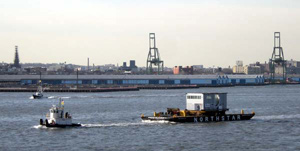
The Lieb House sailing past the Brooklyn Navy Yards.

Kristen Richards

Lieb House, designed by Robert Venturi, FAIA, and Denise Scott Brown and built in 1969, nearly came to a bad end last winter. Selling the land beneath the fabled “little house with big scale” became a necessity for Sheila and Leroy Ellman, a couple who had owned it and protected it for three decades but faced a medical-expense burden; the new buyer, developer Michael Ziman, wanted only the land, planning to build a larger rental property. Ziman did not relish the prospect of demolishing an icon, but his business interests did not include the beach house with the unmistakable round window, tapering staircase, top-floor family room, and supergraphic numeral 9. He had also taken on commitments requiring a tight construction timetable. To those who knew its history and appreciated its quirks, however, the building that Frederic Schwartz, FAIA, calls “the first Pop house” deserved whatever efforts might be needed to stave off the wrecking ball.

Luckily for the house and its architects, their son Jim Venturi joined with longtime friend and associate Schwartz in assembling and coordinating an inspired group of rescuers to arrange for its relocation — first to a safe parking lot nearby in Barnegat Light, NJ, then, after six weeks, northward by barge along the Jersey shore, up the East River, and into Long Island Sound toward Glen Cove, Long Island. There, thanks to the generosity of new owners Drs. Deborah Sarnoff and Robert Gotkin, it joined another Venturi Scott Brown Associates work, the larger Kalpakjian House, as a waterfront guest residence. Its voyage, familiar to readers of this and other publications (see “Lieb House Sets Sail for New Horizons,” e-Oculus, 03.10.09), is now celebrated in a 25-minute documentary directed by Jim Venturi and John Halpern, assisted by writer/producer Nora McDevitt, cameramen Mead Hunt and Todd Sheridan (with a 13-camera crew on moving day), editors Angelo Corrao and Russell Greene, and a host of post-production collaborators. Saving Lieb House tells this happy story.

The house itself is the real star of the film, but quite a few heroes make an appearance and/or made their presence felt behind the scenes. Jim Venturi took the advice of Nathaniel Kahn, director of another filial film, the Louis Kahn biopic My Architect (2003), to override his original inclination and include himself on camera; he comes across as humble, witty, and extraordinarily dedicated. Schwartz invested enormous energy in the project, handling arrangements at the Glen Cove end in parallel with Venturi’s efforts at Barnegat, and offering scene-stealing, colorfully cantankerous commentary throughout the process. Drs. Sarnoff and Gotkin funded the entire move, including rush-job approvals at both ends and special interventions by utility firms. Bit players like a Verizon representative, who promised Venturi his company would not be the reason the project failed, can also share some credit.

One helpful factor was the refreshing absence of obstructionists. Jim Venturi, speaking last winter in the midst of the planning, hastened to credit Barnegat mayor Kirk Larson and landowner Ziman for supporting the move. Once the destination site was identified and the plan in place, Glen Cove mayor Ralph Suozzi and other local and state officials were comparably helpful. At any of hundreds of moments, a single administrative foul-up, overlooked detail, or objection forcing a lengthy environmental review might have derailed the whole endeavor — but, as Venturi described, “we managed in record time by disposing of the concept of dependencies. In any plan, you have a Gantt chart with dependencies: you do this before you do that, because it’s a prerequisite. But another way to do it is just to do everything, assuming that the prerequisites will be met…. Things that would [ordinarily] take months have taken a day.” Even the weather was cooperative: a winter storm might have delayed local utilities’ work ensuring the house’s safe passage under power and phone lines, but the critical days, for both the initial move off its pilings and the final move from storage site to barge to Glen Cove, were clear and bright.

“People seemed to get that they were saving something,” said Venturi after the screening. “There’s something about this house that is moving to people who have no relation to it…. People really cheered this thing on.” Saving Lieb House began as footage for the forthcoming feature Learning from Bob and Denise but gradually assumed its own narrative shape, so that Venturi and colleagues spun it off as a separate film. The cheering is likely to continue when the two films are eventually screened together — and it ought to grow even louder if the Lieb House experience, provided luck and dedication hold out, inspires similar efforts the next time a unique building is threatened.

At the Crossroads of Structure and Sound

Event: Encore ’09: Fontainebleau Schools – A Collaboration of Architecture and Music
Location: Center for Architecture, 11.20.09
Speakers: Thérèse Casadesus Rawson — President, Fontainebleau Associations; Nicholas Stanos — Vice President for Architecture, Fontainebleau Associations; Anthony Gallion — Pratt Institute; Craig Pellet — Composer, Boston Conservatory, winner of 2009 Nadia Boulanger Prize; James McCullar, FAIA — Principal, James McCullar & Associates Architects & 2008 AIANY President; Anthony Béchu — Director, Ecole des Beaux-Arts at Fontainebleau
Performers: Conservatory: Stephanie Song — Violin, Juilliard School/Columbia University; Philippe Treuille — composer/percussion, Northwestern University; Caleb van der Swaag — cello, Columbia University
Architecture/Fine Arts: Kyle Branchesi — Boston Architectural College; Anthony Gallion — Pratt Institute; Calista Ho — City College of New York; Marina Ovtchinnokova — City College of New York
Organizer: The Fontainebleau Associations
Sponsor: AIANY Global Dialogues Committee

Fontainebleau

The Fontainebleau Schools

Courtesy fontainebleauschools.org

Since 1921, a unique program has brought architecture and music students to a 16th-century French royal chateau 60km southeast of Paris for an annual summer month of professional and cultural exchange. The Fontainebleau Schools originated after World War I with General John Pershing’s desire to improve the quality of American military bands through education of Americans quartered in France, studying at first under New York Philharmonic conductor Walter Damrosch and French composer Francis Casadesus. The institution expanded into the visual arts, eventually focusing that component on architecture; it built a proud tradition as an interdisciplinary community, bringing students the opportunity to study with distinguished faculty, which has included Maurice Ravel, Mstislav Rostropovich, and Nadia Boulanger in the musical school, known as the Conservatoire Americain, and Paolo Soleri, Felix Candela, and Aldo van Eyck in the architectural Ecole des Beaux-Arts. Living among peers from both disciplines enhances students’ sense of their own art form through cross-pollination between the fields. Fontainebleau graduates, now drawing from top talent worldwide as well as in the U.S., continue to enrich both realms.

The recent Center for Architecture event celebrated Fontainebleau through testimonials and performance. Violinist Stephanie Song set the tone with samplings from Massenet and Gershwin. Former AIANY President James McCullar, FAIA, a 1962 alumnus of Fontainebleau , recalled the program as an eye-opening opportunity for a young man from Texas seeing Europe for the first time. Another Texan, Anthony Gallion, having described a comparable experience, joined colleagues from both fields in recreating “Spectacle ’09,” a live multimedia performance illustrating how the principles of rhythm and variation can find expression both sonically and visually. As composer/drummer Philippe Treuille led a trio through his composition Moving Forward in the Wrong Direction, a work combining minor-blues-scale riffing, moments of 20th-century dissonance, and rhythms akin to contemporary hip-hop, a troupe of architecture students attacked six large canvases with rollers, spontaneously providing an expressionist primary-color backdrop within a six-minute span.

Projected stills of the chateau, formal gardens, and surrounding woods, along with video clips of recent on-site performances and installations, gave an impression of Fontainebleau as a place where artistic discipline and promise have replaced aristocratic privilege as the qualifications for access to an atmosphere of unparalleled beauty. Director Anthony Béchu outlined the organization’s expectations for the coming year (about 25 architecture students are expected) and its vision for renovations to the physical space. Contemplating Fontainebleau calls to mind Goethe’s much-quoted line about architecture as frozen music, with all its implications about the relations between fluid moments and forms that deserve to endure.