NY-Switzerland Exchange: Making Green the Law

Event: When Green is not an Option but the Law
Location: Center for Architecture, 10.03.11
Speakers: Dr. Daniel Kurz — Head of the Division for Information and Documentation, Building Department of the City of Zurich & Curator and Educator, “Smarter Living — The 2000-Watt Society”; Laurie Kerr, AIA — Senior Policy Advisor, NYC Mayor’s Office of Long-Term Planning and Sustainability; Mathias Heinz, SIA/BSA — Architect & Partner, pool Architekten (Zurich); Richard Dattner, FAIA — Principal, Dattner Architects (NYC)
Moderator: Stephan Tanner, AIA — Principal, Intep (Minneapolis)
Organizers: Think Swiss; Umberto Dindo, AIA; AIANY
Sponsors: Consulate General of Switzerland in New York; Cleantech Switzerland; Stadt Zurich; Center for Architecture
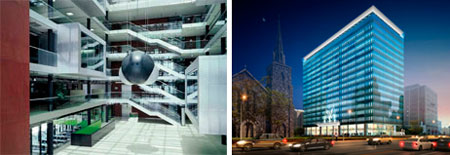
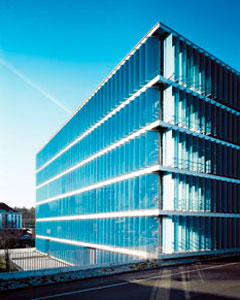
Forum Chriesbach, EAWAG, Swiss Federal Institute of Aquatic Science and Technology. Architect: Bob Gysin + Partner BGP, Zurich (left). GSA Peter W. Rodino Building High Performance Modernization. Architect: Dattner Architects with Richard McElhiney Architects.

Photo by Roger Frei, Zurich, courtesy AIANY (left); Dattner Architects (right)

Both NYC and Switzerland have been committed to sustainability for quite some time. In 1994 groundwork was laid for Minergie, the Swiss equivalent of USGBC’s LEED system. Soon after, the 2000-Watt Society, initiated by the Swiss Institute of Technology with the goal of reducing individual energy use by one-third — or 2,000 watts — was officially integrated into the Swiss constitution.

In NYC, parallel efforts are underway. About four years ago, according to Laurie Kerr, AIA, senior policy advisor in the NYC Mayor’s Office of Long-Term Planning and Sustainability, NYC put into place three progressive strategies to achieve greenhouse gas reduction in the building sector by 2030. These initiatives have snowballed into a number of green codes and regulations. The Green Codes Tasks Force is aimed at the private sector to reduce energy consumption, toxicity, water consumption, and waste. The goal for the Green Greater Buildings Plan is to reduce citywide CO2 usage by 5% by retrofitting all buildings more than 50,000 square feet — which amounts to half of the existing building square footage in NYC. Now in effect, small renovations are required to meet current NYC energy codes. Local Law 87 requires an audit and retro commissioning plan for large buildings every 10 years. In addition, current benchmarking of large existing buildings is required to disclose energy usage to the public. To set an example, the city is enforcing city-owned buildings, hospitals, and universities to reduce energy consumption by 30% in 10 years, which includes approximately 4,000 buildings. Kerr believes that NYC” will become the nucleus of a radical exchange of information about our buildings.”

In conjunction with the opening of “Smarter Living — The 2000-Watt Society,” on view at the Center for Architecture through 10.31.11, curator Dr. Daniel Kurz, head of the Division for Information and Documentation at Zurich’s Building Department, presented a few public projects in Zurich that strive for CO2 reduction. The Friesenberg Cooperative Building Society, for example, is a district heating and storage scheme for a mixed-use public housing project. Via a seven-mile deep underground storage facility, warm air from solar collectors is stored and then distributed in winter months by way of heat pumps.

Richard Dattner, FAIA, founder of NYC-based Dattner Architects, has been practicing sustainable design since the 1970s with clients such as the Estée Lauder Group. They now have a number of sustainable buildings both completed and in the works. For example, with the help of President Obama’s fiscal stimulus dollars, the GSA’s 1960-era Peter W. Rodino Building in Newark, NJ, is currently undergoing a high-performance modernization. Designed by Dattner with Richard McElhiney Architects, the renovation includes wrapping the aging façade with a new, mechanically-ventilated suspended glass curtain wall, which will insulate and protect the federal building. It is clear that both the U.S. and Switzerland are committed to a carbon free future. As Dattner put it: “The Swiss and the Americans have much to learn from each other. We run parallels in thought, yet have very different ways of approaching sustainability.”
The Agile City Paves Way for Sustainable Future

Event: Oculus Book Talk: James Russell, The Agile City
Location: Center for Architecture, 09.15.11
Speakers: James S. Russell, FAIA — Bloomberg Architecture Critic & Urban Analyst, Author of The Agile City (Island Press, 2011)
Organizers: AIANY Oculus Committee

TheAgileCity.jpg

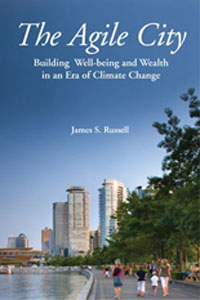
The Agile City

Courtesy AIANY

“We need to focus on solutions to issues for the next five years to turn this industry and economy around, not 20 years from now,” bemoaned a colleague of mine on the economic state of our industry and our country. So with the title of James S. Russell, FAIA’s book The Agile City: Building Well-being and Wealth in an Era of Climate Change, the answer to questions about needing another book on the era of climate change is most definitely yes!

The Agile City is not just another book on this subject. As architecture columnist for Bloomberg News, Russell does what so few do well — viably connecting mainstream economics with building civic engagement and place-making strategies. “The same kinds of design acumen and analytical prowess that the nation regularly invests in biotechnical breakthroughs or in building a better portable music player can be applied to cities and the environment. We simply have to choose to focus our talents in this way.” We only have to look at Hurricanes Katrina and Irene to be reminded that this lack of attention does come at a cost and it’s not just on the lines of a ledger. The agile city would develop out of inventive policies that “deploy regulations straightforwardly, balancing them with incentives. Rules will reward performance (energy, water, and emissions saved), rather than prescribing what light bulbs we’ll use and what cars we’ll drive…. producing economic values that gross domestic product (GDP) fails to measure, like increased real estate values from repaired natural systems and health care costs saved from reduced rates of cancer.”

Russell draws our attention back to carbon neutrality in buildings and transportation, the two largest sources of U.S. greenhouse gas emissions that respectively account for 40% and 28% of emissions. He provokes us with his questions around planning for both our cities and our suburbs asking how we can reconcile change with the “understandable fear of neighborhoods and individuals that they will bear the brunt of the burdens.”

So what is the 21st-century community that Russell envisions and why have some cities in Europe been more successful than we in accomplishing this? Is shared public and civic space less important to us as a culture? This question resonates most recently with changes in our own city. For spaces like Times Square and its lawn chairs “Janette Sadik-Khan, was not shoving a carbon-reduction strategy down citizens’ throats,” writes Russell, “but was cutting through a bureaucratically encrusted process that had made a task as minor as relocating a curb as complex as negotiating a major international treaty. The Times Square strategy inspired by a street-design innovator from Copenhagen, Jan Gehl, was driven by the need to smooth traffic flow, which was done by reducing the number of intersections that were too close together, and making pedestrian movement smoother and safer — both incidentally, carbon-reduction tactics.” In a city with no backyard, it was exciting to find places where there actually was one. This is a perfect example of what Russell illustrates as a goal — how the government can encourage people to embrace new attitudes toward community and the economics of ownership, whether in the public private realm.

The power to take action is in our hands. As a first step, read this book and then connect the dots for yourself in terms of professional practice, economic growth, and being part of the change toward a more “agile city”.

Note about Oculus Book Talks: Each month, the AIANY Oculus Committee hosts a Book Talk at the Center for Architecture. Each talk highlights a recent publication on architecture, design, or the built environment — presented by the author. The Book Talks are a forum for dialogue and discussion, and copies of the publications are available for purchase and signing. The next talk will take place on 10.25.11, featuring a conversation between Janette Sadik-Khan and David Byrne, author of Bicycle Diaries. Click here to RSVP.

Archtober Celebrates Architecture in the City (Part 1 of 2)

Event: Archtober Building of the Day
Location: Varies, 10.01-31.11
Organizers: Archtober

To honor great design in NYC, each day of Archtober celebrated a “Building of the Day.” Here is a compilation of the buildings for the first half of the month. The next issue will feature the remaining buildings.

Archtober_1-3.jpg

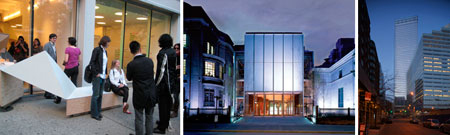
(L-R): Center for Architecture, Andrew Berman Architect; The Morgan Library & Museum, Renzo Piano Building Workshop/ Beyer Blinder Belle Architects & Planners; 7 World Trade Center, Skidmore, Owings & Merrill.

(L-R): Center for Architecture; Richard Cadan; ©David Sundberg/Esto

Archtober_4-6.jpg

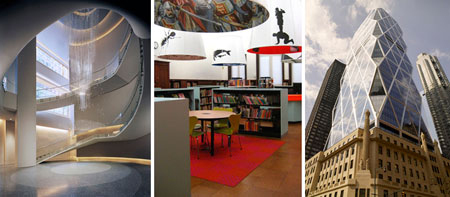
(L-R): Top of the Rock at Rockefeller Center, Gabellini Sheppard Associates; New York Public Library Fort Washington Branch Children’s Room, Sage and Coombe Architects; Hearst Tower, Foster + Partners

(L-R): Paul Warchol; Sage and Coombe Architects; Foster + Partners

Archtober_7-9.jpg

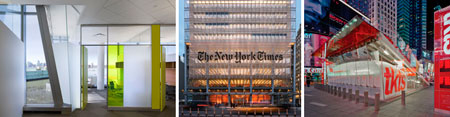
(L-R): IAC Headquarters, STUDIOS architecture; The New York Times Building, Renzo Piano Building Workshop in association with FXFOWLE; TKTS Booth and Revitalization of Father Duffy Square, Choi Ropia, Perkins Eastman, and PKSB Architects.

(L-R): Albert Vecerka/Esto; David Sundberg/Esto; Paul Rivera/ArchPhoto

Archtober_10-12.jpg

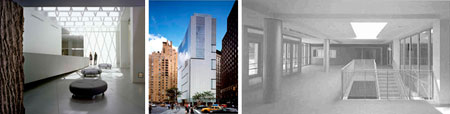
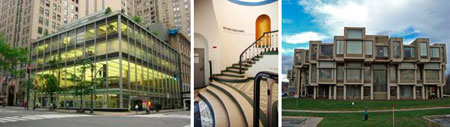
(L-R): Sheila C. Johnson Design Center, The New School, Lyn Rice Architects; The Museum of Arts and Design, Allied Works Architecture; Betances Community Center and Boxing Gym, Stephen Yablon Architect.

(L-R): Michael Moran, Richard Barnes, Noah Sheldon, Lyn Rice Architects; Hélène Binet; Frank Ouderman

Tokyo Dispatch

Tokyo hosted the International Union of Architects’ 24th World Congress of Architecture (UIA2011) during the last week of September. Taking place at the Tokyo International Forum, designed by Rafael Viñoly, FAIA, who was present at the event, the UIA2011 meeting reportedly drew more than 5,000 design professionals and students from more than 100 countries. The focus of the long-planned international forum, Design2050, took on new urgency after the 03.11.11 earthquake and related tsunami catastrophe in north-eastern Japan. Many presentations, panels, and seminars were recalibrated to address what the international design community could do to anticipate, prevent, and respond to similar natural disasters. The major result of the Congress was the issuance of the Tokyo Declaration, which committed the world’s design community to better learn from disasters, exchange initiatives, and promote responsibility within our profession.

During the first day of the conference, a letter was presented to AIANY by Taro Ashihara, Hon. AIA, president of the Japan Institute of Architects, thanking New York’s architects for the support that came in response to the recent disaster. With the involvement of Hisaya Sugiyama, AIA, president of AIA Japan — a KPF alum — a fruitful discussion of disaster preparedness and risk assessment took place.

AIA President Clark Manus, FAIA, along with President-elect Jeff Potter, FAIA, and Executive Vice President/CEO Robert Ivy, FAIA, led the AIA National official delegation. Their blog entries, and those of other delegates, can be found on the AIA National website. Among other functions of the delegates, was voting in the election of the next UIA president to replace Louise Cox, who has served her three-year term, and selecting the venue for the 2017 Congress. Albert Dubler, an architect from Paris, was elected as UIA President; and following the 2014 UIA meeting in Durban, South Africa, the next city to host the conference will be Seoul, whose delegation included Sungjung Chough, Hon. FAIA.

AIANY was represented by Chapter President Margaret O’Donoghue Castillo, AIA, LEED AP, and Executive Director Rick Bell, FAIA, who co-presented the Chapter’s work on Buildings=Energy and Active Design at the UIA’s poster session and technical seminar. At the session, similar research was discussed with colleagues from Nigeria, Indonesia, and Malaysia. The panel discussion on the Active Design Guidelines and public health initiatives drew an enthusiastic audience of architects and others such as Robert Bell, director of the National Gallery of Australia, and Lone Sigbrand of the Danish Building Research Institute.

Keynote speakers included Tadao Ando, Hon. FAIA, Fumihiko Maki, Hon. FAIA, David Adjaye, Hon. FAIA, OBE, Christo (warm and witty with many one-liners, including “Jean-Claude always said we didn’t emigrate to the United States, we emigrated to New York City.”) Somewhat less well-known but as thrilling to hear was Vladimir Slapeta, an architect and historian from the Czech Republic, who wove a narrative of cross-continental cultural influences that linked Japanese Modernism and Metabolism back to the innovations of the Brno International Fair of 1925-28 and its New House Werkbund Exhibition.

As a corollary to the UIA events, the World Architectural Festival unveiled the shortlisted projects from Asia in its annual design competition. An exhibition of the WAF premeated work was held at the galleries in the Tokyo Headquarters of the UCHIDA-YOKO Company, a leading information technology company. WAF President Paul Finch organized evening receptions at which Castillo and recently-elected RIBA President Angela Brady, FRIBA, could renew acquaintances with World Architecture Festival and Architecture Review colleagues including Edmond Katongole, Jessica McFarlane, and Jane Connolly, who had been at the Ibex/New York celebration during the AIA Convention in New Orleans. UCHIDA’s Honorary Chairman Shinichi Mukai, and President/CEO Takashi Kashihara were extraordinarily hospitable to international guests, including AIANY and WAF sponsors from the Hong Kong, Singapore, and London offices of Rider Levett Bucknall.

Apart from the headliner talks, research papers, and design works presented, the star of the conference was the host city itself. An incredible mix of tradition and innovation, Tokyo boasts what is perhaps the most complicated, expansive, and useful public transportation system on earth. The subway made it easy to get around town, to see renowned structures and gardens, ranging from Kenzo Tange’s National Stadium in Yoyogi Park constructed for the 1964 Olympic Games, to more recent commercial structures in nearby Omotesando. The degree to which Japanese and Western cultures have intersected since the removal of trade barriers in the mid-1800s is phenomenal, with European and American branding pervasive. But it is the quintessentially Japanese stores, from Mikimoto to Uniqlo, that capture the spirit of the place.

It was in navigating the street life, urban design, and 24/7 feeling of Tokyo that those from NYC felt most at home. From the New York Grille at the Park Hyatt Hotel — scene of the late-night ponderings in Lost in Translation, to the Frank Lloyd Wright relics at the Imperial Hotel, much looked familiar. Totally different, and totally sublime, was the Supreme Delight club in Roppongi, the pecha kucha basement birthplace where Mark Dytham, architect and expat inventor of that communication art form, holds court. I felt privileged to reprise the UIA “Obesity and Architecture” talk there in the allotted six minutes and 40 seconds.

In this issue:
· World Monuments Fund Lists Three NY Buildings in Danger
· Historic Armory Undergoes Restoration
· Cornell Adds New Wing to Pei’s Art Museum
· Zen Buddhism, Sustainability Are at One in the Catskills
· Expanded Military History Museum Now Largest Museum in Germany


World Monuments Fund Lists Three NY Buildings in Danger

WMF.jpg

(L-R): 510 Fifth Avenue; New York Studio School of Drawing, Painting, and Sculpture; Orange County Government Center.

Courtesy World Monument Fund

The World Monument Fund released its 2012 World Monuments Watch List of 67 sites representing 41 countries and territories worldwide. Two buildings are in Manhattan, and one is in Orange County, NY. At the former Manufacturers Trust Building at 510 Fifth Avenue, designed by SOM’s Gordon Bunshaft and completed in 1954, the list emphasizes that the future of the building could serve as a touchstone for the effectiveness of preservation legislation and policies in the U.S., and of the government agencies charged with their enforcement. Though designated a NYC landmark in 1997, with additional landmark protections for the interior designated in early 2011, original interior features have been removed as it undergoes adaptive reuse. The New York Studio School of Drawing, Painting, and Sculpture in Greenwich Village, assembled by the American sculptor and art collector Gertrude Vanderbilt Whitney is on the list because it played an important role in early 20th-century American artistic production.

Poor maintenance practices, exacerbated by Hurricane Irene flooding, have led to the deterioration of Paul Rudolph’s 1970 Orange County Government Center, in Goshen, NY, giving more fuel to the county’s call for its demolition and replacement. Launched in 1996 and issued every two years, the Watch List provides an opportunity for sites and their nominators to raise public awareness and advance effective solutions.


Historic Armory Undergoes Restoration

Armory.jpg

Park Avenue Armory.

James Ewing

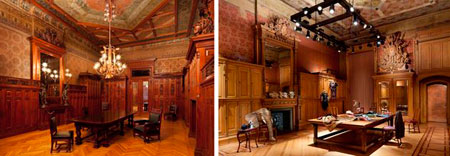
The Park Avenue Armory recently unveiled designs by Herzog & de Meuron for its renovation, restoration, and transformation. Encompassing the entire five-story building, the multi-year project will create new resources and a diversity of spaces for artistic, educational, and public programming, as well as artist-in-residence studios and rehearsal rooms. Restoration includes: the 55,000-square-foot Wade Thompson Drill Hall and former rifle range; 18 period rooms on the first and second floors in the adjacent head house; all public circulation spaces, including the grand hallways, staircase, and new elevators; office space on the third floor; a fifth-floor rehearsal space; and back-of-house facilities on the lower level. In addition, two restored period rooms on the second floor — Company D and E, both originally designed by Pottier & Stymus — were revealed. The firm’s approach includes the addition of new lighting elements, furniture, and surface treatments that complement the building’s original detailing in furtherance of the armory’s mission to create and present visual and performing art that cannot be realized within the limitations of traditional performance halls and white-wall museums.


Cornell Adds New Wing to Pei’s Art Museum

pcherbert.jpg

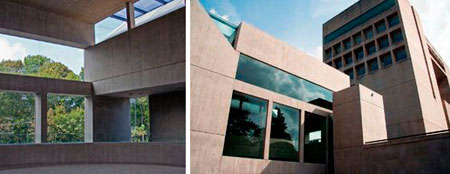
The David A. and Rochelle Hirsch Lecture Lobby in the new wing of the Herbert F. Johnson Museum of Art, Cornell University (left); the west façade of the new wing, with the north façade of the original building.

Robert Barker, University Photography (left); David O. Brown, Johnson Museum of Art (right)

On the heels of the recent opening of the OMA-designed Millstein Hall, Cornell University in Ithaca is now prepping for the opening of the newly renovated Herbert F. Johnson Museum of Art. The new addition, designed by Pei Cobb Freed & Partners Architects, adds 17,165 square feet to the 61,000-square-foot, I.M. Pei, FAIA-designed building that opened in 1973. The extension features a 150-seat lecture room, a workshop studio, new galleries, art storage, and office space. Several areas of the museum have undergone concurrent renovations. The fifth-floor galleries of Asian art, also known for 360-degree views of Ithaca, are now reconfigured with 50% more square. Additional spaces are being renovated to create a photography study and storage space. The museum is the only full-service art museum within a 60-mile radius. Of note: both the renovation and the addition are the work of associate partner John L. Sullivan III, who served as design architect on the original I. M. Pei building.


Zen Buddhism, Sustainability Are at One in the Catskills

Sangha_House.jpg

Sangha House.

Kliment Halsband Architects

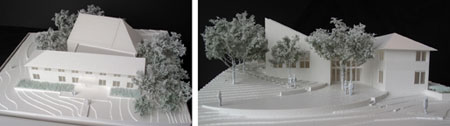
Construction has begun on the Zen Mountain Monastery’s new Sangha House, an 8,500-square-foot, multi-use building designed by Kliment Halsband Architects. Located on 230 acres of forest preserve in Mount Tremper in the Catskill Mountains, the Sangha House is composed of three elements — a long, narrow, two-story component for visitor and communal facilities; a 100-seat Hall of the Arts; and a two-story central circulation and exhibition space that opens onto a sculpture garden. The building has been designed to minimize reliance on fossil fuels and its impact on the natural environment. It will be constructed of timber and bluestone gathered on site, and a solar panel array is planned for the roof of the Hall of the Arts that will provide at least 50% of the energy for the building. The new building joins the monastery’s four-story Main House, built in a Scandinavian arts-and-crafts style in the 1930s, a designated national and state historic landmark.


Expanded Military History Museum Now Largest Museum in Germany

Dresden.jpg

Military History Museum.

Studio Daniel Libeskind

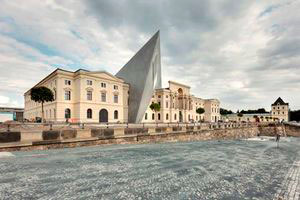
Studio Daniel Libeskind’s extension to Dresden’s Military History Museum is set to open this week. Founded in 1897, it will be the largest museum in Germany now that the extension is complete. The design comprises a five-story, 200-ton wedge of glass, concrete, and steel that slices through the center of the original structure and interrupts the building’s symmetry. A 98-foot-high viewing platform provides views of both the city and the source of the fire-bombs that devastated it during World War II. The exhibition space, designed by Holzer Kobler Architekturen (Zurich) and HG Merz Architekten (Berlin and Stuttgart), reflects the architectural contrast between the museum’s two parts — the history of Germany’s military in the form of a timeline in the existing building, and the military’s lasting impact on society throughout the ages expressed in a themed tour. The exhibition space contains roughly 7,500 items ranging from the smallest pin badge to a space capsule.


THIS JUST IN…
R.I.P.: Despite best efforts from preservationists, the Port Authority of New York and New Jersey (PANYNJ) announced its intention to demolish Terminal 6, I.M. Pei’s “Sundrome,” at JFK International Airport.

Friends of the East River Greenway, a coalition of non-profit organizations, announced that local and state officials have signed off on the plan to complete the East River Greenway from 38th Street to 60th Street using funds generated by the U.N. build-out.

“Civic Action: A Vision for Long Island City” presents scenarios created by four teams led by artists Natalie Jeremijenko, Mary Miss, Rikrit Tiravanija, GeorgeTrakas for the community where Long Island City and Astoria, Queens, converge. The results of this eight-month process will be on view through 04.22. 2012 at the Noguchi Museum. Further realized components of each team’s proposal will be exhibited in Socrates Sculpture Park in May 2012.

A retrospective of work by Richard Meier, AIA, featuring a selection of models, original sketches, renderings, and photographs will open 10.20.11 at the Contemporáneo de Monterrey, in Mexico. Projects featured in “Richard Meier Retrospective” include the Smith House, The Getty Center, The Neugebauer Residence, the Jubilee Church, Perry Street Towers, the High Museum of Art, the Ara Pacis Museum, and the recently completed Arp Museum in Germany.

In this issue:
· Archtober Blotter — Week 1
· NYSERDA Adds Two Classes on ECCCNYS-2010
· e-Calendar


Archtober Blotter — Week 1
Archtober — Architecture and Design Month NYC — kicked off on 10.01.11 with an exciting day of exhibition openings at the Center for Architecture. Starting with the unveiling of the colossal Archtober calendar in the Archtober Lounge, events continued throughout the afternoon and into the evening. Architect Andrew Berman, AIA, led a tour of the Center for Architecture, which he designed and which was selected as the first “Building of the Day” this month. The day was capped off with the well-attended “Buildings=Energy” opening reception, complemented by the opening of the “Smarter Living: The 2,000 Watt Society” exhibition in the Center’s adjacent storefront space at 532 LaGuardia place.

On the evening of 10.03.11, Elle Décor magazine and Scavolini feted Archtober at the Scavolini SoHo showroom on West Broadway. The guest of honor was Amanda Burden, FAICP, Hon. AIANY, chair of the NYC Planning Commission, who discussed the importance of architecture and design, and read Mayor Bloomberg’s proclamation officially naming Archtober as Architecture and Design Month NYC.

A group of architecture and design enthusiasts gathered at the Top of the Rock for the 10.04.11 Building of the Day tour with architect Michael Gabbelini, FAIA. Archtober tourists were charmed on 10.05.11 by the New York Public Library Fort Washington Branch’s Children’s Reading Room, with a tour led by Jennifer Sage, AIA, LEED AP, principal of Sage and Coombe Architects. The throngs of tourists visiting Times Square did not dissuade the participants of the Archtober Building of the Day tour on 10.09.11 of the TKTS Booth and Revitalization of Father Duffy Square, led by plaza designers William Fellows, AIA, and Sherida Paulsen, FAIA, of PKSB Architects.


NYSERDA Adds Two Classes on ECCCNYS-2010

Two additional classes have been added for the NYSERDA Code Training on 10.17.11 and 10.21.11. The 2010 Energy Conservation Construction Code of New York State (ECCCNYS-2010), effective 12.28.10, is now mandatory throughout the state. Urban Green Council and AIANY have developed a four-hour course to familiarize architects and engineers with the ECCCNYS-2010, the fundamentals of low-energy design, and the processes available to demonstrate compliance. Click here for details, or contact AIANY Policy Director Jay Bond at jbond@aiany.org.


eCALENDAR
eCalendar includes an interactive listing of architectural events around NYC. Click the link to go to to eCalendar on the Web.

Center for Architecture Gallery Hours and Location
Monday-Friday: 9:00am-8:00pm, Saturday: 11:00am-5:00pm, Sunday: CLOSED
536 LaGuardia Place, Between Bleecker and West 3rd Streets in Greenwich Village, NYC, 212-683-0023

CURRENT EXHIBITIONS

Building Connections 2011

On view 10.01.2011-02.11.2012

Archtober Lounge

On view October, 2011

New York New Work

On view October, 2011

Buildings=Energy

On view 10.01.2011-01.21.2012

CFAF Kicks Off Archtober with Family Day and Building Connections Open House

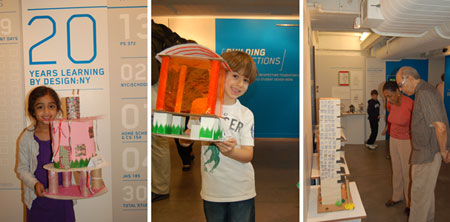
Family Day participants present their architectural centerpieces that will be showcased at this year’s Heritage Ball (left). Exhibition attendees admire the K-12 student work on display at the 2011 “Building Connections” exhibition (right).

Catherine Teegarden

The Center for Architecture Foundation (CFAF) kicked off the launch of Archtober — the inaugural month-long festival of architecture activities, programs and exhibitions in NYC — on 10.01.11 with a number of public events at the Center for Architecture. The day began with a free FamilyDay@theCenter, where families created an architectural centerpiece to be displayed at the Heritage Ball, the Center’s annual fundraising event, based on the theme of “green buildings.”

10.01.11 also marked the opening of “Building Connections,” the Foundation’s 15th annual exhibition of K-12 student design work. The exhibition, which runs through 02.11.12, highlights the achievements of students who participated in CFAF’s built environment education programs during the 2010-11 school year. Featured work includes a high school student who is now applying to colleges to study architecture, following his successful introduction to architecture in CFAF’s Architectural Design Studio.

An Open House was held to coincide with the first day of the exhibition and to introduce teachers, parents, and architecture enthusiasts to the Foundation’s school and family programs. Attendees included math, science, and technology educators from Pratt Institute’s Science Technology Entry Program, who have participated in a skyscraper-focused StudentDay@theCenter and are interested in further incorporating architecture and design into their curriculum.

The Foundation also took the opportunity to publicly recognize its dedicated volunteers and interns who have given their time and talents over the years. The CFAF will be hosting a party on 01.20.12 at the Center to celebrate 20 years of built environment education. The event will bring together the architects, design educators, and students who have participated in our programs since they began in 1991.

The CFAF will be presenting other events in conjunction with Archtober, including the openhousenewyork Weekend Family Festival on 10.15-16.11, and a New Buildings New York tour of the Franklin D. Roosevelt Four Freedoms Park on 10.20.11. For more information about the Foundation’s exhibitions, events, and education programs, visit www.cfafoundation.org.

Learning Again from Lower Manhattan

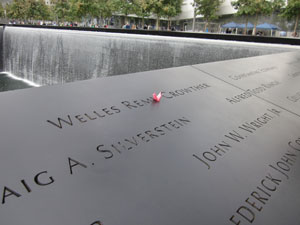
National September 11 Memorial.

Jessica Sheridan

After logging on within the first hour that the reservation system went live and finding the first date available wasn’t until October, my timeslot finally arrived to visit the National September 11 Memorial. At the end of my afternoon I left with mixed feelings about different aspects of the plaza, but I have to withhold full judgment until the vision is fully complete.

After entering the plaza from the southwest corner, the approach to the pools was surreal, with the neatly manicured strips of grass and regularly-planted trees straight ahead and the large HVAC plants to my left and construction to the right. Perhaps because I have witnessed the large hole in the ground at the site for so many years, when I got to the first pool, where the south tower stood, my first impression was that it was smaller than I expected. However, walking around the first pool took quite some time and through the journey itself the enormity of their size really solidified for me.

My biggest criticism of the memorial is that, with the sound of the waterfalls and the flow of water into the center of the pools, my eye was really drawn away from the names of the victims. The pools are so large that the human scale is diminished, and the only thing that drew my focus to the victims and their names were small, pink origami cranes wedged into the engravings and dots of water where visitors had reached into the pool and left their mark next to their loved ones (truly touching and intimate). Also, I had expected to see the sky and surrounding buildings reflected at the basin of the pools, which I thought would be poetic, but because the stone is so dark and the water is constantly moving, all I saw was water moving from the perimeter into a dark void. I had trouble connecting to the meaning behind it.

One of the most successful structures on the plaza is Snøhetta’s Memorial Museum Pavilion. I think it really anchors the two pools on the site and with the angled glazing it reflects both the pools and the surrounding buildings, including 1 WTC, in a way that makes you see both in a different light.

I look forward to revisiting the site as construction continues at different times of the year. It will be interesting to see how the other buildings will reframe the pools as they grow from the ground. Until complete the site will remain in flux, but that should give us all time to adjust to its new future.

Jan Blackmon, FAIA, LEED AP, has been named executive director of the Dallas Chapter of The American Institute of Architects and the Dallas Center for Architecture…

The team comprised of students from Parsons The New School for Design and Stevens Institute of Technology placed first in the Affordability category as part of the U.S. Department of Energy Solar Decathlon 2011…The Emirates Glass LEAF Awards 2011 winners include Cité de l’Océan et du Surf by Steven Holl Architects

Winners of the Jack Kemp Models of Excellence Award from the Urban Land Institute (ULI) include Columbia Commons and Columbia Hicks Apartments by GF55 Partners, and Tapestry by MHG Architects

The Woodward Avenue Tribute program by Calori & Vanden-Eynden received a 2011 National Scenic Byways award…

The Municipal Art Society of New York (MAS) named Gospel for Teens, ioby, Riverpark Farm, Storm King Art Center, and Urban Samaritan the winners of the 2011 MAS Livable City Awards… The Metropolitan Waterfront Alliance’s 2011 Heroes of the Harbor Awards dinner on 10.11.11 honored Madelyn Wils, President and CEO of the Hudson River Park Trust, and James J. Devine, President and CEO of New York Container Terminal…

Zetlin & De Chiara Partners Michael S. Zetlin, Michael K. De Chiara, Raymond T. Mellon, Carol J. Patterson, and Michael J. Vardaro have been named five of the top construction litigation attorneys in NY by Super Lawyers Magazine

Friends of the High Line has appointed Melissa Fisher, the current Director of Horticulture & Park Operations, to the expanded role of Chief Operating Officer…

Thomas K. Fridstein, FAIA, RIBA, LEED AP, has joined The Greenway Group as a consulting principal… WXY architecture + urban design has named Adam Lubinsky as principal…