06.08.11

06.08.11: The Center for Architecture is hosting a number of great talks about the future of New York and Amsterdam. The “GLIMPSES of New York and Amsterdam in 2040” exhibition opens Wednesday, 06.08.11. Ton Venhoeven and Bjarne Mastenbroek started the festivities, and there’s a full weekof celebrations, symposia and discussions. Hope to see you at the Center!

Also, the digital edition of OCULUS magazine is online now! Click here to read.

– Jessica Sheridan, Assoc. AIA, LEED AP

Note: Be sure to follow Tweets from e-Oculus and the Center for Architecture.

And check out the latest Podcasts produced by AIANY.

Following Tragedy, Japan Plans for the Future

Event: Dialogues for a New Japan — Japan: Brainstorming
Location: Center for Architecture, 05.24.11
Speakers: Yasuhisa Kawamura — Deputy Consul General of Japan in New York; Toru Hasegawa — Adjunct Assistant Professor, Columbia University Graduate School of Architecture, Planning and Preservation (GSAPP); Joji Kurumado, JIA — General Manager, Takenaka Corporation; Mutsuro Sasaki, JIA — Founder, Sasaki Structural Consultants; Motoko Shoboji, AIA, LEED AP BD+C — Member, Global Dialogues Committee.
Panelists: Joji Kurumado; Mutsuro Sasaki; Paul Katz, FAIA, HKIA — Managing Principal, Kohn Pedersen Fox Associates; Clifford Pearson — Deputy Editor, Architectural Record; Leslie Robertson, Hon. AIANY — Leslie E. Robertson Associates; Rafael Viñoly, FAIA, JIA, SCA, Int. FRIBA — Principal/Lead Designer, Rafael Viñoly Architects
Moderator: Toru Hasegawa
Introduction: Margaret O’Donoghue Castillo, AIA, LEED AP — 2011 AIANY President & Principal, Helpern Architects; Noushin Ehsan, AIA — Chair, Global Dialogues Committee
Organizers: AIANY Global Dialogues Committee; support by Consulate General of Japan in New York; JETRO; Japan Society; Japan Institute of Architects
Sponsors: Japan by Design; TOTO USA; Hilton, New York

Ocean energy distribution forecast map for the 2011 Sendai earthquake from the U.S. NOAA.

West Coast & Alaska Tsunami Warning Center, National Oceanic and Atmospheric Administration

In the wake of devastating natural disasters, what strategies can we employ to prepare ourselves for future incidents? Japanese and American architects and structural engineers posed variations on this query during a symposium focused on the aftermath of the 2011 Tohoku earthquake and tsunami.

Paul Katz, FAIA, HKIA, managing principal at Kohn Pedersen Fox Associates, remarked that the Tohoku earthquake might be the most visually well-documented natural disaster in history. However, as Toru Hasegawa, adjunct assistant professor at Columbia University GSAPP, iterated that imagery does not tell the entire story. At a magnitude of 9.0, the earthquake is tied for the fourth largest documented seismic event since 1900. Surprisingly, the tremors themselves did very little damage. Indeed, Mutsuro Sasaki, JIA, founder of Sasaki Structural Consultants, mentioned that the Sendai Mediatheque, which he had engineered in collaboration with Toyo Ito, Hon. FAIA, suffered no structural damage following five minutes of shaking.

Instead, the earthquake triggered the tsunami that inundated Eastern Japan, reaching as far as 10 kilometers (six miles) inland, and flooding 470 square kilometers (more than 181 square miles) of terrain. Of the more than 15,000 dead, approximately 92% perished by drowning. Although Japan had dramatically upgraded its seismic design codes in response to the 1995 Kobe earthquake, it was unprepared for walls of water reaching from 3.2-38.9 meters (10-127 feet) in height. According to Takenaka Corporation General Manager Joji Kurumado, AIJ, most of the breached sea barriers were no more than 10 meters (33 feet) high.

Japanese planners are perplexed as to which policy to employ to prevent future harm. Most of the panelists agreed that isolated applications of solutions, including raising the height of tsunami walls or placing a moratorium on building within a defined distance from the coastline, would prove ineffective.

Rafael Viñoly, FAIA, JIA, SCA, Int. FRIBA, of Rafael Viñoly Architects, suggested that Japan consider implementing a comprehensive and holistic land-use plan along the coastline. Architectural, environmental, infrastructural, and recreational concerns could all be integrated into one scheme. In this case, disaster design could become a societal concern, and all of Japan could participate in the discussion to protect its future.

Progress Report on the Greening of NYC

Event: PlaNYC Update: Next Steps to a Greener, Greater New York
Location: Center for Architecture, 05.26.11
Speakers: David Bragdon — Director, Mayor’s Office of Long-Term Planning and Sustainability; Mark Ginsberg, FAIA, LEED AP — President, Citizens Housing and Planning Council & Founding Partner & Principal, Curtis + Ginsberg Architects; Tricia Martin — President, NYASLA; Celeste Layne — Co-Chair, Transportation Committee of the APANY Metro Chapter
Introduction: Ernie Hutton, Assoc. AIA, FAICP — Co-Chair, New York New Visions & Principal, Hutton Associates; Margaret O’Donoghue Castillo, AIA, LEED AP — 2011 AIANY President & Principal, Helpern Architects
Organizers: New York New Visions; AIANY; APANY Metro Chapter; ASLA NY Chapter; Citizens Housing and Planning Council

Courtesy PlaNYC 2030.

New Yorkers are used to PlaNYC being a hot topic, but it has also drawn the attention of the international architecture community, remarked Margaret O’Donoghue Castillo, AIA, LEED AP, 2011 AIANY president. “Having the Center for Architecture here with so many international travelers, I hear over and over again how remarkable this plan is,” she said. It’s an ambitious plan, but now — four years after its release — how much has it lived up to its promise of creating a greener NYC? The plan was recently updated, making this a logical time to reexamine it. David Bragdon, director of the Mayor’s Office of Long-Term Planning and Sustainability (OLTPS), gave a talk that dissected some of the plan’s successes and disappointments so far.

There’s no doubt that NYC is greener now — literally. In the past four years, more than 430,000 trees have been planted, so we’re well on our way to the goal of a million new trees by 2030. And thanks to the city’s new investments in parks and public spaces, there are now “250,000 New Yorkers who live within 10 minutes walk of a park who did not… five years ago,” Bragdon noted.

By contrast, transportation has been a source of some frustration, he said. The state legislature’s failure to approve congestion pricing was a disappointment for the Bloomberg Administration. The city has made progress on other projects, such as creating faster, more frequent bus service and moving ahead on construction of the Second Avenue subway. The city is also planning to launch a bike-share system in the coming months, Bragdon said.

Though PlaNYC sets the goal for New York to have the cleanest air of any big city in America, the city still has far to go in improving its air quality. The updated plan emphasizes reducing pollution caused by buildings using heating oil Number 4 and 6, two of the dirtiest heating oils. Number 6 heating oil is the worst contributor of particulate matter to the air over NYC, creating “more particulate matter than all the cars and trucks in the city combined,” Bragdon alleged. Timed to coincide with the release of the update in April, the Bloomberg Administration issued a new rule phasing out the use of Number 6 oil by 2015 and Number 4 oil by 2030.

Often it’s best to offer both regulation and incentives for sustainable practices (the stick-and-carrot idea), according to Bragdon. In addition to enacting legislation such as the Greener, Greater Buildings Plan, the city has been pursuing ways to make green retrofits easier and more profitable. A corporation is being created that will provide financing for people to make efficiency-related improvements. In addition, the OLTPS helped create a “green lease” meant to obviate the “split incentive” problem for landlords; the lease ensures that both landlords and tenants receive financial profits resulting from energy retrofits, Bragdon explained.

Though PlaNYC has drawn international attention, it’s important for our city to keep looking elsewhere for inspiration, too. “We can learn from Melbourne, Australia, about urban forestry, and we can learn from Philadelphia about green infrastructure. We can learn from La Paz about bus rapid transit,” Bragdon said. “New York, though, increasingly has more and more to teach, as well.”

Design Awards Recipients Have Different Takes on Better Futures

Event: 2011 Design Awards Panels: Urban Design; Unbuilt Work
Location: Center for Architecture, 05.17.11; 06.02.11
Speakers: Urban Design: Paul Buckhurst, ARIBA — Director, BFJ Planning; Stephen Cassell, AIA, LEED AP — Principal & Founder, Architecture Research Office (ARO); Nicholas Cates, AIA, LEED AP — Project Architect, FXFOWLE Architects; Susannah Drake, AIA, RLA — Principal, dlandstudio; Benjamin Gilmartin, AIA — Senior Associate, Diller Scofidio + Renfro; Larry Gutterman, AIA, LEED AP — Senior Architect & Project Manager, Beyer Blinder Belle Architects & Planners; Richard Kennedy — Associate Partner, James Corner Field Operations; L. Bradford Perkins, FAIA, MRAIC, AICP — Founder, Perkins Eastman; Matthew Urbanski — Principal, Michael Van Valkenburgh Associates; Unbuilt Work: Lonn Combs — Principal, EASTON+COMBS; Jonathan Dreyfous — Partner-in-Charge, CR Studio; Kevin Erickson, Assoc. AIA — Founding principal, KNEstudio; Iannis Kandyliaris — Project Architect, SO-IL; Philip Lee, Assoc. AIA — Philip Lee Workshop; David Leven, AIA — Partner, LEVENBETTS; Jennifer Sage, AIA, LEED AP — Principal, Sage & Coombe Architects; Joel Sanders, AIA — Principal, Joel Sanders Architect; Heidi Werner — Philip Lee Workshop
Moderators: Urban Design: Howard Slatkin — Director of Sustainability & Deputy Director of Strategic Planning, NYC Department of City Planning; Unbuilt Work: Kelsey Keith — Editor-in-Chief, Architizer
Organizers: AIANY
Sponsors: Benefactor: Vanguard Construction and Development; Patron: Diller Scofidio + Renfro, FXFOWLE, Trespa; Sponsors: Arup; Buro Happold; Ennead Architects; F.J. Sciame Construction Co., Inc.; Gensler; Halcrow Yolles; Ibex Construction; Ingram Yuzek Gainen Carroll & Bertolotti, LLP; Jaros, Baum & Bolles; Knoll/Lane Office; Kohn Pedersen Fox Associates; Mancini Duffy; MechoShade Systems, Inc.; New York University; Robert A.M. Stern Architects; Roger Ferris + Partners; Sage & Coombe Architects; Stalco Construction, Inc.; Structure Tone Inc.; Studio Daniel Libeskind; STUDIOS Architecture; Swanke Hayden Connell Architects; Syska Hennessy Group; Turner Construction Company; Weidlinger Associates, Inc.

Lower Manhattan: A New Urban Ground (Urban Design Honor Award), by Architecture Research Office and dlandstudio (left); Kukje Art Center (Unbuilt Work Honor Award), by SO-IL (right).

Architecture Research Office and dlandstudio (left); SO-IL (right)

The projects that won this year’s AIANY Design Awards “show the vitality of the architecture and design community, and the dedication of AIANY to celebrate its diversity,” said Lonn Combs, principal of EASTON+COMBS, recipient of an Unbuilt Merit Award for Changing Room, at the AIANY Design Awards panel for Unbuilt Work. And while the categories of Urban Design (UD) and Unbuilt Work (UW) may intuitively seem disparate, all of the projects set their sights high with an ambition to improve the world in which we live.

In urban design, water was key to many of the projects. Lower Manhattan: A New Urban Ground (UD Honor), by Architecture Research Office and dlandstudio, focused on creating a fluid edge condition for Lower Manhattan that integrates water more thoroughly into the city’s infrastructure, with a porous street system, under-surface water collection, and wetland distribution. At Brooklyn Bridge Park (UD Honor), by Michael Van Valkenburgh Associates and Maryann Thompson Architects, the design team wanted to create a park where visitors could access the water. The project expands programming on piers, and builds up the on-shore landscape that raises the park above the 100-year flood plain in response to rising sea levels. For the QianHai Water City (UD Merit), James Corner Field Operations proposed smoothing the transition between the urban edge of this port city with “water filtration fingers” to help define mixed-use districts.

Water also played into some of the unbuilt work, as well. At Marine Company 1 (UW Merit), CR Studio Architects aimed to create a morphology between the civic presence of the pier in which it is sited and the eroded past of city’s waterfront history. PhXcaseXcase: Cactus Flower Housing (UW Honor) in Phoenix, AZ, by LEVENBETTS, takes inspiration from a local cactus in that housing units are organized around a central wet core (bathrooms, kitchen) that transitions to a dry, prickly exterior thanks to sun shading. The project is sited along a canal, and the firm chose to orient the complex toward it, making the canal an amenity linking neighboring buildings. Just Add Water: A Proposal for the NYC Shaft Sites (UW Merit), by Philip Lee Workshop, proposed installing fixtures that would tap into the city’s water infrastructure to cool public spaces and help mitigate storm water runoff.

A couple of the projects focused on improving cities by programming to local needs. The Hanoi Master Plan to 2030 and Vision to 2050 project (UD Merit), by BFJ-Perkins Eastman, Posco E&C, JINA, and the Vietnam Institute of Architecture, is a 20-year comprehensive plan for Hanoi’s growth. The plan, which is expected to move forward this month, creates a central urban hub with outlying satellite craft villages, agriculture, and integrated mass transportation to enhance the regional complexity and provide future infrastructure and industrial zones required to make the city an international capital city by 2050. “Hanoi is currently about 25 years behind China. We have an opportunity to learn from its successes and failures, and make better choices for Hanoi’s future,” said Bradford Perkins, FAIA, MRAIC, AICP, principal of Perkins Eastman.

On a smaller scale, the Kukje Art Center in Seoul (UW Honor) is a gallery on the site of a large development that SO-IL felt was out of scale with the neighboring community. In response, the design sinks much of the program below grade, and sheaths the exterior with a translucent skin and a custom, reflective chain-link façade to blur the boundary between exterior and interior.

Other projects featured small moves that help enhance existing urban spaces. Kevin Erickson, Assoc. AIA, of KNEstudio sees sidewalks as “the most important public space” in NYC, noting that currently the city’s sidewalk sheds would cover half of Central Park if ganged together. For UrbanCLOUD (UW Merit), an entry in the urbanSHED competition, the firm proposed a hexagonal frame suspended by outriggers to create the image of a cloud floating over the sidewalk. Changing Room (UW Merit), by EASTON+COMBS, created an installation in a gallery space in Chicago that aims to provide an intimate space within the public realm. Under extremely tight budget constraints for the Bronx River Art Center (UW Merit), Sage and Coombe Architects sought to take advantage of the building’s oblique shape, its prominent position in the street, and its visibility from the subway. In collaboration with the center’s marketing team, brightly colored paint would make the façade stand out in the community.

Finally, two projects focused on redefining typologies within an urban context. For the Lincoln Center Public Spaces, by Diller Scofidio + Renfro, FXFOWLE Architects, and Beyer Blinder Belle Architects & Planners (UD Honor) faced the challenge of creating a cohesive work over multiple sites. The team achieved this by reorganizing public spaces, connecting the center to the street (literally and figuratively), and designing spaces for impromptu performances. At the LGBT Retirement Community (UW Merit) in Palm Springs, CA, Joel Sanders Architect sought to integrate independent living with assisted living, two types of retirement communities that are typically segregated. By doing this, and by creating a network of lap pools that both connect and separate units, the firm hoped to reflect the cultural diversity — medically and domestically — for the LGBT community.

In this issue:
· Two Parks Expand their Sites
· New Band Shell Improves Audience Experience
· Brooklyn College Targets Green Performance
· QMA Expands Its Visibility
· TRC Brings TLC to UPenn
· Ennead Raises the Bar for New Law School Building


Two Parks Expand their Sites

The Slide Mountain area of the playground features two innovative jungle gyms (left); Wildflower Field in Section 2 (right).

Julienne Schaer (left); Courtesy of Friends of the High Line (right)

Brooklyn Bridge Park, designed by Michael Van Valkenburgh Associates, opened an expanded section at Pier 6. The new 1.8-acre section features three regulation-sized sand volleyball courts, a network of lighted pathways, and a renovated building with restrooms clad with salvaged Long Leaf Yellow Pine. Integrated into the landscape are “Swing Valley,” “The Water Lab,” and “Sandbox Village” (said to be the largest park sandbox in Brooklyn).

Section 2 of the High Line, designed by James Corner Field Operations and Diller Scofidio + Renfro, is now open. Ten more city blocks of elevated park space incorporates lawns and a stepped seating feature. Walking uptown, highlights include a “Woodland Flyover,” a metal walkway lifted eight feet above the rails. A viewing platform above the 30th Street cut-out reveals the structural framework and creates a transition to the rail yard section, yet to be developed.


New Band Shell Improves Audience Experience

Richard Rodgers Amphitheater.

Cooper, Robertson & Partners

A deteriorating band shell in Marcus Garvey Park in East Harlem has been transformed into the new, 1,600-seat Richard Rodgers Amphitheater for music, dance, and drama. Designed by Cooper, Robertson & Partners, the design provides a wider stage that is closer to the audience and features a large, multi-purpose backstage area with changing rooms and restrooms for the performers. An improved seating area includes seatbacks built with recycled plastic, a fabric shade canopy, and upgraded lighting and sound hookups. The $7 million project was made possible through the public/private partnership of the City Parks Foundation, NYC Department of Parks and Recreation, and the Rodgers Family Foundation.


Brooklyn College Targets Green Performance

Leonard and Claire Tow Center for the Performing Arts.

Pfeiffer Partners Architects

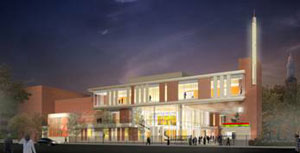
Ground was recently broken for the Leonard and Claire Tow Center for the Performing Arts, a new addition to Whitman Hall, Brooklyn College’s performance venue. Located in the Flatbush/Midwood section of Brooklyn, the 62,000-square-foot facility, designed by Pfeiffer Partners Architects, creates a new front door for the campus with performance, instructional, and rehearsal spaces. The project features a 225-seat theater with flexible stage configurations to accommodate orchestras, chamber ensembles, and experimental theater. Also included are 30 music studios/practice rooms, a large orchestra rehearsal room, and a theater rehearsal space, which can double as performance venues, a choral rehearsal room, a recording studio, and a scene shop for set construction. Respecting the architectural history of the campus, the center incorporates brick that reflects the campus’s color tones but used in a contemporary fashion. Brick “columns” are interspersed with metal panels and glass curtain wall which are spaced to create a rhythm of materials along the façade. The project is targeting LEED Silver certification, making it the college’s first green building.


QMA Expands Its Visibility

Queens Museum of Art.

Grimshaw Architects

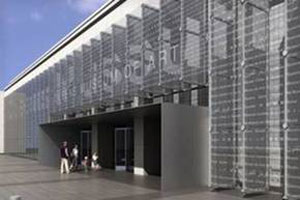
The Queens Museum of Art (QMA) is currently undergoing an expansion that will encompass the entirety of the building originally built as the city’s official pavilion for the 1939 World’s Fair. Designed by Grimshaw Architects, the revitalized QMA will feature new galleries, classrooms, public events spaces, a café, and museum shop. Doubling the size of the museum with the addition of 50,000 square feet, the design focuses on increasing the museum’s visibility and physical connection to its surroundings. A new entrance and expanded outdoor space will be on the park side of the museum; a new entry plaza and a 220-foot-long illuminated glass façade with vertical fins, laminated with a perforated metal mesh will face Grand Central Parkway. The focal point of the design is a glass-enclosed pavilion topped with a cube of translucent glass. Seven galleries are organized around this central space, and integrated sun-shading devices will be part of the skylight system to allow diffused natural light into the exhibition spaces. The glazing of the courtyard walls will control the quality and amount of natural light entering the rest of the building and shield the artwork from harmful UV rays. The $65 million expansion is scheduled to be complete by 2013.


TRC Brings TLC to UPenn

Translational Research Center.

Brad Feinknopf

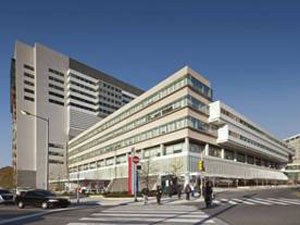
The Translational Research Center (TRC) at the University of Pennsylvania, designed by Rafael Viñoly Architects, marks the first expansion phase in an overall master plan for Penn Medicine that includes the UPenn Health System and the School of Medicine. The building unites research and clinical functions under one roof to allow the practices of scientific investigation and patient care to inform one another. It will provide research and office space for approximately 100 principal investigators and 900 related staff members. The new research center consists of a 14-story extension to the west wing of the Perelman Center for Advanced Medicine, designed by Rafael Viñoly Architects in a joint venture with Perkins Eastman. The TRC was planned with an open, flexible design in mind and the program includes a 225-seat auditorium, conferencing, 144 wet benches per floor, and elevated vivarium floors to isolate noise and movement. DNA-like spiral stairs are strategically situated in common areas.


Ennead Raises the Bar for New Law School Building

William H. Neukom Building.

Misha Bruk

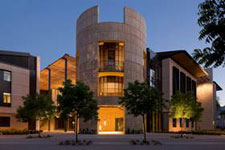
The William H. Neukom Building, a new central hub of the Stanford Law School, designed by Ennead Architects, recently opened. The 65,000-square-foot building creates a new focal point along the principal circulation route linking the residential and academic precincts of the campus. Reinforcing the principles of Frederick Law Olmsted’s original master plan for the campus, the building is organized around a central courtyard. A monumental rotunda referencing the historic entry gates on the main quad marks the convergence of the two principal campus grids and serves as the building’s main entrance. Four three-story wings, connected by glass-walled bridges anchored by a ground-floor plinth, house a legal clinic, seminar rooms, faculty offices, open work areas, and conference rooms. The rotunda’s open-air staircase leads to the faculty garden, which is intended to be the school’s “living room,” and upper levels, which house offices, meeting areas, and the dean’s suite and conference room — a circular, wood-clad, sky-lit space. The garden façades of each of the four wings are articulated by planar limestone walls. The building construction satisfies the equivalent of LEED Gold and the new building is expected to use 30% less energy than California code requires.

In this issue:
· Annual Meeting — 06.21.11
· Passing: Anna M. Halpin, FAIA
· e-Calendar


Annual Meeting — 06.21.11

The 144th AIANY Annual Meeting will be held Tuesday, 06.21.11, 6-8pm at the Center for Architecture. We will be voting on the 2012 slate, which includes Chapter President Joseph Aliotta, AIA, LEED AP, and Jill Lerner, FAIA, as president-elect. The Chapter will also be bestowing a number of awards, including the Medal of Honor to Daniel Libeskind, AIA. RSVP here .


Passing: Anna M. Halpin, FAIA
Anna M. Halpin, FAIA, of Oklahoma City, formerly of NYC, died 05.09.11 after a brief illness. She joined the AIA in 1963 and became a member of the College of Fellows in 1976. Her obituary can be read in full here, and her life is honored in this personal remembrance by colleague, Sarelle T. Weisberg, FAIA:

Anna’s introduction of the “Resolution on the Status of Women in the Profession” at the 1973 AIA National Convention was remembered, at a farewell event we held at the Chapter when she moved away from the city. I know she was very proud of that historic contribution, but on a more personal note:

Anna was an irreplaceable, exceptional role model and mentor for all of us during her many years in New York. Having worked in the design aspect of our profession, as well as very successfully in the corporate world, she was always a leader and a special friend to so many women and minority members.

She enthusiastically showed us how to use the Chapter in the best way for career advancement and development. She encouraged us to apply to become Fellows of the AIA, as well as to serve as local and state officers and committee leaders.

When she was an executive at McGraw-Hill, she served annually as its host for the spectacular Opening Party at each of the National AIA Conventions; I have very special memories of her in these unique National AIA settings!

I was very fortunate to have visited Anna in Oklahoma City a few years ago, where she and her niece introduced me to the range of architectural sights, architects, and the diverse ethnic origins characteristic of Oklahoma! As a New Yorker, I was not at all aware of all the history, cultural aspirations, and accomplishments of Oklahomans!

I did feel that her special warmth, helpful professionalism, and the enduring nature of her friendship to me and many others in the Chapter deserve a special acknowledgment.

— Sarelle T. Weisberg, FAIA


eCALENDAR
eCalendar includes an interactive listing of architectural events around NYC. Click the link to go to to eCalendar on the Web.

Center for Architecture Gallery Hours and Location
Monday-Friday: 9:00am-8:00pm, Saturday: 11:00am-5:00pm, Sunday: CLOSED, open 05.08.11 and 05.15.11, 11:00am-5:00pm
536 LaGuardia Place, Between Bleecker and West 3rd Streets in Greenwich Village, NYC, 212-683-0023

CURRENT EXHIBITIONS

Glimpses of New York and Amsterdam in 2040

On view June 8 – September 10, 2011

AIANY Design Awards 2011

On view April 14 – June 25, 2011

2011 CFA Design and Eleanor Allwork Recipients

From portfolios of Yinery Baez, Nick Tran, and Mark Thompson.

Courtesy Center for Architecture Foundation

The Center for Architecture Foundation is pleased to announce the recipients of the 2011 scholarship program. This year, the Scholarship Committee awarded Mark Thompson of Cooper Union and Nick Tran of Pratt Institute with the Women’s Auxiliary Eleanor Allwork Scholarship. Yinery Baez of the City College of New York received the Center for Architecture Foundation Design Scholarship.

The Eleanor Allwork Scholarship is for students seeking their first degree in architecture from a NAAB-accredited school within New York State. Each nominated student must demonstrate a high level of academic performance and evidence of financial need.

The Center for Architecture Foundation Scholarship is for students seeking their degree in architecture or a related design discipline from an accredited school in New York State. Similar to the Eleanor Allwork Scholarship, each nominated student must demonstrate a high level of academic performance and financial need.

The Center for Architecture would like to thank AIA National for providing a partial matching grant to help support the 2011 Women’s Auxiliary Eleanor Allwork Scholarship. The next Center for Architecture scholarship deadline for The Stewardson Keefe LeBrun Travel Grant is 11.01.11. The grant was established to further the personal and professional development of an architect in early or mid-career through travel. For application details and information on other awards that the Foundation offers, visit cfafoundation.org.

Bittertang Puts Visitors into a Dream State

Burble Bup by Bittertang.

Courtesy of FIGMENT.

At an “Archi-Film Mashup,” hosted by SUPERFRONT, Bittertang founders Michael Loverich and Antonio Torres showed videos of humans crawling into animal carcasses for shelter from the cold, as well as Rococo paintings of baby cherubs reaching toward a cloudy sky. These two disparate images surprisingly manifest in their work cohesively, as can be seen in their most recent project, Burble Bup.

Burble Bup is this year’s FIGMENT/ENYA/SEAoNY City of Dreams Pavilion competition-winning entry. The walls consist of stacked large-scale pink and green nylon stockings stuffed with bark chips. The roof is made from custom-designed inflatables dyed purple and peach. The floor is covered with scattered bark chips. Preliminary renderings looked both fantastical and vaginal at the same time, walking the line between the grotesque and whimsical. The actual structure, now complete and open on Governors Island for the summer, does, as well.

For months, as one of the organizers of the competition and one of the more than 125 volunteers that helped build Burble Bup, I have been looking at the renderings alongside Bittertang’s body of work, which ranges from plush toys and piñatas, to one of the sukkahs installed in Union Square for last year’s Sukkah City, trying to fully make sense of where they are coming from. Now, I see that it is an aspiration to create womb-like spaces — the ideal cozy space that both encloses and protects, permitting visitors to relax and dream.

The American Institute of Architects (AIA) Committee on Architecture for Education (CAE) has selected 13 educational and cultural facilities for this year’s CAE Educational Facility Design Awards, including The Learning School by Platt Byard Dovell White Architects (Merit Award)… The AIA has selected the eight recipients of the 2011 Small Project Awards, including PS 234 by Macrae-Gibson Architects… The AIA announces that the Union des Architectes Internationale (UIA) has selected the winners of the First UIA Architecture & Children Golden Cubes Awards; the Center for Architecture Foundation’s Learning by Design program was a finalist in the Institute Award category… AIA New York State has received a 2011 AIA Component Matching Grant for the Student Awards Program…

The Smithsonian’s Cooper-Hewitt, National Design Museum announced the winners of the 2011 National Design Awards: Architecture Research Office (Architecture), Shelton, Mindel & Associates (Interior Design), and Gustafson Guthrie Nichol (Landscape Architecture). For the full list of winners and finalists, click here

Gene Kaufman Architect has acquired a majority share in Gwathmey Siegel & Associates Architects. The firm will be renamed as Gwathmey Siegel Kaufman & Associates. Gene Kaufman Architect will retain the same name…

Sandow, the owner of Surface and Interior Design magazines, announced that it has acquired Material ConneXion, Inc…. Thomas Frascatore has been appointed as executive publisher and chief operating officer of Metropolis magazine… Nicolai Ouroussoff is leaving the New York Times to write a book about the architectural and cultural history of the last 100 years…

Kim Yao, AIA, has been named Principal of Architecture Research Office… Howard Kronland, AIA, has joined the AEG as Vice President…