Educational Architecture Promotes Social Inclusion in Colombia

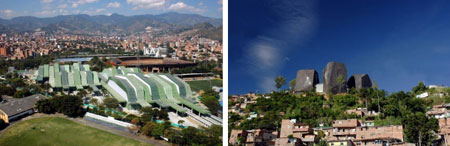
Coliseums for the South American Games (left); España Library.

Photos by Veronica Restrepo (left) and Sergio Gomez (right)

Event: Giancarlo Mazzanti — Colombia’s Rising Star
Location: Center for Architecture, 02.17.11
Speaker: Giancarlo Mazzanti — Architect (Bogotá)
Organizers: AIANY Committee on Architecture for Education
Sponsors: Fernando Villa, AIA, LEED AP; Consulate General of Colombia in New York

Medellin has transformed some of the poorest and crime-ridden neighborhoods in Colombia into safe environments, bringing social stability and hope to its residents. The city has also become an example of how educational projects can positively impact the city and its inhabitants. In a continuation of last summer’s event, “A Tale Of Two Cities” (See “Colombia Builds Communities with Schools, Libraries,” by Umberto Dindo, AIA, e-Oculus, 07.07.10), Colombian architect Giancarlo Mazzanti shared his design philosophy and projects.

Mazzanti presented projects aimed at promoting social well-being and a more sustainable society through architecture, organized around four themes: landscapes; program; growth and patterns; and modules and adaptive systems.

Landscapes connect urban geographies with topographies. By folding and tearing the existing terrain, architecture and landscape develop simultaneously, Mazzanti said, creating relationships between the figure and the field. The España Library in Medellin attempts to re-imagine architecture as a texture and the local geography as a new hierarchy.

Patterns are abstract organizational systems that allow one to develop new building strategies. Whether it is based on repetitive or irregular elements, Mazzanti finds order in direction and growth. With the design of the coliseums for the South American Games, for example, he explored the relationship between the interior and the exterior, the mass and void, as a unified object. The exterior public space and the coliseums have a spatial relationship that is divided by a thin skin of perforated metal, which allows for views and natural ventilation. The four coliseums function both individually and as a whole complex.

To illustrate the concept of program, Mazzanti presented the El Porvenir kindergarten in Bogotá, inspired by flowers and designed as an open-ended, modular system. It is an example of how space can be used as an educational tool. Each module contains a classroom with a central courtyard, and the massing promotes natural ventilation; the interstitial spaces between the classrooms expand or contract, and each courtyard is defined by an educational and playful theme.

Through the development of open and adaptive systems comprised of modules and patterns, a design can grow and adapt to diverse situations — topographic, urban, or programmatic.

Rybczynski Proposes Ideas About Cities

Event: Oculus Book Talk: Witold Rybczynski
Location: Center for Architecture, 04.11.11
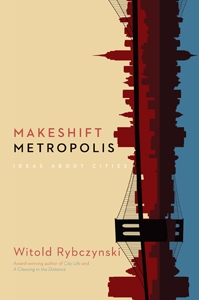
Speaker: Witold Rybczynski, AIA — Author, Makeshift Metropolis: Ideas About Cities (Scribner, 2010)
Organizer: AIANY Oculus Committee

Courtesy AIANY

Makeshift — “a temporary or expedient substitute for something else.” Metropolis — “a large city or urban area.” Together these two words form the alchemical ingredients of a pragmatic and poetic work about urban design and the future of our cities, by author, critic, and professor Witold Rybczynski, AIA.

There are no villains or heroes in this story. This is a reflective examination of a century of ideas in urban planning that evolved from movements such as City Beautiful, the Garden City and the ideas of Le Corbusier, Frank Lloyd Wright, and Jane Jacobs. As the history unfolds it does so alongside the reshaping of our cities. This is a book that encourages the reader to think about the distinction between good ideas and implementation; as well as history, ideologies, and forward-thinking possibilities.

Rybczynski opens the book with Michael Van Valkenburgh’s Brooklyn Bridge Park and closes with Moshe Safdie’s new city of Modi’in, Israel — creative voices that clearly speak to the 2lst century. As for the pages between, all I can say is this: A planner walks into a bar… Charles Mulford Robinson, Le Corbusier, Frank Lloyd Wright, Jane Jacobs, Lewis Mumford, and Patrick Geddes are sitting there together, reading, and not saying much to each other until Patrick Geddes (who is on the final page of the book) breaks the silence, quoting the author: “History does not always have the answers — new problems do sometimes require new solutions — but it behooves us to keep one eye on the past as we venture into the future. This is not about nostalgia or summoning an imagined past, but freedom from history is no freedom at all. The next city will include much that is new, but to succeed it cannot ignore what came before. Linking the past with the present, and seeing the old anew, has always been part of our improvised urban condition.” With that the personages of history order a round and raise their glasses to the future. As for the how this has impacted the planner who walked into the bar and observed this moment in time — that part of history is yet to be written.

Note about Oculus Book Talks: Each month, the AIANY Oculus Committee hosts a Book Talk at the Center for Architecture. Each talk highlights a recent publication on architecture, design, or the built environment — presented by the author. The Book Talks are a forum for dialogue and discussion, and copies of the publications are available for purchase and signing. This article is a preview for Witold Rybczynski’s upcoming talk on 04.11.11. Click here to RSVP.

In this issue:
· Van Alen Books Fills Gap Left by Urban Center Books
· Installation Worms Its Way Down the Bowery
· Staten Island Museum Nestles in to Snug Harbor
· Luxury Hotel Reaches New Heights
· It Takes a Village, Condominium, and Hotel in Jesolo Lido


Van Alen Books Fills Gap Left by Urban Center Books

Book emporium at the Van Alen Institute.

LOT-EK

The Van Alen Institute will be opening a new architecture and design book emporium and gathering space later this month. The store will make available the remaining stock from the shuttered Urban Center Books, and will collaborate with publishers to offer a selection of new and noteworthy titles. Designed by LOT-EK, the storefront space at the institute’s headquarters features a 14-foot-tall staircase crafted from a stack of 70 recycled doors, which step up to create an amphitheater overlooking the street through glazed storefront windows. Sourced from Build It Green! NYC, a nonprofit supplier of salvaged building materials, the solid wood doors form a triangular platform evoking the steps of Times Square’s TKTS Booth, a project originated through the institute’s 1999 design competition. Beyond its role as a bookstore, multidisciplinary performances, debates, discussions, and storytelling sessions will be programmed. Van Alen Books is made possible through seed funding from Furthermore, a program of the J. M. Kaplan Fund, as well as the guidance of Joan K. Davidson and Margot Wellington.


Installation Worms Its Way Down the Bowery

The Worms planned for the Storefront for Art and Architecture’s StreetFest International.

Family and PlayLab

A team of emerging NYC-based designers, Family and PlayLab, has been selected as the winners of Storefront for Art and Architecture’s StreetFest International competition. The competition called for designs of street tents that not only serve as shelters, but also as active elements. “The Worms” are modular accordion forms, skinned in bright, lightweight, waterproof rip-stop nylon. Each modular unit is 10 feet high and 20 feet long, and can be combined in a number of configurations. Rolled galvanized steel ribs supported by steel forks resting on swivel casters create bays that can expand, turn, and contract to host a variety of programs. They will be on view near the New Museum on 05.07.11 as part of the Festival of Ideas for the New City. In addition, “The Worms” will be used at the NYC Department of Transportation’s summer events and other temporary street fairs this summer.


Staten Island Museum Nestles in to Snug Harbor

Staten Island Museum.

Gluckman Mayner Architects

The Staten Island Museum recently broke ground for its new home in Building A, a landmarked, long-vacant building on the Snug Harbor Cultural Center Campus. The reconstruction, designed by Gluckman Mayner Architects, will provide 18,000 square feet of usable space, including an auditorium/performance venue and a multipurpose room for community exhibitions. Upon completion, a full-scale Mastodon replica will greet visitors in the first floor lobby, which will also contain Hudson River School paintings placed in counterpoint with newly commissioned contemporary representations of the Staten Island landscape. The second floor will contain a mix of ancient art on loan. The ground level will be home to “The Green Museum: Keeping Our Cool” exhibition, where visitors can learn about the history of Snug Harbor’s architecture and the innovative engineering of the 19th century, as compared with today’s green technologies. The new facility, which is expected to achieve LEED Gold, will utilize a closed loop geothermal system. Staten Island Museum, which is currently located in St. George, is owned by the City of New York and benefits from public funds provided through the NYC Department of Cultural Affairs.


Luxury Hotel Reaches New Heights

The Ritz-Carlton Hong Kong.

Photo by Grischa Ruschendorf

The world’s highest hotel, The Ritz-Carlton Hong Kong, located on the uppermost floors of the International Commerce Center designed by Kohn Pedersen Fox Associates, recently opened. The hotel occupies floors 102 to 118 of the “vertical city” and contains 312 guest rooms and luxury amenities. The hotel also has the world’s highest bar, glass-enclosed on the rooftop with an outdoor terrace. The tower contains offices, residences, retail, restaurants, cafés, and a 360-degree observation deck situated above a transportation network that spans the Pearl River Delta. Hong Kong-based Wong & Ouyang served as the associate architect, and Singapore’s LTW Designworks was the interior designer for the hotel.


It Takes a Village, Condominium, and Hotel in Jesolo Lido

Jesolo Lido Condominiums.

Renderings by dbox

Jesolo Lido Condominiums, Phase 2 of an ongoing project along Italy’s Adriatic coast designed by Richard Meier & Partners Architects, is scheduled to open this summer. The 10-story building features open staircases and shaded terraces on all elevations with ocean views. The project contains 69 units, featuring six ground-floor apartments with private gardens and a spa, and are five duplex penthouses, each with its own outdoor pool. Phase 1, Jesolo Lido Village, completed in 2007, is a long rectangular residential building with 23 units and retail space on the ground floor. Phase 3, in the development stage, is a 30,000-square-foot, six-story hotel with 122 rooms above a two-story lobby. All three projects — village, condominiums, and hotel — are tied together along a spine running from north to south, which also acts as a viewing corridor and public access walkway to the beachfront.
In this issue:
· AIANY & Colleagues in Lima Sign Cooperation Agreement
· AIA National Makes Energy a Priority
· AIANY Comments on Local Energy Laws
· e-Calendar


AIANY & Colleagues in Lima Sign Cooperation Agreement

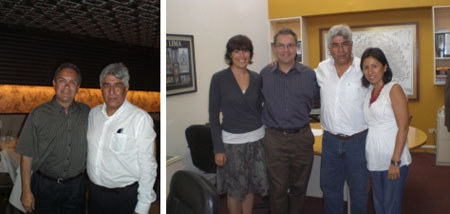
Rick Bell, FAIA, with José Enrique Arispe Chavez (left); (L-R): Martha Bell; Rick Bell, FAIA; José Enrique Arispe Chavez (Decano Regional); and Architect Rosalia Matos.

Martha Bell (left); courtesy of Rick Bell (right)

José Enrique Arispe Chavez, architect and regional dean of the Lima Regional Component of the College of Architects of Peru (CAP-RL), greeted AIANY Executive Director Rick Bell, FAIA, in Lima on 03.11.11. The meeting resulted in an Institutional Cooperation Agreement approved by the AIANY Board of Directors, which agrees to an exchange of ideas, journals, and information on major projects in Lima and New York. The promotion of the views of architects in professional, academic, and cultural capacities is meant to mutually enhance the importance of architecture. The accord was noted by CAP-RL on its website:
http://www.caplima.pe/ and the Spring 2011 issue of Oculus, “Design for a Change: Buildings, People, Energy” is on the way to Peru.


AIA National Makes Energy a Priority
Last week, AIA National announced its top five legislative proposals to increase energy efficiency. These agenda items include: strengthening the commercial building energy efficiency tax deduction; passing a long-term transportation bill that empowers communities to plan to reduce energy-wasting congestion and promote livable, walkable neighborhoods; passing the bipartisan America’s Clean Energy Leadership Act (ACELA) approved in 2009 by the Senate Energy and Natural Resources Committee, which promotes stronger energy building codes and building retrofits; restoring funding for government building energy retrofits that was cut in the most recent continuing resolution; and passing legislation to allow states and localities to use PACE bonds, whose proceeds are lent to commercial or residential property owners to finance energy efficiency measures and small renewable energy systems. Read the entire AIA release here.


AIANY Comments on Local Energy Laws
On 03.21.11, 2011 AIANY President Margaret Castillo, AIA, LEED AP, delivered comments on the NYC Department of Building’s proposed rule pursuant to Local Law 84. The rule requires owners to benchmark their buildings by 05.01.11. Benchmarking involves gathering information on a number of fuel types: natural gas, electricity, and renewables, and combines them into one measure called energy use intensity (EUI). At the 03.21.11 hearing and in other venues, including NY1 (see Names in the News 03.08.11), Castillo has made a strong case for benchmarking. “It is our goal to see reporting lead to upgrades and retrofits that will not only improve energy performance, but make better buildings which will garner benefits through decreased operating costs for the owner, the user, and the city of New York. Better efficiency and decreased fuel loads and costs mean decreased build out of city-wide infrastructure, less pollution, and, ultimately, a healthier and sustainable NYC,” she said. Read the statement here.

Castillo also believes that architects can and should be employed to take these measurements and propose energy-saving solutions to building owners. Visit the AIANY NBAU website for more information on benchmarking. The proposed rule goes into effect 05.01.11, but last week an “effective extension” to 08.01.11 for compliance has been put into effect.


eCALENDAR
eCalendar includes an interactive listing of architectural events around NYC. Click the link to go to to eCalendar on the Web.

The 2011 Arnold W. Brunner Grant Goes to Doris Sung

Courtesy Center for Architecture Foundation

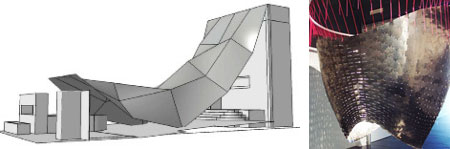
“Sunny Side Up,” by Doris Sung.

The Center for Architecture Foundation is pleased to announce the winner of the 2011 Arnold W. Brunner Grant: Doris Sung, principal of Rolling Hills, CA-based dO|Su Studio Architecture and adjunct associate professor at the University of Southern California. Through her project, “Sunny Side Up,” Sung plans to challenge the “traditional presumption that building skins should be static and inanimate by viewing building skins as a prosthetic layer between man and his environment as a responsive and active system.” The project will be an outdoor installation that demonstrates the capacity of thermo-bimetal, a heat-sensitive smart material that can self-ventilate and shade, to be an environmental architectural application. Ultimately, “Sunny Side Up” will serve as a canopy that will strategically shrivel and change shape as it tracks the sun and shades the Materials & Applications gallery space.

The Arnold W. Brunner Grant was established for mid-career professional architects for advanced study in any area of architectural investigation that will effectively contribute to the knowledge, teaching, or practice of the art and science of architecture.

The next Center for Architecture Scholarship and Grant deadline is 05.03.11 for the Douglas Haskell Award for Student Journals. The Haskell Award was founded to encourage student journalism in architecture, planning, and related subjects, and to foster regard for intelligent criticism among future professionals. For application details [http://www.cfafoundation.org/files/Haskell_Application_Form.pdf ] as well as information regarding the other scholarships and grants offered by the Center for Architecture Foundation, visit www.cfafoundation.org.

NAAB Reveals Disparity in Education

Last week, the National Architectural Accrediting Board (NAAB) issued the 2010 Report on Accreditation. It provides data on: accreditation actions taken in 2010; aggregated statistics on NAAB-accredited programs; and an overview of accreditation-related activities in 2010. While some of the report focuses the evaluation of accredited schools and those seeking accreditation, I found that the most interesting studies were centered on ethnicity and gender.

Overall, 52% of architecture students were White and 48% were minorities (14% were Hispanic/Latino, 10% Asian, 10% Native Hawaiian or other Pacific Islander, 7% Nonresident alien, and 5% Black or African-American, with 0%-1% each of other ethnicities). Males consisted of 59% of the overall enrollment, and 41% were females. Compare this with professors: 79% were White; and 74% were male.

I think that this study reveals a disparity in education. Is the predominance of White and male professors affecting students and their impressions of the profession? Do women and minority students have the role models that they require to be encouraged to pursue architectural careers? As the profession is becoming more diverse, is academia lagging behind?

Of course, the ethnicity and gender of faculty members are not solely responsible for under-representation in education. And professors can be role models to anyone, whether or not they are of the same ethnicity and gender. However, if the profession is to continue to develop and diversify, I think some of the responsibility lies in professorial make-up. And, as I think this study reveals, academic institutions need to address this issue at the faculty level.

The Center for Architecture Foundation‘s Learning by Design: New York (LBD:NY) program has been selected as one of four National Nominees for the inaugural International Union of Architects (UIA) Architecture & Children Golden Cubes Awards in the “Institution” category…

The winners of the 2011 Architectural League Prize for Young Architects and Designers include NY-based Ajmal Aqtash, Richard Sarrach, and Tamaki Uchikawa of form-ula, and Unchung Na, Assoc. AIA, and Sorae Yoo of NAMELESS

Jesse Reiser, AIA, and Nanako Umemoto of Reiser + Umemoto, RUR Architecture will be awarded The Cooper Union Irwing S. Chanin School of Architecture’s John Q. Hejduk Award for outstanding contributions to the theory, teaching, and practice of architecture…

The finalists competing for the 2011 European Union Prize for Contemporary Architecture — the Mies van der Rohe Award include the Acropolis Museum by Bernard Tschumi Architects

The National Council of Architectural Registration Boards (NCARB) has selected Michael Armstrong, currently a senior vice president at the International Code Council, as its next chief executive officer, effective 06.2011…

Deborah Marton has announced plans to step down from the position of executive director of the Design Trust for Public Space effective 04.08.11…

2011 OCULUS Editorial Calendar
If you are an architect by training or see yourself as an astute observer of New York’s architectural and planning scene, note that OCULUS editors want to hear from you! Projects/topics may be anywhere, but architects must be New York-based. Please submit story ideas by the deadlines indicated below to Kristen Richards: kristen@ArchNewsNow.com.

2011 Themes:
Spring (President’s Theme): Design for a Change: Buildings, People, Energy
[Closed]

Summer: AIANY Design Awards 2011
[Closed]

Fall: Interior Activity
— Sustainable interior architecture/design.
— Interiors as laboratories for small firms.
— Changes in Practice: Diversity out of necessity; multi-disciplinary cross-overs; architectural firms establishing quasi- or totally independent design studios for products, graphics, etc.
— Pro-bono policies: we’d like to hear from firms participating in established programs such as The 1%, Architecture for Humanity, etc. — and from firms who have an established in-house pro-bono program and/or policy.
Submit story ideas by 04.22.11

Winter: Up, Down, and Sideways: Density and Transportation
Density enabled by transportation: mass transit, cycling; Moynihan Station; Regional connections; Housing Authority: former purposeful disconnect, now reintegrating back into neighborhoods; How a century of New York skyscrapers has/is/will affect the architecture, planning, and culture of the city and the world.
Submit story ideas by 08.19.11

For further information, contact OCULUS Editor Kristen Richards: kristen@ArchNewsNow.com.

04.11.11 Call for Presentations: TRI State Design Conference

04.15.11 Call for Entries: AIANY Interiors Committee Speed Presentations: Not-for-Profit Projects

04.20.11 Call for Nominations: MASterworks Awards

04.25.11 Call for Submissions: 2011 Photo Urbanism Fellowship

04.25.11 Request for Proposals: Water Street Median — Feasibility Study

05.01.11 Call for Entries: The Generative Space Award

05.01.11 Call for Entries: The Gowanus Lowline — deadline extended

05.21.11 Call for Entries: Life at the Speed of Rail

06.01.11 Call for Entries: ACADIA 2011 Design + Fabrication Competition: Sponsored by FLATCUT_

06.15.11 Call for Papers: 49th International Making Cities Livable Conference on Planning Healthy Communities for All

03.25.11: As part of the Jugaad Urbanism Film Series, “Bombay Summer” was screened at the Center for Architecture.

“Bombay Summer” director Joseph Mathew.

Caley Monahon-Ward

(L-R): Rosamond Fletcher, Director of Exhibitions, Center for Architecture; Rick Bell, FAIA, Executive Director, Center for Architecture; Yumi Ito, Assistant Manager, Business Solutions Group, Hitachi; and Jen Apple, Development Manager, CFA.

Emily Nemens, Center for Architecture

03.31.11: As part of the Jugaad Urbanism program, speakers of “Contemporary Design Typologies in India: Housing, Airports and Mixed Use Developments” presented projects from the perspective of foreign firms and their interaction with local clients, contractors, and regulatory authorities.

Purnima Kapur, Director of the Brooklyn Office, NYC Department of City Planning, introduced the program.

Emily Nemens, Center for Architecture

(L-R): Rick Bell, FAIA, Mary Burke, AIA, and Laura Marlow, Program Director, Innovation & Business Development, Reed Construction Data.

Emily Nemens, Center for Architecture

03.30.11: Speakers at the “Energy Code and Lighting” presentation at the Center for Architecture discussed what conformance means in a practical sense.

(L-R): Jack Bailey, Partner, One Lux Studio; Patricia Di Maggio, LC, LEED AP, MIES Specifications Engineer for Osram Sylvania; and Deborah F. Taylor, AIA, LEED AP.

Caley Monahon-Ward

03.30.11: To mark the paperback release of Why Architecture Matters (Yale University Press), New Yorker Architecture Critic and Author Paul Goldberger, Hon. AIA, conversed with Oculus and ArchNewsNow.com Editor Kristen Richards, Hon. AIA, Hon. ASLA, at the Lower East Side Tenement Museum.

Debra Pickrel

03.25.11: A ceremony was held to commemorate the 100th Anniversary of the Triangle Shirtwaist Factory Fire.

Black and purple drapes were placed on the eighth floor windows where the fire originated in the building, located near Washington Square.

Frank Ritter, Ritterphoto.com

A ceremony was held at the Eldridge Street Synagogue, where 146 men and women wore black veils in honor of those who died in the fire.

Frank Ritter, Ritterphoto.com