Tools of the Trade: New Technologies for the Job Site

Event: New Tools for Builders
Location: Center for Architecture, 11.29.10
Speakers: Onalee Finio — Director of Technical Services, The Hilti Group; Larry DeGennaro — Strategic Business Director, The Hilti Group; Rick Pulling — Director, Worldwide New Equipment, Otis Elevator Company; Saulius Toleikis — Director of Sales, Festool
Introduction: Anthony Schirripa, FAIA, IIDA — AIANY 2010 President
Organizer: Center for Architecture as part of the “Innovate:Integrate” exhibition
Sponsors: Lead Sponsors: ABC Imaging; Competition Architectural Metals; Coreslab Structures; Ductal by Lafarge; F. J. Sciame Construction Co.; Gensler; Georgia Institute of Technology, Digital Fabrication Laboratory; kammetal; Lutron; Mancini·Duffy; MechoShade Systems; Oldcastle Building Envelope; Peter Arbour / RFR Consulting Engineers; Permasteelisa North America; Plaza Construction; Structure Tone; Syska Hennessy Group; Turner; Zetlin & De Chiara; Sponsors: Aerotech Manufacturing; Francis Cauffman; Polytek; HeliOptix; STUDIOS Architecture; and Trespa North America
Supporters: AKF Group; db3; Forest City Ratner Companies; Hugo S. Subotovsky Architects; Levien & Company; National Institute of Building Sciences; Pennoni Engineering and Surveying of New York; Peter Pennoyer Architects; SMART; Steelcase; Stephan Jaklitsch Architects; Thornton Tomasetti; WB Wood; Friends: Benjamin Moore; Brenda Levin; Matthews Coatings; New York Building Congress; Presentation Products; Theo. David Architects TDA/KAL; Weidlinger Associates

Speed Sleeve by The Hilti Group.

Hilti.com

The Hilti Group, Festool, and Otis are known for innovation in the areas of job-site safety and productivity, as well as for the energy efficiency of their tools. As part of the exhibition “Innovate:Integrate” (on view through 01.15.11), representatives from these manufacturers gathered at the Center for Architecture to exhibit and demonstrate their latest products.

Hilti is a manufacturer of low-velocity, powder-actuated tools. They produce a high-speed fastening system that allows workers to lay steel deck in one-third of the time compared to traditional methods, according to Onalee Finio, director of technical services. The company now also manufactures the Speed Sleeve, a cable management fire-stop device that “takes all of the guesswork out of the contractor’s hands,” explained Finio. It does this with “spin on” flanges that allow for quick installation and the flexibility for cables to be inserted at any height. In addition, Hilti has developed software programs that perform calculations and aid in specifications for decking, fire protection, and anchor systems.

Festool produces woodworking and cabinet-making tools, including cordless drills, jigsaws, and routers, as well as dust extractors, which improve air quality on the job site. With a focus on efficiency, Festool’s motto is “Faster. Easier. Smarter.” For example, they claim their dual-mode sander achieves results up to three times faster than traditional sanders.

Otis Elevator Company’s two new models have proven popular with architects because of their reduced footprints and energy efficiency. The Gen2 System operates with polyurethane coated-steel belts instead of the traditional metal cable. No gears or lubrication are required. According to Rick Pulling, director of worldwide new equipment, the model uses half the energy of a typical elevator. The ReGen system takes energy conservation a step further by working with gravity and capturing energy that otherwise would be lost in braking. This energy can then be fed back into the building’s grid.

In this issue:
· PS90 Will Soon Dance for Joy
· Gateway Opens Doors to Harlem
· Hudson Square Selects Pedestrian Friendly Team
· Stairway Leads to Italian Kitchen Designs
· Stony Brook Aims for First LEED Certified Residence Halls
· Museum for Jewish History Opens Book on Independence Mall


PS90 Will Soon Dance for Joy

Center for Learning and the Arts at PS90.

Curtis + Ginsberg Architects

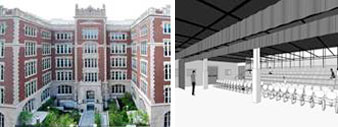
Curtis + Ginsberg Architects (C+GA) is transforming PS90 from a 20th-century abandoned school into 75 new condominiums, 20 of which are affordable. The cellar and first floor (18,000 square feet) will be occupied by the Center for Learning and the Arts, which will house programs by the National Dance Institute, a non-profit organization established to provide dance classes to public school children. The Center, designed by C+GA with design consultant H3 Hardy Collaboration Architecture, will include four dance studios, the largest of which will be a fully equipped performance space that seats 180. Visitors will be able to view rehearsals through ribbon windows that connect the studios to the lobby/gallery. This project is part of the city’s planned redevelopment of West 148th Street — the last large cluster of vacant city-owned buildings in Harlem.


Gateway Opens Doors to Harlem

Gateway II.

Michielli + Wyetzner Architects

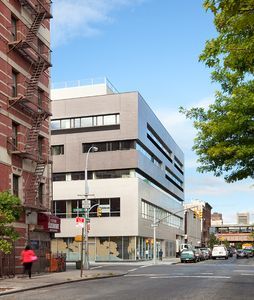
Gateway II, a new six-story, 50,000-square-foot, mixed-use project in East Harlem, is home to a combination of commercial and not-for-profit tenants. Designed by Michielli + Wyetzner Architects, for ddm development and services, retail will occupy the ground floor, two floors are dedicated to office space, and three floors are for assisted living, each having its own entrance. The structure incorporates a Con Ed substation with thick concrete walls that isolate and protect it. To visually lighten the building’s mass, the firm divided the second through the fifth floors into two, two-story volumes clad with light and dark gray glazed brick. A narrow band of recessed windows on the third floor marks a break between the two volumes. The brick façade is articulated with a varied fenestration pattern to express programmatic divisions. The sixth floor includes a green roof on a setback that offers residents on the top floor a “lawn” view.


Hudson Square Selects Pedestrian Friendly Team

Hudson Square Connection, the Business Improvement District for the neighborhood bounded by W. Houston Street on the north, Canal Street on the south, Sixth Avenue on the east, and Greenwich Street on the west, has selected a team of seven firms led by Mathews Nielsen Landscape Architects to design pedestrian-friendly streetscapes. The area, known for its Art Deco buildings and once populated with publishers and printers, has now become a center for creative industries, including a number of architecture firms. Working closely with the NYC Department of Transportation, the team will have until the end of 2011 to draw up plans for socially, economically, and environmentally sustainable spaces. Team members include Rogers Marvel Architects (urban design), Billings Jackson Design (industrial design), and Arup (transportation planning and lighting design).


Stairway Leads to Italian Kitchen Designs

Scavolini SoHo Gallery.

Photo by Enrico Como

One of the stops on the Italian Design Street Walking Tour — part of the I Saloni Milano campaign to promote Italian Art and Culture — is the new flagship Scavolini SoHo Gallery, designed by SpaCe Architects. The design of the 10,000-square-foot space maintains the openness of the Nancy Hoffman Gallery, the previous occupant, to “exhibit” high-end kitchens manufactured by Scavolini. Existing cast iron columns draw visitors to a repositioned, re-sized glass staircase — the focal point of the space on axis with a new vestibule at the entrance. The stairway is enclosed by a lattice-like structure designed by Greneker Solutions. There is one fully operational kitchen designed by Karim Rashid, which will be used for cooking demonstrations. SpaCe is currently working in collaboration with Milan-based Brugi-Messi on a new store for fashion designer Etro, also located in SoHo.


Stony Brook Aims for First LEED Certified Residence Halls

SUNY Stony Brook Nobel Hall.

Photo by C. Taylor Crothers

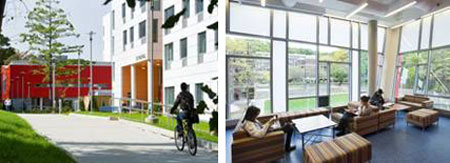
Goshow Architects has completed Nobel Halls, a 175,000-square-foot complex on the campus of State University of New York at Stony Brook. The $56 million project is composed of two conjoined residences and a community center. Named after two Nobel laureates and former faculty members C. N. Yang and Paul C. Lauterbur, the residence halls combined contain 104 suite-style apartments. Each suite contains three double bedrooms centered around a common living room. Common spaces, such as lounges, small kitchens, and laundry rooms are located on the ground floor. The Center for Global Studies and Human Development serves as a community center with a café/lounge, seminar rooms, offices, and a 350-person meeting room. The project is on track to be certified LEED Gold. Sustainable features include insulated metal panels with high recycled content for the exterior cladding, and the use of rapidly renewable materials such as linoleum flooring and agrifiber door cores.


Museum for Jewish History Opens Book on Independence Mall

National Museum of American Jewish History.

Photos by Jeff Goldberg/ESTO

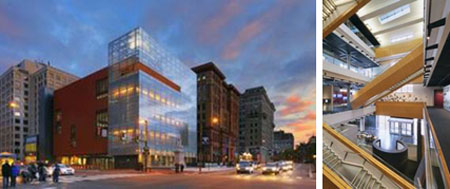
The new $150,000 million National Museum of American Jewish History, a Smithsonian affiliate, recently opened across the street from Independence Mall in Philadelphia. The 100,000-square-foot building, designed by Ennead Architects (formerly Polshek Partnership), is composed of two interlocking volumes — one opaque, the other translucent. The interior merges glass and masonry volumes and is arranged on six levels. Four floors feature interactive exhibition space, a changing exhibit gallery, a 200-seat auditorium, and an education center. An 85-foot-high atrium creates a spatial connection throughout the museum, allowing visitors to comprehend the organization of the building from any point. Two sculptural works are integral to the architectural concept — the 19th-century sculpture “Religious Liberty” was restored and relocated to the entry plaza, “Beacon,” a new LED sculpture by Ben Rubin, is located in the uppermost corner of the glass façade. Its undulating panels appear as pages in a book, such as the Talmud, one of the central texts of Judaism. Interlaced vertical and horizontal lines drawn freehand by the architects who designed the project define the pattern of the glass curtain wall and are intended as a metaphor for the interconnectedness of all.

In this issue:
· Procrastinators’ Days start tomorrow
· Community Board Application Reminder
· eCalendar


Procrastinators’ Days start tomorrow
Procastinators’ Days will begin tomorrow, 12.09.10, and run through Saturday, 12.11.10. Thirty-five credits of courses will be available over the three-day event (architects can earn up to 19 HSW credits) with programs by Abet Inc, Assa Abloy, Bradley Corp, Bradley Corp, Brick Industry Association, Custom Building Products, Custom Building Products, Decorating with Fabric, DSA-Ceramics, Enviroshake, Fit City, Graphisoft, Green Logic, Honeywell, Hoover Treated Wood, ILVA, Kinetics Noise Control, Miller Edge, Mitsubishi Electric, Polycor, Price Industries, Re:Source NJ, Saniguard Alliance, Seieffe, Smart Vent, Spec Mix, Stone Peak Ceramics, Venco, Versatex Trimboards, Viracon, Viridian Systems, and Wedi Corp. Visit aiany.org/procrastinators for details, and sign up now! Advance registration closes today, 12.08.10 at 6pm.


Community Board Application Reminder
01.14.11 is the application deadline to become a member of Manhattan Community Boards in 2011. Join AIANY and the Manhattan Borough President’s Office on 12.15.10 for an information session on serving on community boards. Ask questions about service and learn more about how to apply. Download the application here.


eCALENDAR
eCalendar includes an interactive listing of architectural events around NYC. Click the link to go to to eCalendar on the Web.

Center for Architecture Gallery Hours and Location
Monday-Friday: 9:00am-8:00pm, Saturday: 11:00am-5:00pm, Sunday: CLOSED
536 LaGuardia Place, Between Bleecker and West 3rd Streets in Greenwich Village, NYC, 212-683-0023

CURRENT EXHIBITIONS

Innovate:Integrate – Building Better Together

LiquidWall

On view October 6 – January 15

Design for Decades

On view December 8, 2010 – January 22, 2011

Building Connections 2010

Print

On view November 4 – March 12

CFAF Preps Eighth Graders for National Competition

Students from MAT worked in teams to construct scale models of “green” buildings. One group built a spiral apartment building with green roofs, wind turbines, and a rainwater collection system.

Maggie Yolen

Eighth graders from Manhattan Academy of Technology (MAT) are gearing up to compete in the National Engineers Week Future City Competition. The 19th annual competition fosters interests in math, science, and engineering by challenging students to design a “city of the future,” first through computer simulation using Sim City software, and then by constructing their designs in large, three-dimensional models. In addition to garnering invaluable computer skills, students are learning about sustainability. As preparation for the competition, Hau-yu Chu, an eighth-grade technology teacher at MAT, brought her class to the Center for Architecture Foundation (CFAF) for two Student Day programs: Neighborhood Design and Green Buildings.

First, students designed an “ideal” neighborhood. Considering different building types, community needs, and neighborhood density, students collaborated to build a livable neighborhood. Then, under the guidance of CFAF Director of Programs Catherine Teegarden, students explored methods of making buildings greener, including incorporating renewable energy and passive solar design features. Teegarden supplied the class with a student-friendly version of the LEED checklist to help guide their “green” model building.

One group of three students constructed a spiral apartment building complex with green roofs, wind turbines, and a rainwater collection system. “Oh, and it will be made of recycled materials,” one of the students added enthusiastically. Another group explained that their model was relying solely on solar energy to power the building. The roof of their glass building was covered with small trees and shrubs made from green tissue paper. “It’s hard to design a building that’s all sustainable when you’re trying to consider space too,” a team member remarked as he added a shrub to the roof. While determining whether bike racks were in proportion to her building, one student described how the gym on the first floor would use treadmills to power a portion of the building’s electricity.

After completing the scale models and giving an oral presentation to their school, Chu will choose three students to represent MAT in the national competition.

Student Days are hands-on workshops exploring architecture and design, offered for K-12 classes at the Center for Architecture, Monday-Friday. To schedule a Student Day, visit www.cfafoundation.org/studentday and fill out a Student Day Request form or contact Catherine Teegarden at cteegarden@cfafoundation.org 212.358.6135 for more information.

DOT Pops Up New Designs

The NYC Department of Transportation (DOT) is seeking applications for its Pop-up Café Program. As an advocate for more creative uses of public spaces, the expansion of the pilot program, which was tested this year, will increase the public’s access to good design.

For the two-year program, the DOT expects to partner with local restaurants and cafés in up to 12 locations throughout the city. Each restaurant selected will choose a design and hire a NYS-licensed architect/engineer and construction team. The restaurant will also cover the cost of design, construction, and maintenance (an estimated $10,000 per restaurant according to the website), and the pop-up will be fully accessible to the public.

The efforts by the DOT not only to create a more pedestrian-friendly city by expanding sidewalk programs and green spaces, but by also varying programs and designs speaks of an active effort to improve the quality of life in the city. This is an excellent opportunity for design firms to explore new ways for people to inhabit their streets, while giving firms access to restaurant owners, potentially leading to future work. Overall, this program is a win-win for designers and city residents. I am looking forward to the designs in the next couple of years in addition to other related programs aiming to make the city more accessible to pedestrians.

AIANY won the AIANYS Empire State Challenge for the project, “Regulatory Review Coordination and the NYC Charter Revision Commission: An Issue with Statewide Implications.” The Chapter received $5,000 at the AIANY Board Inaugural to further the initiative in 2011.

The 2011 AIANY Nominating Committee has been elected: Michael Arad, AIA; Lance Jay Brown, FAIA; Sara Caples, AIA; Yvonne Szeto, FAIA and Tony Schirripa, FAIA.

Serena Chen, AIA, LEED AP, is the recipient of the first annual ENYA Merit Award. The AIANY Emerging New York Architects Committee (ENYA) established the $1,500 award to defray ARE exam expenses.

The U.S. Environmental Protection Agency (EPA) recognized five projects with the 2010 National Award for Smart Growth Achievement including Smart.Growth@NYC, which won the award for Overall Excellence…

Under the theme “Challenge of the Time,” NYC-based L.E.FT has been selected as one of the Top Ten List by the Iakov Chernikhov International Prize for Young Architects…

12.10.10 Call for Entries: The Art of Urban Environments

12.13.10 Call for Ideas: suckerPUNCH: new, larger home for the museum of cartoon and comic art [MoCCA]

12.10.11 Call for Entries: 2011 AIA Housing Awards

12.10.11 Call for Entries: 2011 AIA/HUD Secretary Awards

01.07.11 Call for Entries: AIA National Healthcare Design Awards

01.10.11 Call for Submissions: d3 Housing Tomorrow 2011

01.10.11 Call for Submissions: Structures for Inclusion 11 SEED Competition

01.11.11 Call for Entries: AIA Small Projects Awards

01.14.11 Call for Entries: AIA/ALA Library Building Awards

01.15.11 Call for Entries: The City of Dreams 2011 Pavilion

01.17.11 Call for Submissions: 2011 Ceramic Tiles of Italy

12.07.10: AIANY welcomed its 2011 Board of Directors at its annual Board Inaugural celebration.

AIANY President Anthony Schirripa, FAIA, IIDA, AIA Queens President Laura Heim, AIA, and AIA National President George Miller, FAIA.

Sam Lahoz

AIANYS Executive Director Edward Farrell presented a certificate and $5000 check to AIANY for winning the first annual AIANYS Empire State Challenge. (L-R) Farrell, AIANY 2011 President Margaret Castillo, AIA, LEED, and AIANY 2010 President Anthony Schirripa, FAIA, IIDA

Sam Lahoz

AIANY Executive Director Rick Bell, FAIA, and AIA National President George Miller, FAIA, in the new “Design for Decades” exhibition, on view in the Margaret Helfand Gallery.

Sam Lahoz

Landmarks Preservation Foundation Executive Director Christina Davis and 2009 AIANY President Sherida Paulsen, FAIA.

Sam Lahoz

12.02.10: The winning competition entry for the Art Basel Miami Beach and Creative Time Oceanfront project was the Exhale Pavilion, by Phu Hoang Office and Rachely Rotem Studio. The project created a public art venue for the annual Art Basel Miami Beach contemporary art fair. The “floating ropes” installation is activated by a wind-speed sensor, and a hammock provides space for the public to lounge and swing beneath the canopy.

The Exhale pavilion uses two types of rope to create diverse interactive environments. Some ropes are reflective while others are phosphorescent; together they produce a canopy that shimmers and glows in the night.

Robin Hill

Programs included video and performance artists as well as D.J. dance programs.

Robin Hill

(continued) Inaugural Speech: 2010 AIANY President Anthony Schirripa, FAIA, IIDA


Healthy Cities
Our ongoing collaboration with the NYC Department of Health and Mental Hygiene is growing. Together with the Department of Health and six other agencies including the NYC Department of Design and Construction, we created and helped publish the Active Design Guidelines, which grew out of Fit City 3 and 4. Fit City 5 was a huge success, and mark your calendars now for Fit City 6 on May 17.We also launched both the NYC Department of Transportation’s Street Design Manual, and the Inclusive Design Guidelines created by the Mayor’s Office for People with Disabilities.

Not Business As Usual
In 2009, we initiated the “Not Business As Usual” initiative in an effort to rally the architecture and design community during the economic downturn. Participants engage in bi-weekly free lunch programs focused on the series’ core topics: : job skills development, presentation skills development, and government advocacy. This year, we continued the program, with everything from NYSERDA energy code training to public speaking workshops. If you haven’t yet attended an “NBAU” lunch, please join us on December 15 for the next session: how to use the EPA’s Portfolio Manager and Target Finder program.

Exhibitions
Visitors to the Center for Architecture this year viewed some of our most immersive and interactive exhibitions yet. I already mentioned “Innovate:Integrate — Building Better Together.” The highlight of the show is a full-size prototype of an energy-efficient curtain wall. Building a prototype like this is a first for the Center — thank you again to Sciame and our generous sponsors for making this possible. We hope to do more projects that demonstrate experimental design and construction technologies through cross-industry collaboration.

The Center installed another 19 exhibitions this year, most notably “Our Cities Ourselves,” an exhibition we developed in partnership with the Institute for Transportation and Development and Policy.

“MADE IN NEW YORK,” showcasing the work of AIANY members, was on public view at the West 4th Street subway station this October. The creative use of subway advertising space compelled tourists and straphangers alike to look over projects in the “galleries” on their way to the train. And, of course, we were all proud to see “ContextContrast: New Architecture in Historic Districts” installed at the AIA National Headquarters last spring.

Helfand Gallery Showcases
This year, the Margaret Helfand Gallery featured everything from a showcase of the 2,200-unit New Domino development by Rafael Viñoly Architects with Beyer Blinder Belle Architects & Planners, and Quennell Rothschild and Partners on the East River waterfront, to a handmade cedar sukkah by tinder.tinker. The storefront gallery rotates monthly with timely, relevant projects that have far-reaching impacts on NYC’s built environment. We will continue to generate public interest in important projects, as well as present in-depth information to the Center’s design community in this exciting — though compact — space. Tonight, we’re celebrating the soft opening of the most recent Helfand Spotlight, selections from AIA National’s Design for Decades initiative, the brainchild of AIA National President George Miller, FAIA.

New Members in 2010
At this time, I would like to welcome all 615 new members who joined the AIA New York Chapter in 2010. I hope that you’ve had the opportunity to participate in programs at the Center for Architecture. While this has been a difficult year for other AIA components, the influx of new members has offset a slightly lower retention rate so our overall membership has remained stable.

Licensure
I would also like to recognize the 96 members who became newly registered architects this year. We expect many more associates to attain licensure as the fourth edition of our Architectural Registration Exam Boot Camp begins in January 2011. These popular programs, the Study Materials library and the spin-off self-guided study groups have been instrumental in aiding our young professionals.

ENYA Merit Award
Among those recently licensed, I’d like to congratulate Serena Chen, AIA, LEED AP, the recipient of the first annual ENYA Merit Award, a $1,500 prize that defrays the exam expenses.

The purpose of the ENYA Merit Award is to recognize the significant contributions of Emerging Architects to the AIA New York Chapter at an early stage of their career. As an Intern Architect, Serena was an active Associate AIA member involved in several AIANY Emerging New York Architects Committee (ENYA) programs in addition to her involvement with The Nature Conservancy. Since achieving her license, Serena continues to contribute to the Chapter by creating and leading the Structural Systems ARE Boot Camp course.

Training Center
We opened the Ibex Training Center last fall, and continue to present very successful courses in REVIT Architecture and host study groups and lab hours in the space. I’m happy to say that our younger participants are using the training center, too. This summer and fall, the Center for Architecture Foundation hosted vacation and after school programs on digital design.

Geothermal Gallery
Speaking of spaces in the Center, have you been to the geothermal gallery lately? We installed a glass fire door so visitors can see the geothermal well in action, and plans are underway for a permanent geothermal gallery. Stay tuned for more news on the “geo-vater.”

Digital Initiatives
Most of our communication with you is now done online, and I would like to recognize some of the significant technology initiatives we have implemented this year. The re-launched aiany.org is running smoothly with more functionality than ever. We have started recording on-demand Webinars, and are making our online directory more robust. We have joined with Naylor to publish OCULUS and roll out a new integrated media campaign. In 2011, you’ll be able to read the digital edition of our magazine. We’re building the Chapter’s online presence with Vimeo and Flickr accounts, and we’re on Facebook, LinkedIn, Twitter, and foursquare.

Advocacy
I’d also ask that you join us on the front lines. Under the guidance of Director for Legislative Affairs Margery Perlmutter, AIA, and our new Policy Director Jay Bond, we’ve taken our advocacy agenda to the next level.

Our agenda seeks to:
– Enhance and strengthen the leadership role of the Chapter with public policy issues concerning architecture, preservation, and urban planning.
– Foster broader involvement of the AIANY Board and membership.
– Advocate the interests of the architectural profession on issues of the built environment, professional regulation, education, and legislation.

With Jay’s 14 years of experience in city and state government, we have new energy and perspectives driving our work with agencies and representatives. We have lobbied in Washington and Albany, and met with local, state, and national leaders. We examined how all of the City agencies that affect the design and construction of buildings interface with one another. In that process, we reached out to the Charter Review Commission and Deputy Mayor for Operations to begin a discussion about how we could improve the effectiveness of these agencies’ efforts. Stay tuned for more updates on this important project. Ultimately, we want to make it better to practice in New York City.

2010-2015 Long Range Plan / “The Weave”

This enhanced advocacy agenda is part of the 2010-2015 Long Range Plan. I’m happy to say that we’ve made progress not only in advocacy, but also in outreach, professional development, and design excellence. Completing “The Weave,” an initiative of AIA National further honed our priorities and goals as a Chapter.

I am also happy to report that despite the rugged economy, the Chapter ended the year in a strong financial position thanks in large part to the fundraising efforts of the Board members and committees. We hosted two successful fundraising events, the Design Awards Luncheon and the Heritage Ball.

AIANY Staff
I want to recognize the entire staff of the Center for their dedication and great work over the past year. Day in and day out, I see your commitment, and I know that many long nights and weekends have been spent ensuring the success of the Chapter and the Institution.

2010 AIANY Board
I would also like to thank our Chapter leaders — the 2010 AIA Board and the chairs of our 25 Committees. Our committees have had exceptional programming this year. I applaud the New Practices Committee for another successful iteration of New Practices New York, and ENYA, for their first annual City of Dreams Pavilion on Governors Island and for the great High Bridge competition and exhibition. I thank the Professional Practice Committee for organizing the programs in support of Architect as Leader, and would like to congratulate the Committee on the Environment for their five-part Integration series with ASHRAE. Finally, I would like to acknowledge the Global Dialogues Committee for their enthusiasm throughout the year. With programs like the Brazil World Cup architectural summit, you broaden our audience.

2011 Nominating Committee
The 2011 Nominating Committee has been elected. I am looking forward to working with Michael Arad, AIA, Lance Jay Brown, FAIA, Sara Elizabeth Caples, AIA, and Yvonne Yan Szeto, FAIA, on this committee, with staff support from Suzanne Mecs, now Honorary AIA New York State.

Thanks to all for your commitment to the Chapter.