Energy Code Mandates Response to Climate Change

Event: Energy Code Changes: What the Design Team Needs to Know (5-part series)
Location: Center for Architecture, 10.26-28, 11.03-04.09
Speakers: Session 1 — Overview of the Greening of the NYC and other Codes: Chris Garvin, AIA, LEED AP — Senior Associate, Cook+Fox Architects & Project Leader, Terrapin Bright Green; Session 2 — Lighting Design and the Energy Code: Hayden McKay, AIA, FIALD, FIESNA, LEED AP — Principal, Horton Lees Brogden Lighting Design; Shoshanna Segal, IALD — Associate, Horton Lees Brogden Lighting Design; Session 3 — Mechanical Systems and the Energy Code: John Rundell, LEED AP — Buro Happold; Session 4 — Building Enclosures and the Energy Code: Michael Waite, PE, LEED AP — Simpson Gumpertz & Heger; Session 5 — Energy Modeling and the Energy Code: Adrian Tuluca, RA, LEED AP — Principal, Viridian Energy and Environment
Organizers: AIA New York Chapter; AIANY Committee on the Environment; Building Enclosure Council; AIANY Building Codes Committee; ASHRAE; Urban Green

As of this past September, New York State instituted the latest update to its energy code. Currently, all projects in New York must comply with the Energy Conservation Construction Code of New York State (ECCCNYS) or ASHRAE 90.1-2004. With the city’s plans for all buildings to reduce energy consumption by 2030, the codes and regulations will become more stringent while greater enforcement will be put into place. The Greener Greater Buildings Plan, part of the Mayor’s PlaNYC, sets a goal of achieving a 30% reduction in NYC’s annual greenhouse gas emissions by 2030. In addition, there are rumors that once the Department of Buildings begins new mandatory auditing procedures, projects that do not meet the current energy code will lose their permits. Because of this, the AIANY Committee on the Environment teamed up with the Building Enclosure Council, AIANY Building Codes Committee, ASHRAE, and Urban Green to produce a five-part series on what architects need to know about the ever-changing energy codes.

Prescriptive vs. Performance-Based Methods
To calculate energy use in a building, architects have a choice to use either prescriptive or performance-based methods. The prescriptive method is the cheapest, fastest way, as COMcheck (for commercial buildings) and REScheck (for residential) are readily available online. These programs filter information provided by architects and engineers to determine code compliance. While all methods provide a choice to use ECCCNYS or ASHRAE 90.1-2004 (not to be confused with ASHRAE 90.1-2007, the code required for LEED), all of the speakers recommended using ASHRAE 90.1-2004.

Performance-based methods involve energy simulation, a process that takes longer, is more expensive, and often requires additional consultants. However, energy modeling is sometimes required, and, as codes become stricter, it may become inevitable for new projects.

Continues…

They’ve Seen the Future, and Some of it Works

Event: How Do We Design Successful Cities? Challenges and Solutions
Location: Center for Architecture, 10.27.09
Speakers: David Burney, FAIA — Commissioner, NYC Department of Design and Construction (DDC); Richard Plunz — Professor of Architecture & Director, Urban Design Program, Columbia University Graduate School of Architecture, Planning and Preservation, & Director, Urban Design Lab, The Earth Institute
Introductions & Responses: Michael Plottel, AIA — Project Executive, DDC; Anna Torriani, AIA — Partner, Atelier Pagnamenta Torriani
Organizers: AIANY Public Architecture Committee

This discussion of possible urban futures began with Director of the Urban Design Program at Columbia University’s Graduate School of Architecture, Planning & Preservation Richard Plunz’s recent fact-finding trip to China with Jeffrey Sachs, head of Columbia’s Earth Institute. Plunz, admitting his own lack of preconceived knowledge about China, described what he found there as “fascinating and terrifying.” To these observations NYC Department of Design and Construction (DDC) Commissioner David Burney, FAIA, expressed a degree of skepticism about the implications of the evening’s official title — a literal discussion of how to design successful cities, he noted, presumes that anyone actually can — and some points for comparison based largely on the experiences of New York and London. In the West’s premiere cities, the economic base, built environment, and cultural accommodations that add up to forms of successful urbanism have evolved over centuries. Plunz and Burney both suggested that China’s effort to do something similar, but larger and faster, is unpredictable, risky, and impossible to ignore.

Plunz got the impression that “the Chinese are very proud of their problems,” but also that they are serious about confronting them. China’s urbanization strikes him as not only unprecedented in scale and speed — Shenzhen, for example, grew from a town of 35,000 to a city of 9 million in three decades, and the nation now has over 100 cities of a million or more — but somewhat unformed. “In many ways,” he said, “Chinese urbanization is relatively primitive in the sense that the cities are really examples of the first phase of something.” No one within or outside China has a clear idea how to establish a reasonable quality of life for such a population, from basic questions of food production, and distribution (despite a projected 23% drop in arable land by 2049) to the preservation of cultural identity. Identifying five major representative challenges for Chinese urbanism, Plunz terms them urban implosion (the problem of rapid growth), urban equilibrium (the urban-rural disjunction), urban fabric (the problem of preservation), cultural transformation (the problem of consumption), and education for innovation (the problem of advancement).

“Building a consumer economy with 1.3 billion consumers,” Plunz says, puts China in a position no nation has ever been in, even the 20th-century U.S. as it approached its high-consumption phase. China is polluting its cities alarmingly, but it is also producing 80% of the world’s solar panels, hedging its bets in the transportation sector by producing mass transit as well as autos, and taking constructive steps in advanced technologies such as superconductors and biomass-based fuels. The intelligence of China’s leadership impressed him, and their methods of governance struck him as offering certain adaptive advantages despite the obvious objections from a democratic perspective. In any assessments made across the borders of culture, chronology, and scale, Plunz recommends circumspection: “It’s not the same game for them that existed for us over the last 50 years.”

Burney shares Plunz’s sense that continuity between prior experience and the hyper-urbanized future may have its limits, noting that even the successes of figures like Christopher Wren and Baron Haussmann have left us with no bulletproof guidelines for how to produce an ideal city. Still, certain examples do offer grounds for optimism. An almost obsessively planned district like Battery Park City and a virtually unplanned one like London’s Canary Wharf can end up closer in form than one might expect, he noted. There are certain qualities that planning and design can enhance, as the UK’s Commission for Architecture and the Built Environment has broadly sketched in its document World Class Places. Here, multiple city agencies have embedded similar principles into rezoning, steering growth toward transit-rich sites, health programs opening schoolyards as public playgrounds, and greening efforts expanding access to parks and plazas. “There seems to be some sort of consensus growing about how we define successful urban space,” Burney summarized; “I think there’s less consensus as to how we get there.”

Note: Bill Millard sat down with Burney to discuss his ideas further. To listen to the Podcast, click here.

Landmarks Preservation Commission Takes to Knitting

Event: Roundtable Discussion on “Appropriateness”
Location: Center for Architecture, 11.04.09
Speakers: Harry Kendall, AIA — Partner, BKSK; Richard Cook, AIA — Partner, Cook+Fox Architects; Bill Higgins — Principal, Higgins Quasebarth & Partners; Margery Perlmutter, AIA — Partner, Bryan Cave & Member, Landmarks Preservation Commission
Moderator: Mark Silberman — General Counsel, Landmarks Preservation Commission
Organizer: AIANY Historic Buildings Committee
Sponsors: AIANY Historic Buildings Committee

FrontSt-PeckSlip

Historic Front Street (left) and 24 Peck Slip by Cook+Fox Architects.

© Karin Partin for Cook+Fox Architects (left); © Seong Kwon for Cook+Fox Architects (right)

What does it mean for architecture to be “appropriate?” It’s quite a nebulous, subjective term, yet the NYC Landmarks Preservation Commission (LPC) has the tricky task of evaluating it before granting a Certificate of Appropriateness for new architecture in a historic district. Since the mid-1960s, the LPC has granted around 250 such approvals, said Mark Silberman, LPC general counsel, at a recent panel presented in conjunction with the exhibition ContextContrast: New Architecture in Historic Districts, 1967–2009.

Weighing those decisions can be “difficult and perplexing,” because while landmarks law provides some general guidelines, “it’s pretty broad,” Silberman remarked. “It doesn’t really guide us, the commission, as to this question of, well, what is that new building to be? Is it supposed to be a copy of an old building?” Or should it instead be boldly contemporary, “a landmark of the future?” While the law provides no exact formulas, the LPC has always been sympathetic to the notion of progress in historic districts, rather than seeking to freeze them in time, he said.

The issues really came alive through the presentations of Harry Kendall, AIA, of BKSK, and Richard Cook, AIA, of Cook+Fox Architects. Kendall and Cook discussed their firms’ approaches in various projects, including two that appear in the exhibition: 114-116 Hudson Street, a residential project in the Tribeca West Historic District; and Historic Front Street in the South Street Seaport Historic District, a large mixed-use project that involved restoring 11 buildings and designing three new ones.

In researching the history of the Front Street area, “We started to think that there were many things that were relevant to a discussion of appropriateness that weren’t necessarily tangible at all,” Cook said. “They weren’t about bricks and mortar.” Inspirations including Moby Dick by Herman Melville and a 1936 Berenice Abbott photograph showing a schooner at Pier 11 with city buildings in the background helped the architects understand the maritime history of a place filled with “ghosts of our past,” he added.

In the design of one new building at 24 Peck Slip, the glassiness of a façade has a contemporary feel, but “wood solar shades might allude to the wood sailing vessels,” and tension rods for canopies “crisscross in a crazy pattern and allude to rigging of a ship.” In a nearby building at 217 Front Street, a window design evokes the form of a whale’s tail, an homage to Melville. Using 10 geothermal wells for the project’s heating and cooling not only boosted sustainability, it also reduced noise and kept roofs uncluttered by cooling equipment, preserving the look of the roofscape.

BKSK’s project on Hudson Street involved restoring an existing building from the 1840s and creating a contemporary expansion in an adjacent vacant lot. The expansion’s glass-and-metal façade forms an abstract grid that subtly echoes the lines of the masonry buildings to either side. However, the new design is different enough that it didn’t look jarring to make the addition slightly taller than the existing building, Kendall said.

While the notion of appropriateness takes center stage in new architecture in historic districts, the issue is really commonplace, Kendall remarked. “What we realized was that we had just formed a continuum with something that always goes on in architecture: that when you build something next to something else, you don’t copy it, but you do things that knit it in. We just continued that tradition: context and contrast.”

What If? Re-envisioning Greenwich South

Event: Five Principles for Greenwich South: A New Model for Lower Manhattan
Location: Center for Architecture, 10.30.09
Introduction: Chris Reynolds, AIA, LEED — Alliance for Downtown New York
Speakers: Elizabeth H. Berger — President, Alliance for Downtown New York; Stephen Cassell, AIA — Principal, Architecture Research Office; Neil Kittredge, AIA — Partner, Beyer Blinder Belle Architects & Planners; Paul Lewis, AIA — Lewis.Tsurumaki.Lewis;
Panel Respondents: Rick Bell, FAIA — Executive Director, AIANY, Greenwich South Study Committee; Eric Anderson — Anderson Equities, Greenwich South Study Committee; Jordan Gruzen, FAIA — Principal. Gruzen Samton Architects & Co-Chair, New York New Visions
Moderator: Ernest Hutton, FAICP, Assoc. AIA — Co-Chair, New York New Visions & AIANY Planning and Urban Design Committee, Hutton Associates
Organizer: AIANY Planning and Urban Design Committee
Sponsors: AIANY; New York New Visions

greenwichsouth

Courtesy AIANY

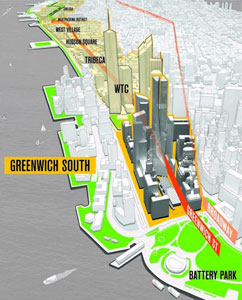
The 41-acre swath of land south of the World Trade Center between Broadway and West Street has been the victim of a “300-year cycle of alienation,” according to Elizabeth Berger, president of the Alliance for Downtown New York. Since the 1960s, many entities, including the NYC Department of City Planning, the Lower Manhattan Development Corporation, and New York New Visions, have completed studies attempting to tie this area into the fabric of lower Manhattan. Now, the Downtown Alliance has assembled a “dream-team” of 10 designers to contribute their visions for “Greenwich South,” including: Architecture Research Office (ARO); Beyer Blinder Belle Architects & Planners; Coen + Partners; DeWitt Godfrey; Iwamoto Scott Architecture; Jorge Colombo; Morphosis; Lewis.Tsurumaki.Lewis (LTL); Open; Raphael Lozano-Hemmer; Transsolar Climate Engineering; and WORKac.

The Downtown Alliance developed a five-pronged approach to create a vision — rather than a comprehensive plan — for future development. The goals are to encourage mixed-use development, reconnect the city to Greenwich Street, create an east/west corridor, build density designed for people to inhabit the space, and ultimately design a reason for people to both visit and stay.

Downtown Manhattan is home to more than half of the one-time tallest buildings in the world. When it was built, the World Trade Center officially severed Greenwich Street. “It would seem the west side of lower Manhattan was doomed from the beginning of settlement,” said Stephen Cassell, AIA, principal of ARO, a firm engaged by the Downtown Alliance. The Brooklyn-Battery Tunnel holds more than 3 million square feet of transferable air development rights in the area. Utilizing this space, ARO proposed a public market, park, plaza, and recycling center over the tunnel approach. Paul Lewis, AIA, a principle of LTL and resident of Greenwich South, envisioned a “bicycle epicenter” with bike storage and rentals and shower facilities. Along with Transsolar Climate Engineering, LTL also conceptualized the space above the tunnel entrance as a translucent structure, or a “vertical park,” with an ecological center to produce food, decompose waste, and harvest water. Called a “green sponge,” the facility would cleanse the tunnel’s exhaust air.

Neil Kittredge, AIA, partner at Beyer Blinder Belle Architects & Planners, claimed that Greenwich Street is the only other iconic connecting street in Manhattan besides Broadway. To maximize its connection to Greenwich Village, the Meatpacking District, and the High Line, he proposed sustainable public transit systems, such as light rail, to carry passengers among these destinations.

The Downtown Alliance has assembled these proposals into a document titled “What If.” As Berger pointed out, its “great work, great process, so what?” There are many roadblocks in the path of progress, such as capturing air rights over the tunnel and interfacing with the MTA, police department, and other stakeholders, not to mention working with property owners to open ground floors of buildings into public connectors. Incentives from city government could prove a potential catalyst, they agreed.

Until these larger issues can be resolved, small efforts are already underway. Artist Rafael Lozano-Hemmer designed a public art installation. Open developed a way-finding and place-marker system. And Coen + Partners created a green gateway. For renderings and more information on the proposals for Greenwich South, visit the Downtown Alliance website.

The Environment Inspires Sacred Spaces

Event: God Comes to Earth: Designing Sacred Spaces for Environmentally Sensitive Times
Location: Center for Architecture, 10.26.09
Speakers: Michael J. Crosbie, Ph.D., AIA — Editor, Faith & Form; Rabbi Lea Cohen — Congregation B’Nai Chaim, Georgetown, CT; Alexander Gorlin, FAIA — Principal, Alexander Gorlin Architects; Victoria Meyers, AIA — Founding Partner, hanrahanMeyers architects; Henry Stolzman, FAIA — Partner, PKSB Architects
Organizer: PKSB Architects

StGabriels-Infinity

St. Gabriel’s Church by Larkin Architects (left); Infinity Church by hanrahanMeyers architects.

Larkin Architects (left); hanrahanMeyers architects (right

If you visit Congregation Rodeph Shalom on the Upper West Side, or any synagogue designed by Henry Stolzman, FAIA, of PKSB Architects, look for the memorial wall. Instead of illuminating the names of the deceased, you’ll see small stones. This not only replicates the Jewish custom of leaving a stone on a headstone to mark a visit to the gravesite, but it also brings nature into a house of worship. In his current project, Temple B’nai Chaim in Fairfield, CT, that tradition will be repeated. Clad in stone and glass, floor-to-ceiling windows in the sanctuary will also open to the wetlands beyond.

Sacred spaces were originally built like fortresses — places to escape from this world. They were soaring spaces with light pouring in from above. Today, the trend with sacred spaces is similar to that of other public and private places — to be socially responsible and sensitive to the environment. Michael J. Crosbie, Ph.D., AIA, editor of Faith & Form, cited St. Gabriel’s Church in Toronto, designed by Larkin Architects and completed in 2006, as a space that is intended to create a sense of the greater context of creation for worshippers. The church has a wall of greenery, it collects rainwater, the pews are made from recycled wood, and unadorned concrete serves as a canvas for colored skylights that illustrate the earth moving around the sun.

The Kabbalah and the notion of the tzimtzum, which in Hebrew means contraction, inspired Alexander Gorlin Architects’ design of the North Shore Synagogue in Kings Point, NY. According to Kabbalah teachings, God began the process of creation by contracting his infinite light, forming an empty space in which creation could begin. Natural light is used in the building’s design as a way to sculpt the space of the sanctuary.

Victoria Meyers, AIA, founding partner of hanrahanMeyers architects, was specifically commissioned by the 10th Church of Christ Scientist to create the Infinity Church in Greenwich Village because they appreciated the way her firm works with light. The chapel, currently under construction, features a cubic sanctuary “deformed” by light. The sacred geometries of squares, golden section rectangles, and “spheres of light” will surround worshippers. Three curving walls — from the south, north, and east — evoke the shape of a “Klein bottle” or Möbius strip, simple figures that suggest infinity with no beginning or end.

Puerto Rican Architecture Ripens

Event: PUERTO RICO NOW: Recent Architecture and History
Location: Center for Architecture, 10.29.09
Speakers: Segundo Cardona, FAIA — Partner, Sierra Cardona Ferrer; Luis Flores, FAIA — Owner, Luis Flores Arquitectos; Jorge Rigau, FAIA — Principal, Rigau Arquitectos
Moderator: Warren James — Principal, Warren A. James Architects + Planners
Organizers: AIANY Global Dialogues Committee
Sponsors: AECOM; Turner International; AIA Puerto Rico Chapter; Landair; Rums of Puerto Rico

Condado_300

City Skyline, San Juan, PR.

Courtery: WAJAP New York, 2009

Architecture in Puerto Rico has come a long way in a short time. “When I started in 1966, there were barely 150 architects in a population of 2.6 million people,” stated Segundo Cardona, FAIA, of Sierra Cardona Ferrer Arquitectos. “Now there are 1,350 architects and 4 million people. The number of architects in the population has multiplied by six.” Cardona was one of three architects in New York to describe their body of work on the island.

Cardona speaks of his work in reference to the roots of Puerto Rican architecture. The island’s architects take inspiration from construction limitations and from the pervasive nature of the tropical climate. For his visitor center in the Yunque Forest, the building was created simply from timber and concrete and is in the shape of a cruciform. “I wanted to integrate the medium with the message,” he said. “The cruciform expresses a sense of reverence towards nature.” Cardona purposefully left a hole in the middle of the roof so that people would get wet when it rains. “You can’t ignore the climate, so why not pay homage to it.”

Luis Flores, FAIA, of Louis Flores Arquitectos, described how architects in Puerto Rico had established their own identities since the island’s architecture schools opened in the late 1960s. At first, architects were educated to build in a North American style rather than using the traditions of Spanish and Caribbean architecture. “Since then there has been an extraordinary revolution in terms of our awareness and our search for identity,” he said. Flores presented Balneario El Tuque, a pool complex made from concrete blocks and timber pergolas. “What architects in Puerto Rico learned was that you can use the tropicality and the breezes and the sun to their advantage. A minimalist architecture in this climate suggests space.”

Jorge Rigau, FAIA, of Rigau Arquitectos, was the youngest of the speakers, and his take on Puerto Rican architecture was less about handcraft than about style. He explained that he was influenced not only by traditional Spanish architecture, but also by late 20th-century tectonics. A career immersed in architectural education also contributed to his urban thinking, he claimed. This was best represented in a project in Isabela that re-imagined 35 kilometers of irrigation channels as landscaped nature trails for tourists and school groups on the island. “Design is not necessarily just about buildings, but also about making something happen,” he said.

The post-talk discussion centred mainly on sustainability, and how Puerto Rico is reacting to the climate change agenda. Cardona said that the primacy of the tropical climate meant that all Puerto Rican architects had to think about sustainability, but added that the stipulations of LEED ratings would not work in his country. Rigau explained that there was more skepticism about green architecture on the island. “In Puerto Rico, there is a saying that when things are green, we have to wait for them to ripen,” he said. An audience member asked if air-conditioning is the largest obstacle to lowering energy use. Cardona responded that air-conditioning is not needed. “We have a blessing — our climate,” added Flores. “We have another blessing,” cut in Rigau. “We can’t afford it.”

Barcelona Opens Book to Cultural Landscapes

Event: A City of One’s Own: Architecture and Urbanism as Cultural Heritage in Barcelona
Location: Center for Architecture, 11.02.09
Speakers: Eulàlia Bosch — Curator & Program Designer, Education and the Arts
Organizer: AIANY; The Catalan Center at New York University, an affiliate of the Institut Ramon Llull

Barcelona

Image from www.lapedreraeducacio.org, a website dedicated to Antoni Gaudí’s Casa Milà.

Courtesy www.lapedreraeducacio.org

With an ardent aptitude for educational outreach, Eulàlia Bosch has centered her career as philosopher, curator, writer, and web designer on the integration of didactics in contemporary art, digital media, and urban studies. Comparing the process of education to bovine rumination, Bosch believes the collection of knowledge in the cultural “fields” of a city is best reflected upon in schools, equated with “barns,” and then transformed into academic nourishment through dialogue. Bosch’s work seeks to reinvent the traditional learning environment and blurs the boundaries of education, infusing urban life with the public exchange of information.

In collaboration with Ramon Espelt, Bosch is responsible for educational websites that look at cultural centers in Barcelona under multiple lenses. A website dedicated to Antoni Gaudí’s Casa Milà, www.lapedreraeducacio.org, explores the building from every angle, providing literary, film, and graphic references; perspectives of artists, inhabitants, and neighbors on the space; as well as history, architectural details, and visual metaphors. Most importantly, the website serves as an interactive platform to contribute, collect, and reflect on information. A multi-faceted resource unique to other institutional websites, the educational component of Bosch and Espelt’s creation is limitless and self-renewing.

According to Bosch, a city becomes a city of one’s own when it is recognizable in its details. Through her work, Bosch is achieving this for future generations by creating cultural grazing lands, both digital and physical, that embody Barcelona and open new public perspectives on its cultural landscape.

Shape-Shifting Buildings to the Rescue

Event: Adaptive Building Initiative
Location: The Cooper Union, 10.28.09
Speakers: Chuck Hoberman — Hoberman Associates & Adaptive Building Initiative; Craig Schwitter, PE — Buro Happold Consulting Engineers & Adaptive Building Initiative
Organizers: The Architectural League of New York

ACM-sequence_FINAL

Adaptive Building Initiative designed an automated shading system, shown in open and closed positions, for Foster + Partners’ Aldar Central Market in Abu Dhabi.

Foster + Partners

When energy (in the form of light and heat) enters and exits a building in an uncontrolled fashion, unwelcome fluctuations in the internal environment result: spaces become too hot or cold, too bright or dark. Typically, fossil fuel-guzzling mechanical systems are used to counter these effects, making the building sector as a whole one of America’s biggest energy drains. However, if a building’s outer envelope could prevent unwanted energy transfers from occurring in the first place, mechanical workarounds would be unnecessary and energy consumption would drop dramatically.

This is the challenge that the Adaptive Building Initiative (ABI), a joint venture established in 2008 by Buro Happold and Hoberman Associates, has set for itself. As its name indicates, the firm designs building envelopes that can respond intelligently to environmental cues by changing shape or size. Projects include several shading systems for Foster + Partners projects, each consisting of a series of geometrical panels programmed to adjust for the amount of sunlight as needed.

ABI principals Chuck Hoberman and Craig Schwitter, PE, view their firms as part of an emerging movement that will fundamentally change building design as environmental concerns grow. “It’s a space that’s very undefined, I think: this concept of how energy can affect architecture,” said Schwitter. “The parameters are changing under our feet.”

Down the Arthur Kill

ArthurKill

(L-R): 5414 Arthur Kill Road, Tottenville; Charles Kreischer House; St. Peter’s Lutheran Evangelical Church; Manee-Seguine Homestead.

Fran Leadon

I made nine trips to Staten Island last summer, visiting hundreds of buildings and parks for inclusion in the upcoming fifth edition of the AIA Guide to New York City (Oxford University Press, 2010). One trip was by ferry (free); the other eight were by car (Verrazano-Narrows Bridge tolls: $88). Staten Island had been a mystery to me before my recent forays. Now I have a better sense of its geography (twice the size of Manhattan), its architecture, and its history.

One unique feature of Staten Island is the undercurrent of rural life peaking through more recent development. If you look hard enough, there are fragments everywhere of an agrarian and seafaring life that now seems distant in the city’s collective memory. But change came relatively recently, its remaining farms and open tracts of land mostly plowed under by the wave of suburban development that followed construction of the Narrows Bridge in 1964. While there are still stretches of virtual wilderness on the island, especially along its southern shore, many historic settlements such as Sandy Ground and Princes Bay have been virtually obliterated over the last 30 years by banal tracts of cookie-cutter housing.

A drive down the old Arthur Kill Road is instructive but disorienting, its hairpin turns unnerving. Twisting and narrow, the road was clearly built for the occasional horse and carriage, not for today’s rush hour SUVs. The Arthur Kill winds its way from the geographical center of the island at Historic Richmond Town past 17th-, 18th-, and 19th-century graveyards and roadside taverns in Rossville and Charleston to the remnants of a former factory town called Kreischerville, where some amazing architecture awaits: the Charles Kreischer House, a turreted Stick Style extravaganza (1888), the trim, wood-framed St. Peter’s Lutheran Evangelical Church (1883), and Kreischer’s spare, functional worker’s housing (1890) — all landmarks in a veritable ghost town overtaken by woods populated by deer and feral cats.

The Arthur Kill ends in the far southern corner of the island at Tottenville, a village seemingly suspended in time. Along Main Street are all the sights one would expect to find in small-town America, including a Masonic Lodge and abandoned movie theater, an impressive collection of intact Queen Anne, Stick Style, and Italianate houses, and even one stunning but out-of-place Modernist specimen, the Dr. Henry Litvak House by architect Eugene G. Megnin (1949).

Landmarks on Staten Island are generally not treated very well. One would think that the Manee-Seguine Homestead (1690), an important example of 17th-century roadside architecture (it once functioned as an inn) would be beautifully restored and open to public tours. Instead, it is a ruin, concealed from view in a thicket, slowly decaying and returning to the earth. Historic Richmond Town is a vital collection of 17th-, 18th-, and 19th-century landmarks (houses, sheds, stores, outhouses, a railroad depot) originally located elsewhere on the island, now protected from demolition or gradual disintegration. Historic Richmondtown feels like a kind of intensive care unit for neglected buildings; an architectural hospital of sorts, where old Federalist and Queen Anne gems are rescued and brought back from the brink.

With LEED Becoming Even More Complicated, Is it Still Worth the Effort?

On 11.01, the Green Building Certification Institute (GBCI) launched its Credentialing Maintenance Program (CMP) for all LEED Accredited Professionals. As a LEED AP who wants to stay active, I signed on to the agreement that I will complete 30 continuing education hours biennially and pay the $50 maintenance fee. Since I attend events regularly at the Center for Architecture, which is now incorporating Sustainable Design credits for CEUs, I thought it would not be too difficult to maintain 15 CEs per year to continue my LEED accreditation.

Once I logged on to the CMP Report Summary page, however, I realized that the system is much more complicated than I thought. Not only do I have to complete 30 hours overall, I have to complete a minimum amount of hours related to each section of LEED: four CEs for Project Site Factors; three for Water Management; six for Project Systems and Energy Impacts; three for Acquisition, Installation, and Management of Project Materials; five for Improvement to the Indoor Environment; two for Stakeholder Involvement in Innovation; and one for Project Surrounding and Public Outreach. In addition, six of the 30 hours must go toward LEED-specific training. To enter my CE hours I had to submit the date, subcategory, the type of event, a brief description, details about the event hosts, and information about the speakers, along with the number of CE hours I am reporting. After all of this, which I did a week ago, I am still waiting for approval from GBCI.

In the end, not only is self reporting tedious, but it is also unclear whether AIA SD CEUs will count toward LEED CE’s. The only listed approved provider is the U.S. Green Building Council (USGBC), and it seems from the website as if there is an organization — called Education Reviewing Bodies, or ERBs — that makes the decision whether or not a credit is LEED-worthy. For architects who have to complete 18 CEUs per year of AIA credits, how are they supposed to complete 15 CEs in addition that are solely generated by USGBC programming?

I am an advocate for sustainable design, and I was a proponent for LEED when it first launched. What I do not understand, however, is why organizations that provide continuing education for architects and engineers are not collaborating with the GBCI to develop the standards and provide sufficient training. At a time when sustainability is being integrated more into the practice of architecture, many believe that LEED will eventually become obsolete. In my opinion, the GBCI certainly is speeding up this process.