Sadik-Khan Unveils NYC Model for Transport Reform

Event: Sustainable Streets: Highlights from the Strategic Plan for the New York City Department of Transportation 2008 and Beyond
Location: Municipal Art Society, 04.28.08
Speakers: Janette Sadik-Khan — Commissioner, New York City Department of Transportation; Edward Skyler — Deputy Mayor for Operations, Office of the Mayor (introduction)
Organizers: Municipal Art Society of New York

In the wake of the state legislature’s refusal to bring Mayor Bloomberg’s congestion pricing proposal to a vote in time to secure federal funds, the mood at the launch of the Department of Transportation’s (DoT) new strategic plan might have been subdued. However, Commissioner Janette Sadik-Khan energized the crowd by promoting local independence in transit policy. The congestion pricing program would have adapted a “London model,” Sadik-Khan noted, and debate has also drawn attention to ideas from other international cities, but she favors a “New York City model” building on local strengths like mass transit, pedestrianism, and democratic procedure.

Described by Deputy Mayor of Operations Edward Skyler as a “transportation visionary,” Sadik-Khan introduced the plan as a way to “treat streets as valuable public places rather than utilitarian corridors.” Citing safety statistics including last year’s lowest number of traffic fatalities since annual recordkeeping began in 1910, she outlined further traffic-calming measures focusing on schoolchildren, seniors, infrastructure inspections, and public education. The goal is to cut fatalities in half by 2030, which would win NYC the title of “safest city in the world” given PlaNYC’s projected population growth to nine million.

A Bus Rapid Transit (BRT) project on Fordham Road in the Bronx is the first segment of a plan to add new BRT lines and incorporate BRT-like features such as dedicated bus lanes into the existing system. Bicycle infrastructure expansion will extend some of the innovations tested in Chelsea’s Ninth Avenue cycling zone, aiming to double citywide bike commuting by 2015. New parking policies will strive to raise curbside vacancy rates and reduce space-hunting time. Selected sites such as the three-way intersection of Broadway, Fifth Avenue, and 23rd Street will see low-performing square footage reclaimed as destination plazas — in Sadik-Khan’s phrasing, “putting… the ‘square’ back into Madison Square.”

Like other PlaNYC green initiatives, the full Sustainable Streets publication is thorough and detailed, presenting the potential of public-sector activism. Instead of a single attention-getting plan like congestion pricing, Sustainable Streets offers a broad range of nuts-and-bolts reforms that may ultimately be more effective at restoring civility to vehicle-ravaged civic space. (The talk wasn’t just for the anti-auto faction, though: Sadik-Khan also hailed DoT’s road-resurfacing operation, a division that saves the annual equivalent of nearly a million barrels of oil by recycling used asphalt.)

Both Sadik-Khan and Skyler expressed long-range optimism about congestion pricing as an idea whose time has come: “We do believe that ideas, just like cities, can be sustainable,” Skyler said, “and that there’s going to be a coalition built around that.” The near miss may have galvanized a community’s resolve to take back the quality of its street life. Long timetables, though, put the enthusiasm of Sadik-Khan and her team to serious tests: how much of the DoT program can be realized during this administration’s remaining months, and how much of it will be upheld by its successor?


Mayors from Across Globe Talk Up Sustainable Globalization

Event: Forum on Sustainable Urbanization in the Information Age
Location: United Nations Headquarters, 04.23-04.24.08
Speakers: For a full list of Chairs, Panelists & Respondents click here.
Moderators: Rick Bell, FAIA — Executive Director, AIANY; Professor Urs Gauchat — Dean, New Jersey School of Architecture; Lance Jay Brown, FAIA, FIUD — ACSA Distinguished Professor, City College of New York School of Architecture, Urban Design and Landscape Architecture
Organizers: UN-Habitat; UN-Global Alliance for ICT and Development; Regional Planning Association; AIA New York Chapter
Partners: The City of New York; The Institute for International Urban Development; The City College of New York School of Architecture, Urban Design and Landscape Architecture; New Jersey School of Architecture; IT4ALL; United Cities and Local Governments; ISOCARP; New York New Visions; World Architecture Community

Topics ranging from planning for smart growth to sustainable urbanization in the information age occupied the Forum on Sustainable Urbanization in the Information Age for two days. It included sessions linking cities from countries including: Brazil, Columbia, Madagascar, Senegal, Singapore, Spain, Switzerland, Tanzania, Turkey, Tunisia, and USA. At the end, all urged greater concern for Least Developed Countries (LDC), urban dwellers and population growth, and rural/urban linkage. In addition, the problems of limited budgets for basic social needs must be addressed.

Throughout the forum, many championed using the Internet to connect nations, not just to distribute information. An online blog was set up through the UN Global Alliance for ICT and Development (UN-GAID) website for attendees to report on issues throughout the conference. It also serves as spur to a potential follow-up event or annual summit.

Below are key quotes by participants:

“The role of the mega-region seems to be the vehicle that will connect the local to the global.”
– Lance Jay Brown, FAIA, FIUD, ACSA Distinguished Professor, The City College of New York School of Architecture, Urban Design and Landscape Architecture

“The mayors and responsible executives from different cities have to [deal] with similar issues, but the contexts and the economic, environmental, social situations in those cities are hugely different. Therefore, the differences translate to politics and political agendas. I think we have to be aware that this is the case.”
– Ambassador Peter Maurer, Permanent Representative of Switzerland to the Untied Nations

“Whether there are enough resources to do everything we need in the future, I think the issues discussed show that there is a commonality and a vision plan…. We can truly learn from each other.”
– James McCullar, FAIA, 2008 AIANY President

Architecture for Humanity Serves Homeless in Morningside Heights

Project: Medical Area Renovation, Morningside Heights, NY
Designer: Architecture for Humanity NY
Client: Care for the Homeless
Volunteers: Shelby Doyle, LEED AP; Deborah Buelow, LEED AP; Pollyanna Rhee
Sponsors: Häfele; 3form; Elkay Companies; Evans + Paul; AFM Safecoat; Gateway Plumbing and Heating; Bettencourt Green Building Supplies; Aura Lighting

The renovated space for Care for the Homeless.

Shelby Doyle for AFHny

When Care for the Homeless (CFH), a non-profit that provides medical services to at-risk populations, received a grant in 2007 from the Health Resources and Services Administration of the U.S. Department of Health and Human Services, funding did not cover the entire cost of much-needed renovations. Located in the basement of Broadway Presbyterian Church in Morningside Heights, CFH takes up 500 square feet in a space it shares with multiple homeless outreach services, including a soup kitchen and shelter operated by Broadway Community Incorporated. Providing new designs and renovations for CFH, the NY Chapter of Architecture for Humanity (AFHny), with NY-based contracting firm GO Construction Corporation, were able to maximize the budget and pursue donations and price reductions needed to start construction.

In addition to crammed quarters, CFH had long been operating in sub-par conditions — the medical and counseling team, provided by The Institute for Family Health, did not have private space to advise clients or even easy access to a sink. AFHny’s design concept applied architectural strategies to help make health care available and accessible. The renovation includes: a new exam room, triage space, two counseling rooms, two offices, reception, copy center, and storage. Translucent sliding doors tuck into pockets to maximize the limited space, built-in desks are topped with Corian for durability, and new lighting brightens the renovation. A refinished floor and steel plates cover what was once an open plumbing trough. Since the space is occupied 24 hours a day, it was important to use non-VOC paint and formaldehyde-free insulation, as neither product off gasses toxic volatile organic compounds.

While the project is too small to consider LEED certification, AFHny took into account cultural, economic, and ecologic factors, supporting its mission to sustainably provide architectural solutions to communities in need. Volunteers fostered new relationships between the non-profit clients and local building community, and the resulting renovation will hopefully prove that even when resources are scarce, sustainable and collaborative design can make a difference.

Changes Brew for IDP

Event: 2008 National Conference for the Intern Development Program (IDP)
Location: Albuquerque, NM, 04.11-12.08
Speakers: For a full list of speakers and presentations, go to the conference website
Organizer: AIA Emerging Professionals Committee

This year’s IDP conference introduced many changes to the process that may cause ripple effects throughout the profession. The Intern Development Program, hosted by the National Council of Architectural Registration Boards (NCARB), has been around for some 33 years, not long when compared to the 150-year-old AIA.

One major change to IDP involves the time period that interns have to report their Training Units. If approved during NCARB’s June 2008 Annual Meeting, Resolution 2008-G will require interns establishing a new IDP record on or after July 1, 2009, to report their Training Units in periods of no longer than six months. Beginning July 1, 2010, all interns enrolled in IDP will need to report their hours every six months. Upon implementation, retroactive reporting will become a thing of the past. This new policy is being introduced in conjunction with NCARB’s new online IDP reporting system, which itself is expected to be complete before July 1, 2009.

In addition to IDP reports, the New York State architectural licensure process will soon allow interns enrolled in IDP to concurrently take the Architectural Registration Exam (ARE). Other states have already adopted this practice, and upon approval by the New York State Board of Regents this fall or winter, candidates will be able to take the ARE at the same time they are completing their hours for IDP.

As more firms embrace IDP, AIA and NCARB have introduced two award programs: the IDP Firm Award and IDP Outstanding Firm Award. Recognizing firms that demonstrate exemplary efforts to support interns, the AIA hopes these awards will become a catalyst for IDP awareness. This year’s recipients of IDP Firm Awards include: BRR Architecture (Merriam, KS), Centerbrook Architects and Planners (Centerbrook, CT); Hendon + Huckestein Architects (Birmingham, AL); James Hundt Architecture (Clifton Park, NY); KTGY Group (Irvine, CA); Scott&Goble Architects (Tulsa, OK); Seay Seay, & Litchfield (Montgomery, AL); and Williams Blackstock Architects (Birmingham, AL). No NYC-based firms were given awards this year. The IDP Outstanding Firm Awards Program is still accepting submissions. The Summer 2008 cutoff deadline is July 15. Click here for more information.

No. 7 Digs Deeper, Worms its Way to Times Square

Event: Project Team Collaborations: No. 7 Subway Extension; part 3 of Architects in Training 2008
Location: Dattner Architects, 04.30.08
Speakers: Judith Kunoff, AIA, LEED AP — Chief Architect, MTA New York City Transit (NYCT) (CCM); Kieran Spillane, PE — Senior Supervising Engineer, Certified Project Manager — Parsons Brinckerhoff (prime consultant to NYCT); Beth Greenberg, AIA — Principal, Dattner Architects (architect, consultant to Parsons Brinckerhoff)
Organizer: AIANY Emerging NY Architects (ENYA) Committee

No. 7 Subway extension

The proposed 34th Street entrance of the No. 7 Subway extension.

Dattner Architects/PB Americas

As mega projects are being planned and constructed internationally, NYC has its own mega project burrowing beneath its surface. Dattner Architects, as consultants to PE Parsons Brinckerhoff and MTA New York City Transit (NYCT), has been developing the No. 7 Subway extension since 2003. With ground broken at 27th Street, large drills will soon be inching their way to Times Square.

The $2.1 billion project will add two new transit stations, five power plants, ventilation buildings, and two miles of new train tunnels to the city’s infrastructure. The team believes it is a vital intervention to the city’s rezoning and redevelopment plans. Indications of its potential impact are taking shape as many developments are springing up along the Far West Side.

Unlike most development projects, the entire team is located in one office; architects, engineers, consultants, and even client representatives — collectively more than 80 professionals — work within a few feet of each other. This facilitates the process, allowing for multiple parts of the project to move forward simultaneously. For example, in 2002, the Environmental Impact Study (EIS) and conceptual design were developed concurrently.

In planning the extension, the team was faced with challenges that addressed not only surface interactions, but also below-ground obstacles, such as the multiple Hudson River crossings and West Side transit corridors (Amtrak, NJ Transit, and two Lincoln Tunnel tubes). The deepest tunnels in NYC will make up the No. 7 Subway extension.

Circulation studies, or “frustration level diagrams” as stated in the PowerPoint presentation, analyzed how to move thousands of riders through the stations most efficiently. Once in the tunnels, riders will be greeted with state-of-the-art metallic finishes and creative lighting. Walls will be covered with murals integrated with directional signage. Taking cue from many European stations, access-ways will also feature diagonally moving elevators — a first in NYC, and multiple escalators will add to fluidity of movement.

The stations above ground will consist of metal-and-glass canopied entries surrounded by park spaces and pedestrian-friendly plazas. The ventilation and power stations will incorporate metallic façades. These elements are still being designed.

Overall, the presentation emphasized the team effort required to develop the No. 7 Subway extension. The proposal attempts to create solutions for a better living standard in the city.

Connecting Urban Isolation

Event: This Will Kill That? A reading forum with Alex Kotlowitz
Location: Center for Architecture, 05.07.08
Speaker: Alex Kotlowitz — Author, There are no Children Here: The Story of Two Boys Growing Up in The Other America (Anchor Books)
Organizers: AIANY Emerging NY Architects (ENYA) Committee

When Alex Kotlowitz, author of There are no Children Here; The Story of Two Boys Growing Up in The Other America, first visited Chicago’s Horner Homes to write about the lives of the Rivers family, he expected to find a strong sense of community. Instead, he found “a community that had begun to unravel.” Lafayette, the older Rivers boy, explained to Kotlowitz that he has only “associates,” not friends. Having studied the problems of public housing in urban America, Kotlowitz believes that while architecture may have contributed, the real core of the problem is a mix of politics, race, drugs, violence, and a scarcity of work — “the thread that holds the social fabric together.”

While architecture may not be the primary problem or solution, Kotlowitz thinks super-block planning and the lack of public streets enables gangs to control neighborhoods relatively surveillance-free. In recent years, Chicago has razed several super-blocks aiming to decentralize public housing. Old towers will be transformed into low-rise mixed-income housing. Despite these efforts, however, many of the former residents have simply moved to similarly troubled communities. “The stubborn persistence of violence” among the poorest cities has not abated, argues Kotlowitz.

One of the greatest challenges in addressing safety problems is to overcome the profound “physical and spiritual isolation” that Kotlowitz sees defining communities such as Horner. By improving access to educational and cultural institutions, as well as improving the quality of public architecture in poorer neighborhoods, cities can encourage re-integration. Ultimately, however, Kotlowitz believes that to create change, people must tell their stories making them known outside of their communities.

Mario Botta and the Architecture of Wellness

Event: Mario Botta — Recent Projects
Location: Steelcase, 04.28.08
Speaker: Mario Botta — Principal, Mario Botta Architetto
Organizer: School of Architecture and Design at New York Institute of Technology
Sponsors: Consulate General of Switzerland; AIANY

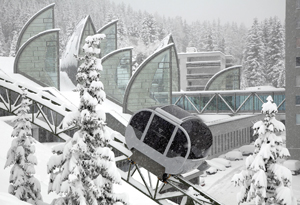
The Wellness Centre — Berg Oase by Mario Botta incorporates leaf-life skylights that blend with the landscape.

Urs Homberger

Swiss-born architect Mario Botta is best known for his rigorous use of symmetrical massing, pure geometric forms, and the mystery he evokes by using masonry as his primary medium.

For Botta, architecture is an expression of its locale, through ideas, aesthetics, history, and tectonics. In the Nuova Sede della Banca Nazionale (the new site for the national bank) in Athens, Greece (1998-2001), local limestone is the main construction material. A nearby archeological site influenced the decision to create a grand entry with direct views and public access to the excavation, referencing the city’s history yet re-framing it in contemporary space.

“Architecture is not born through program, but through a specific situation of space,” according to Botta. In the Biblioteca Municipale in Dortmund, Germany (1995-2000), he conceived the building as two contrasting joint volumes made from different materials and geometric forms. A transparent and open semi-circular glass structure faces the main street and a new part of town, while an opaque, rectangular stone form faces the old neighborhoods. Botta sited the latter to act as a fort protecting the old town from new development.

Botta believes in the healing power of architecture and landscape. For the Wellness Centre — Berg Oase (2003-2006), commissioned by the Grand Hotel Tschuggen, in Arosa, Switzerland, all of the program is buried underground in response to the “extraordinary geographic configuration of natural bowls surrounded by mountains.” The only visible element is a series of vertical, “leaf-like” skylights that breach the tree line acting as light wells and providing views of the surrounding terrain.

“The technical aspect of architecture is just the beginning. The choice of form and material in relation to a specific situation is imperative to transmit strong emotions and give the architecture a meaning beyond programmatic requirements,” Botta said. Architecture “builds a roof for humanity.”

Government Oops

On May 6, the Governmental Operations Committee of the New York City Council tacitly agreed with the architects and engineers packing the City Hall committee hearing room that we were right — a registered architect or professional engineer should continue to head the NYC Department of Buildings. This was done not by a vote, but by avoidance of a vote, or, in fact, by lack of any visible support for Intro 755, which, if passed, would eliminate this requirement about the experiential and training requirements for the Buildings Department head. By cogent and probing questions, the Government Ops members present, including Councilmembers Joseph P. Addabbo, Inez E. Dickens, Erik Martin Dilan, Dominic M. Recchia, Jr., and Larry B. Seabrook, put the Administration’s representative, Anthony Crowell, in the position of defending the indefensible. Crowell, in essence, said that it didn’t matter whether or not a Commissioner who knew anything about buildings could head the Buildings Department so long as the nominee was a good manager and good communicator.

Other council members not on the committee holding the hearing, including Jessica Lapin, John Liu, Rosie Mendez, James Oddo, and David Yassky, sat at the hearing table to aggressively challenge Crowell’s arguments. Liu, for one, stated that the proposed legislation was “absurd” on the face of it. In times of heightened concern about building safety, the idea that the Buildings Commissioner did not need to be trained and tested on how buildings are made safe seemed wrong to all of the council members speaking — and to 100% of those members of the public who came to testify.

Many industry leaders, including Michael Macaluso, RA, President of the Architects Council of New York, and Anthony Schirripa, AIA, AIANY Vice-President for Public Outreach, were joined inside and outside the room by other chapter leaders from all five NYC borough components. The American Council of Engineering Companies New York Chapter was represented at the meeting by its national chair, John F. Hennessey, III, PE, and its local chapter head, Hannah O’Grady. A letter from Christine McEntee, Executive Vice President and Chief Executive Officer of the AIA national component was read into the record by AIANY Policy Coordinator Laura Manville.

The Chapter’s position statement also became part of the testimony and is attached to this summary. It was accompanied — think Miracle on 34th Street — by petitions signed by more than 3,000 individuals saying the same thing, “No PE’s, No Justice.” More signatures are needed. Click the link, add your name and e-mail it to the AIANY.

The fight is not over. A compromise bill, asking to temporarily put aside the needed experiential requirements, is within the realm of possibility, and could come back to the City Council’s Committee within the next two weeks. Please write or e-mail your Councilmember now, whether she or he is on the Governmental Operations Committee or not. It makes no sense for the City’s Health Commissioner to not be a doctor, whether for four years, four months, or four weeks. It makes less sense, given the professional needs for code and zoning interpretation, action, and decision-making, for the Buildings Commissioner not to be a licensed design professional. New York needs a Buildings Commissioner who knows how buildings stand up.

D.C. Takes to Street — by Bike. Why Not NYC?

Following in the footsteps of France, Spain, and Scandinavia, Washington D.C. this month launched a bike-sharing program it calls SmartBike DC. Made possible by Clear Channel Outdoor and the District Department of Transportation, 10 modular, self-service bike stations are located in the city’s central business district. After paying an annual fee of $39.99, subscribers receive a card that works like a MetroCard, and they can rent a bike for up to three hours at a time.

Since May is “Bike Month” in NYC, I have been looking at a number of proposals on the table to increase bike access in the city — from expanded cycling zones to better bridge access and increased bicycle parking. I have not come across many proposals for bike-share programs, however. Storefront for Art and Architecture hosted a temporary program last year (See “NYC Looks to Pop a Wheelie,” by Carolyn Sponza, AIA, LEED AP), which launched the New York Bike-Share Project website, but that website has not had much activity since. The only current proposal I could find is the free bike-share program planned for Governors Island, with bikes designed by the West 8/Rogers Marvel Architects/Diller, Scofidio + Renfro/Quennell Rothschild/SMWM team.

Even though many bike-share programs in other countries have failed due to vandalism and theft, I think bike sharing is a great way to ease congestion, both in subways and on the streets. It also encourages exercise and healthy lifestyles, and it can be affordable. With a reasonable annual fee, using D.C.’s example, the program becomes cheaper than taking the subway. Without having to pay for and maintain a bicycle, I can see such a program taking off in NYC. I hope D.C. will prove a successful model.

Please comment and let me know what you think about bringing bike-sharing to NYC.

In this issue:
· Whitney Heads Downtown
· Ad Agency Fosters Creativity Through Design
· A Contemporary Take on Bond Street
· LEED Gold Restoration Preserves Texas Treasure
· R&D Goes Green in China
· A New Great Wall for China


Whitney Heads Downtown

The entrance to the proposed downtown Whitney Museum of American Art designed by Renzo Piano Building Workshop.

Courtesy Whitney Museum of American Art

The Whitney Museum of American Art recently unveiled Renzo Piano Building Workshop’s design for a second 185,000-square-foot museum in the Meatpacking District. The six-story downtown museum will include 50,000 square feet of galleries, affording the Whitney to show more of its 20th- and 21st- century American art. The third-floor special exhibition gallery will be approximately 17,500 square feet, one of the largest free-span exhibition spaces in NYC.

Approximately 15,000 square feet of rooftop galleries will be situated on various levels of the building for dynamic outdoor exhibitions. The building also will contain an education facility, research library, conservation area, multi-use space for film and performing arts, 175-seat theater, study center, restaurant, café, bookstore, and a ground-floor exhibition gallery. The upper stories will spread beyond the building’s base, stretching toward the Hudson River to the west and stepping back from the elevated High Line park on the east. A cantilevered entrance along Gansevoort Street will shelter a public plaza steps away from the southern entrance to the High Line. Cooper, Robertson & Partners is collaborating on the project, slated to begin construction in Spring 2009 with an anticipated opening in late 2012.


Ad Agency Fosters Creativity Through Design

Dentsu America.

Chuck Choi

The New York office of TPG Architecture has completed the renovations to the global advertising agency Dentsu America’s NYC flagship office in Tribeca. The office, at 32 Avenue of Americas, is a landmarked 27-story art deco building designed by Voorhees, Gmelin & Walker in 1933, and built as the world headquarters for AT&T. The 40,000-square-foot office has an industrial loft-like aesthetic and features an open plan and glass-front offices. The client wanted a workspace that fosters creativity, so TPG developed solutions such as two brainstorming rooms, or think tanks, constructed on 30-inch platforms that appear to be suspended above the sunken staff area. LED lights are installed at the base of each structure to further enhance the floating effect. A raised café, compete with a 10-foot, 800-gallon Koi fish tank, offers uptown views.


A Contemporary Take on Bond Street

48 Bond Street.

Deborah Berke & Partners Architects

The Deborah Berke & Partners Architects-designed 48 Bond is about to be completed. Working with GF55 Partners acting as Executive Architect, the 11-story building in NoHo shares a cobblestone street with Herzog & deMeuron’s 40 Bond. Interpreting the neighborhood’s 19th century architecture, the building has zinc and glass at street level, segueing into a flamed charcoal grey granite and sheet glass. A contemporary take on the bay window, the building has narrow panes tilting out from the façade allowing for a play of shadows throughout the day. The building has 17 units.


LEED Gold Restoration Preserves Texas Treasure

The Nix House, before and after renovation.

Portico Residential LLC

New York-based Portico Residential, a real estate advisory and development firm, has been awarded the “Treasure of Texas” by Preservation Texas, a partner of the National Trust for Historic Preservation. The award was for its work on the Nix House, a circa 1899 Victorian mansion designed by Texas architect Atlee B. Ayers located in the heart of San Antonio’s King William Historic District.

The restoration incorporated over 20 green design principles for greater energy efficiency and minimal environmental impact, most notably solar chimneys, non-vented roof/attic, rainwater harvesting system, and an upgraded utility grid. The project is expected to be certified LEED Gold for a historic home. Portico Residential’s president, architect and attorney and AIANY member Roy R. Pachecano, AIA, spearheaded the project with his father, both of whom are San Antonio natives. The house is currently for sale.


R&D Goes Green in China

Genzyme.

RMJM Hillier

RMJM Hillier, the North American division of U.K.-based RMJM Group, has been selected as design architect and laboratory planner for a 200,000-square-foot, $90 million Beijing research and development center for Genzyme Corp., one of the world’s leading biotech companies. Located in Zhongguancun (ZGC) Life Science Park, an area dedicated to academic and government research centers as well as pharmaceutical and biotechnology companies, the new facility will be used for research and development activities.

Green features include a narrow foot print and four-story atrium to maximize natural ventilation; a living roof to reduce pollution from storm water runoff; a solar thermal system to provide a significant portion of the building’s hot water and reduce its energy consumption; low-flow fixtures; a high-performance exterior glass system to enhance natural light; and a sensored motorized blind system to control light and heat gain. The research and administrative portions of the building are connected via the atrium in which a series of horizontal bridges and staircases of varying heights and dimensions aim to promote productive and playful movement of people, light, and air.


A New Great Wall for China

GreenPix – Zero Energy Media Wall.

Simone Giostra & Partners Architects

New York-based Simone Giostra & Partners Architects has designed the GreenPix – Zero Energy Media Wall at Xicui Entertainment Complex in Beijing, near the site of the 2008 Olympics. The project applies sustainable and digital media technology to a curtain wall and features the largest color LED display in the world, composed of 2,292 color (RGB) LED’s, comparable to a 24,000-square-foot monitor screen. The technology transforms the building envelope into a self-sufficient organic system, harvesting solar energy by day and using it to illuminate the screen after dark, mirroring the day’s climatic cycle. Giostra, along with Arup, developed a new technology for laminating photovoltaic cells in a glass curtain wall and oversaw the production of the first glass solar panels by Chinese manufacturer SunTech. The wall will have its premiere performance in June showcasing videos, installations, and performances, organized by a team of independent curators, art institutions, and benefactors, lead by curator/producer Luisa Gui.