Two-Way Exchange Marks China's Rising Urban Boom

Event: New York/China Dialogues
Location: The Center for Architecture, 03.20.08
Speakers: Li Chung (Sandi) Pei, AIA — Partner, Pei Partnership Architects; James von Klemperer, FAIA — Principal, Kohn Pedersen Fox Associates; Frederick Bland, FAIA, AICP — Managing Partner, Beyer Blinder Belle Architects & Planners; Calvin Tsao, FAIA — Co-Founder, Tsao & McKown Architects
Moderator: Susan Chin, FAIA — Assistant Commissioner, Capital Projects, NYC Department of Cultural Affairs
Organizers: Center for Architecture
Sponsors: Patron: Digital Plus; Supporters: Beyer Blinder Belle Architects & Planners; EDAW; Jerome and Kenneth Lipper Foundation; Friends: Bartco Lighting; Häfele; Ibex Construction; Let There Be Neon; Tsao & McKown Architects

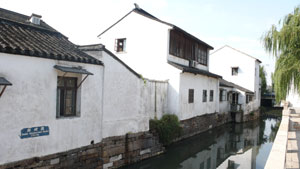
Suzhou

Vernacular architecture in Suzhou.

Annique Fung

Beyond the simple exportation of Western design, there is an opportunity for two-way exchange between China and New York. Because of China’s building boom, James von Klemperer, FAIA, a principal at Kohn Pedersen Fox Associates (KPF), sees parallels to “what happened in New York 100 years ago.” “For those of us who think we understand urbanism living in New York, going to China will teach you a lot,” stated Frederick Bland, FAIA, AICP, managing partner of Beyer Blinder Belle Architects & Planners (BBB).

With a long history working in China, Pei Partnership Architects melds geometric Modernism with spatial sequences and materials that “evoke what is familiar to the Chinese,” according to partner Li Chung (Sandi) Pei, AIA. In the Suzhou Museum, designed in conjunction with I.M. Pei Architect, for example, gray tiled roofs and white plastered walls echo similar techniques used throughout history. Similarly, KPF created a pedestrian network of through-block connections at the base of the Jingan Complex, drawing inspiration from the fine grain of Shanghai’s traditional urban blocks. Taking clues from the “ingredients” of the Bund, BBB’s Nanjing Road Urban Design Project for People’s Square in Shanghai incorporates water, open green space, and both historic and contemporary buildings to re-brand People’s Square as a “Spectacle Zone” that functions for Shanghai much like Time Square does for NYC.

Shifting focus from the specificities of design to the logistics of urban development, Calvin Tsao, FAIA, co-founder of Tsao & McKown Architects, has teamed with his developer brother and various NGOs to propose economic and community development strategies to improve living conditions in China. In Chengdu, for example, Tsao and his partners proposed land use regulations that focus development in urbanized centers and preserve open space, and specific neighborhood plans that integrate schools, hospitals, and other community services.

The future of east-west architectural exchange is developing. Pei sees an “emergence of a synergy between Western and Chinese architecture practices,” while Tsao more cautiously urges focus on the specificity of place and culture to avoid the “import and export of architecture as product.” While acknowledging “the enormity of problems” in China, Bland believes there is “potential to effect change,” and it is up to architects globally to promote preservation, “not just of buildings, but of a society and a way of life.”

Berlin, New York: A Two Cities Dialog

BDA / CFA

Deutsch Arkitektur Zentrum, Berlin (left) and Center for Architecture, NYC (right).

Courtesy Google Earth.

The final installment of Berlin-New York Dialogues took place March 3-7 in Berlin. The DAZ (Deutsch Arkitektur Zentrum, or German Architecture Center), hosted an opening party for AIANY Emerging Practices and several up-and-coming Berlin architects at the GLAZHAUS, and the Berlin-New York Dialogues: Building in Context exhibition, that recently closed at NYC’s Center for Architecture, re-opened to a VIP press party on March 7 in Berlin. I was among many Chapter members who came to both the well attended openings.

The Bund Deutscher Architekten (BDA), a professional organization similar to the AIA, played host to the weeklong event. National BDA president Michael Frielinghaus made the trip from Stuttgart to speak about the value of the exchange between the two cities. He and the many National BDA board members who came hoped for even more dialog between the BDA and AIANY.

The week featured mobile workshops in the neighborhood of Kreuzberg, illuminating common struggles of balancing reclaimed industrial waterfronts used for public access with trying to maintain a working waterfront. Planners Ronald Schiffman, FAICP, Hon. AIA (NYC) and Peter Zolinski (Germany) gathered experts to discuss the subtle variations in urban planning approaches. Kreuzberg, for example, marks a surgical, or “tweezers” approach to renewing the neighborhood. Family by family, shop owner by shop owner, changes are made to the urban fabric, succeeding where attempts with large brushstrokes have failed. Using local people as cornerstones differs from an American urban renewal approach that looks to organizations and medium to large commercial enterprises to anchor a neighborhood. The developments in Kreuzberg do not rely on attracting big box stores or developers to construct whole city blocks; rather, individuals and their families implement ideas, making many small yet effective moves.

The Akademie der Kunst on Pariser Platz hosted a “Terrain Vague” dialogue. Presentations by Claire Weisz, AIA, Charles Renfro, AIA, Susan Chin, FAIA, and Greg O’Connell were balanced by Berlin architects Louisa Hutton, RIBA, Markus Bader, Winfred Haefner, and others. Zolinsky and Schiffman closed the event summarizing not only the day, but also the entire exchange over the years.

Berlin can be seen as a “City of Voids,” seeking an identity and historical context that can be proudly expressed by the public. It relies on small entrepreneurs to renew itself in the current economy as it struggles with too few city dwellers and too much land area — half the population of NYC and twice the land area. NYC, on the other hand, constantly renews itself, cycling through economic and social changes. A robust economy and geography have pushed the Terrain Vague, or unused areas in the city, to the perimeter leaving the city center largely closed to the poor or even the middle class. Its urban renewal is often at odds with community groups, developers, and/or city planners. The struggles facing the two cities are similar and the exchange of ideas should help uncover solutions.

Having lived and worked in Berlin in the early 1990s, I saw the possibilities offered by competition proposals and visionary lectures. I lived through the euphoric reunification and its disappointing realities. Berlin is a city still struggling to find its identity as many neighborhoods are still being sewn together. Berlin is a work in progress, as is NYC. The Berlin-New York Dialogue is not just a lengthy symposium but, as Frielinghaus argued, the start of a long learning relationship.

Experiments with Donuts and Other Mood Enhancers

Event: Emerging Voices Lecture Series
Location: New Museum of Contemporary Art, 03.19.08
Speakers: Anne Rieselbach — Program Director, The Architectural League of New York (Introduction); Nat Oppenheimer — Director, The Architectural League of New York (Master of Ceremonies); Brian Johnsen, AIA, Sebastian Schmaling — Principals, Johnsen Schmaling Architects; Granger Moorhead, Robert Moorhead — Partners, Moorhead & Moorhead
Organizer: The Architectural League of New York

Parts House / Mobile Chaplet

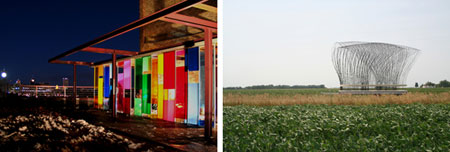
Johnsen Schmaling Architects’ Parts House Pavilion incorporates moveable panels (left). Moorhead & Moorhead’s Mobile Chaplet is a woven traveling place of worship.

Johnsen Schmaling Architects (left); Moorhead & Moorhead (right)

Moorhead & Moorhead is a multidisciplinary NY-based studio led by Granger Moorhead, an architectural designer, and brother Robert Moorhead, an industrial designer. They admire materials and craftsmanship, and described how testing the potential of weaving and folding gave birth to some wild-looking yet highly practical designs. One weaving experiment led to the carbon-fiber Filament Wound Bench, resembling a donut wrapped in a fishnet stocking. Created using a manufacturing process commonly used for large-but-light items such as aircraft fuselage, the 54-inch-diameter bench weighs a mere 17 pounds.

A week-long weaving binge with their architect father yielded the Mobile Chaplet: a traveling chapel with a curvy mesh canopy made of two layers of thermoplastic-composite rods woven together. The canopy doubles as a backrest for a built-in bench, and its porous form offers a veil of privacy that still allows views of the surrounding landscape, Granger explained.

For Johnsen Schmaling Architects, Brian Johnsen, AIA, and Sebastian Schmaling believe, “the size and budgets of the projects are so limited, we have to make sure that the structures themselves are simple, so we have a little bit of wiggle room to explore the issues that we’re interested in: skin, materiality, tectonics, and context.” Most of those issues came into play in one early, defining project, the Parts House Pavilion, completed a year after the Milwaukee-based firm formed in 2002. The pavilion features movable colored Acrylite panels that can be rearranged into various Mondrianesque configurations, forming shifting frames for the surrounding cityscape and architecture. (The cheery colors in contrast to the gray city might be termed a “Milwaukee mood enhancer,” Johnsen quipped.) The windows draw public attention, too, and the client’s penchant for rearranging them earned him a neighborhood nickname as “the South Side Picasso,” Schmaling said.

The award-winning Camouflage House in Green Lake, Wisconsin, shows a similar interest in framing and context. The building façade echoes surrounding trees with layers of thin, vertical strips of untreated cedar, Prodema panels in foliage colors, and clear glass. In a renovation of a former brewery, walls made of beer bottles provide a nod to the building’s historical ties to another of Milwaukee’s famous mood enhancers.

Mannahatta Project Surveys NYC Past in 3-D

Event: The Mannahatta Project
Location: Center for Architecture, 02.15.08
Speakers: Eric Sanderson, Ph.D. — Associate Director, Living Landscape Program; Tom Jost — Director of Planning, Arup; Glenn Phillips — Executive Director, NYC Audubon; James Karl Fischer, AIA, RIBA, Ph.D. — Co-Chair, AIANY International Committee
Moderator: Ernie Hutton, FAICP, Assoc. AIA — Co-Chair, AIANY Planning & Urban Design Committee
Organizers: AIANY Planning & Urban Design Committee

UWS 1609

The Upper West Side in 1609.

Courtesy Wildlife Conservation Society

It’s hard to imagine that 54 distinct ecosystems once existed on the island of Mannahatta — the land of many hills in the Lenape Indian dialect. Some traces of what once was has been commemorated by their names — Murray Hill and Canal Street, for example — but the marshes, beaches, and forests that once dotted the landscape are long gone and mostly forgotten. Did you know that there once was a beach on 125th Street and the Hudson River? An orchard on the Bowery? A Red Maple Swamp in Times Square?

Eric Sanderson, an ecologist with the Wildlife Conservation Society who is in charge of its “human footprint” project has been studying military maps from the American Revolution, early 19th century topographic surveys, and bird-watching and plant surveys to build a digital model of primeval Manhattan. Sanderson’s Mannahatta Project will compile the data and map the history of the island with GPS precision to show us what Manhattan looked like when Henry Hudson sailed the western shore in 1609, from the landscape to Native Americans and the wolves, mountain lion, and elk. He is planning to publish a book, website, and possibly curate an exhibition in time for the quadricentennial celebration of Hudson’s discovery. The highlight of the project will be virtual 3-D mapping of places like Times Square, complete with images from 400 years ago and projections 400 years from now. Eventually, he would like to recreate views on bus shelters or install plaques around the city pointing to landscape features that no longer exist.

Sanderson talked about a system he calls the Muir Web, named after naturalist John Muir, that shows how each species of plant, animal, and habitat forms a web of dependency. Panelist James Karl Fischer, AIA, RIBA, PhD, commented that it would be better if conservationists started with Charles Darwin and proceeded on to Muir. This “would allow one to produce better strategies to confront contemporary wildlife issues. Darwin speaks of ubiquitous impacts, not a static balance.”

Sanderson’s presentation included a split-view map of Manhattan — the left side was untouched and forested, and the right was filled with today’s skyscrapers. “The Mannahatta Project,” says Sanderson, “is not only a look into our past, but also a look forward to our future. It is the decisions we make now… that shape our planet and will endure as our legacy into the future.”

Climbing the Stairs of School Spirit

Event: City College of NY (CCNY) School of Architecture Lecture Series: Herman Hertzberger
Location: CCNY School of Architecture, 03.20.08
Speaker: Herman Hertzberger, Hon. FAIA, Hon. FRIBA, Hon. FRIAS — Founder, Architectuurstudio HH architects and urban designers (Amsterdam)
Moderator: George Ranalli — Dean, CCNY School of Architecture
Organizer: CCNY School of Architecture

Montessori College Oost

The central stairs in the Montessori College Oost in Amsterdam.

Architectuurstudio HH architects and urban designers

The creation of social space within a building drives every design for Herman Hertzberger, Hon. FAIA, Hon. FRIBA, Hon. FRIAS, founder of Architectuurstudio HH architects and urban designers in Amsterdam. This comes through especially in his school designs, which typically includes three architectural strategies: oversized stairs, split level floor plates, and the creation of an internal street or piazza.

In the Montessori College Oost in Amsterdam, a ground floor “piazza” with stairs crisscrossing overhead connects split-level classroom floors. From the stairs, students visually connect to others on floors above or below, even down to the ground floor. The stairs incorporate double-height risers to provide seating, and wood is the dominant material, as Hertzberger believes students are more likely to gather around materials that resemble desks and tabletops. In essence, the stairs are the nexus of physical interaction in the building.

Hertzberger’s use of the stair as a prominent social space was greatly influenced by a visit to Columbia University in 1967. He observed students using library stairs as a common gathering space to debate intense political issues. He relished the symbolism of students turning their back to an institution of academic knowledge, and using the building in an informal manner to better serve their needs.

The replacement of formal spaces with informal space is another layer to Hertzberger’s work. He sees buildings as mini-cities and seeks to replicate the informal characteristics of the street, rather than the formality of the square. “The square is somewhere you go — a destination that is stagnant. The street is where you move. If you pass the same person on the street a few times, perhaps you may talk to them… That is social interaction.”

Which Icon Will Win?

On March 6, an explosive device damaged the U.S. Armed Forces Recruiting Station, designed by Architecture Research Office (ARO). When completed in 1999, the modest building contradicted the oversized glitz of Times Square. The fluorescent American flag façade seemed ironic as the surrounding flashing advertising swallowed the small pavilion. After 9/11, the recruiting station took on new meaning, standing defiantly in nationalistic pride. It seemed optimistic –standing for an America that is not burdened by the capitalism constantly encouraging people to shop. Now, its damaged entrance has taken on a new aura. It represents imperfection and frailty despite the military’s promise of safety and protection.

With all of the new development in NYC, it seems as if new buildings are competing for iconic domination, not just for air space. But while symbolism is thrown around prior to much of the construction — from Libeskind’s naming of the Freedom Tower to Tishman-Speyer’s New York Steps or Ratner’s Miss Brooklyn Tower — I wonder if anyone is concerned about how those symbols will develop post-construction.

The life of the recruiting station is not yet over, and I am not one to predict how the symbolism will change in the future. The March 6 event, however, makes me concerned for the future of the city as a whole, as designers, developers, the city, and people in positions of power continue to make bold guarantees with their latest, greatest icons.

In this issue:
· Tishman-Speyer Wins Big West Side Prize
· South Bronx Bank Note Building to House Artists, Food Market
· Brooklyn Goes Residential/Commercial Green
· A Cohousing Project to Grow in Brooklyn
· Toronto Gears Up for an Alternatively Fueled Future
· New Center Simulates for Med Students


Tishman-Speyer Wins Big West Side Prize

West Side Rail Yards

The Tishman-Speyer West Side Rail Yard proposal.

Courtesy tishmanspeyer.com

Mayor Michael Bloomberg, Governor David Paterson, Metropolitan Transportation Authority (MTA) Executive Director and CEO Elliot Sander, and MTA Chairman H. Dale Hemmerdinger announced the conditional selection of Tishman Speyer to develop the air space over the two development sites that compose the MTA’s John D. Caemmerer Rail Yard — the Western Rail Yard (WRY) and the Eastern Rail Yard (ERY). The design team for the project includes Murphy/Jahn Architects, master plan architect; Cooper-Robertson, master planner; and PWP Landscape Architecture. This decision ends a six-month bid process, which originally involved five competing developers. Tishman Speyer outbid a joint venture between the Durst Organization and Vornado Realty Trust — by $112 million, offering to pay $1.004 billion for the rights to develop the 26-acre site.

The Tishman Speyer proposal would construct more than 12 million square feet of commercial, residential, retail, cultural, and community space while preserving and rehabilitating the High Line’s linear open space. The complex includes 13 acres of open public space, 3,000 residential units of which 379 units will be affordable housing, 550,000 square feet of retail space, a public school, and a 200,000-square-foot cultural venue overlooking the “Forum.” The project is pursuing LEED Gold certification. The majority of the High Line on-site will be maintained as a linear park, but the plan will demolish the spur over Tenth Avenue and part of the section along 30th Street.


South Bronx Bank Note Building to House Artists, Food Market
Bank Note Building

The Bank Note Building.

Beyer Blinder Belle Architects & Planners

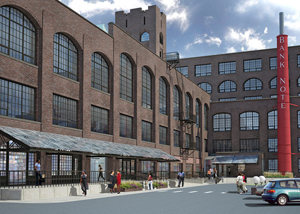
The redevelopment of the newly designated NYC landmark — the former American Bank Note Building in Hunts Point, has begun. Beyer Blinder Belle Architects & Planners is redesigning the 420,000-square-foot, circa 1911 classical revival building. Taconic Investment Partners and Denham Wolf Real Estate Services purchased the building earlier this year for $32 million hoping to attract a tenant mix including visual and performing artists, architects, film production/studios, and a food market. When the building reopens in 2011 for its centennial celebration, it will be known as The BankNote.


Brooklyn Goes Residential/Commercial Green
439 Metropolitan

439 Metropolitan Avenue.

Helder Design

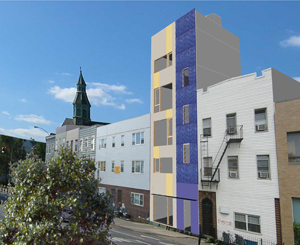
Helder Design is aiming for LEED Platinum for a residential project on Metropolitan Avenue in Williamsburg, Brooklyn. The three-unit condo building will have two duplex residential units and one commercial unit. Green features include radiant floor heating in conjunction with continuous filtered ventilation with heat recovery, which will bring air quality to near High Efficiency Particulate Air (HEPA) standards, and private photovoltaic solar panel arrays for each unit. Since the building faces south, it also uses passive solar heating. An art gallery will occupy a portion of the ground floor, and the ground floor and cellar will be Helder Design’s architecture studio.


A Cohousing Project to Grow in Brooklyn
Cohousing communities are managed by residents and combine the advantages of private homes with the benefits of more sustainable living, including shared common facilities — such as a common dining hall and kitchen, children’s spaces, outdoor areas, and tool rooms. There are more than 100 cohousing communities in North America, the largest percentage being in California and Colorado. New York State currently has two such built communities — one in Ithaca, the other in Saugerties — with several more in various stages of formation. The new Brooklyn Cohousing Group is looking for a site within walking distance of Prospect Park that they can build from scratch or renovate to accommodate 30 families who will own their private apartments. Alex Marshall, senior editor of the Regional Plan Association’s newsletter, Spotlight on the Region, and his wife, Kristi Barlow founded the group a year ago. Now incorporated, they are working with Chris Scott Hanson, who has developed cohousing communities throughout the country.


Toronto Gears Up for an Alternatively Fueled Future
West Don Lands

West Don Lands on the Toronto Waterfront.

Courtesy waterfronttoronoto.ca

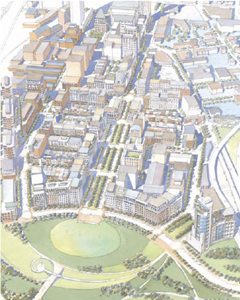
Waterfront Toronto, which oversees a 2,000-acre tract of largely publicly owned land, has selected Steven Holl Architects (SHA) to design the 3,500-square-meter District Energy Centre (DEC) in the West Don Lands, which will provide centralized heating and cooling to the first new waterfront neighborhoods of Toronto. A network of underground pipes will extend to every development parcel in the precincts, and all new buildings must rely on this system. Initially the plants will be natural gas-fired, but will be designed for conversion to alternative fuels when they become approved for urban use. Toronto-based Bortolotto Design Architect (BDA) will be collaborating with SHA. The DEC is slated to begin construction by the end of 2008 and is expected to deliver heating and cooling by the beginning of 2010.


New Center Simulates for Med Students

CELA

CELA control room.

Donald Blair & Partners Architects

The Center for Experiential Learning and Assessment (CELA), a two-floor fit-out of shell space within a larger medical research building has recently opened at Vanderbilt University Medical Center in Nashville, TN. Designed by NYC-based Donald Blair & Partners Architects, CELA is a state-of-the-art clinical educational facility designed to train medical students and medical staff with two distinct programs — the Simulation Technologies Program, and the Program in Human Simulation. In the former, robots are programmed to simulate medical conditions, and in the latter, actors are trained to “perform” as patients for students to evaluate and review.

Wired for audio and video recording and observed from control rooms, the simulation rooms are designed for flexibility and can adjust to different scenarios — operating rooms, intensive care rooms, and/or emergency room settings. A Virtual Reality Room contains procedural computer training machines. CELA’s overall design incorporates the need for a realistic healthcare environment — supported by the choice of finishes, materials, healthcare standards, and equipment — combined with a comfortable learning, conference, pre-encounter briefing and post-encounter de-briefing facility.
In this issue:
· RMJM Hillier and Harvard GSD Address Architect Shortage
· 9th Annual Save-a-Sample! Box-A-Thon
· Passing: Norbert N. Turkel, AIA
· Passing: Ralph Rapson, FAIA


RMJM Hillier and Harvard GSD Address Architect Shortage
Despite the current building boom, many recent graduates from architecture and engineering schools are choosing to pursue more lucrative careers in high-tech and management consulting, according to the Society for Marketing Professional Services (SMPS). RMJM Hillier and Harvard University Graduate School of Design announced the launch of a $2 million program to tackle a global shortage of architects.

RMJM’s $1.5 million donation, matched by another $500,000 from the Harvard GSD, establishes the “RMJM Program for Research and Education in Integrated Design Practice,” which aims to stem the “brain drain” in the design and construction industry. It is the largest cash donation received by the GSD since a donation from the Aga Khan in 1999. The program is intended to encourage more architects to enter the profession by training them to integrate business management principles and knowledge of advanced technologies with design skills, thereby improving project delivery, client satisfaction, and the bottom line.


9th Annual Save-a-Sample! Box-A-Thon
Pack up your old, discontinued fabrics, finish samples, and/or binders, and donate them to SpecSimple.com’s 9th Annual Save-a-Sample! Box-A-Thon, April 15-17. Materials will be donated to design schools around NYC. In addition to collecting literature and samples, Save-a-Sample! also raises money to fund design school scholarships. To participate in Save-a-Sample!, the organization requests that firms refer a minimum of five potential sponsors to contact on their behalf. Sponsors will be asked to pledge $25 per box. There are prizes for the top five firms to sign up sponsors. Firms’ participation will be formally recognized by the sponsors’ NY chapters: SMPS, AIA, ASID, IIDA, and USGBC.


Passing: Norbert N. Turkel, AIA
Norbert N. Turkel, AIA, passed away on March 8. Founding partner of Turkel Collaborative Architects in Manhattan, Turkel was responsible for large-scale commercial, institutional, religious, and residential architectural projects. During the 1970s, he was a leader in addressing community planning issues in Riverdale, where he lived for 40 years. Following chairmanship of the Land Use Committee, he served two terms as Chairman of Community Board 14, working to develop the concept of Natural Area Districts, initially applied to Riverdale. As architectural advisor, Community School Board 10 provided Turkel with the opportunity to influence planning for new school sitings and aesthetics. In 1961, Turkel became a faculty member of Pratt Institute School of Architecture, and taught there for more than 40 years, earning the Service Award in 1996.


Passing: Ralph Rapson, FAIA
Ralph Rapson, FAIA, one of the oldest practicing architects and dean of the University of Minnesota College of Design for 30 years, passed away March 29 at the age of 93. As principal of Ralph Rapson and Associates, his Modernist ideals spanned many sectors; projects included the original Guthrie Theater in Minneapolis, 1963. Rapson preferred to think of himself as an architect, furniture designer, educator, and artist. “The word architects is a term that may be too limiting when speaking about Ralph Rapson,” states his firm’s website.

As Rapson was planning on attending this year’s AIA Convention in Boston, colleagues are encouraging all professionals to go in his honor, to celebrate his life and commitment to the profession.

Let Your Ears & Eyes Celebrate 150 Years of the AIA

The AIA’s sesquicentennial celebrations have not ended yet! Check out the Young Architect Forum Podcast, “150at150.” 150 emerging architects are interviewing 150 AIA Fellows for intergenerational discussions. Go to the AIA PodNet website, or subscribe on iTunes.

Also on the occasion of the 150th anniversary, the AIA asked more than 70 contributors to examine the complex and evolving role of America’s architects in shaping its cities and communities. Through essays, vignettes, and profiles, Architecture: Celebrating the Past, Designing the Future, provides a look at the breadth and depth of the architecture profession. If you purchase the book before April 11, you may take advantage of the pre-publication $65.00 price. Once the book is published, the price jumps to $95.00.

The AIA New York Chapter/ Boston Society of Architects The 2008 Building Type Award winners include, in the category of Sustainable Design, Honor: 100 VE — Unilever London Headquarters, Kohn Pedersen Fox Associates; The New York Times Building, Renzo Piano Building Workshop in association with FXFOWLE Architects (Base Building Architecture) and Gensler (Interior Architecture); Inland Steel Building Restoration, Skidmore, Owings & Merrill; and The Queens Botanical Garden Visitor & Administration Center, BKSK Architects… Sustainable Design, Merit: Harvard University Library Services Building, Leers Weinzapfel Associates and Samuel Anderson Architects; Sarah Lawrence College, Monika A. and Charles A. Heimbold Jr. Visual Arts Center, Polshek Partnership Architects; and Linked Hybrid, Steven Holl Architects

In the category of Urban Design, Honor: 55 Water Street Plaza, Rogers Marvel Architects; and Hudson Square RISE, Zakrzewski + Hyde Architects… Urban Design, Merit: Long Island Rail Road East Side Access and 50th Street Ventilation Facility, DMJM HARRIS — subconsultant to the joint venture group of PB, STV, and Parsons Transportation Group; Pentagon Reservation: Perimeter Security & Pedestrian Plaza, Rogers Marvel Architects and Ritter Architects; Musiskwartier, Robert A.M. Stern Architects; and Unified New Orleans Plan (District 3 and District 4), Frederic Schwartz Architects

In the category of Educational Facility Design, Honor: Fleet Library at the Rhode Island School of Design, Office dA; Sheila C. Johnson Design Center, Lyn Rice Architects; Syracuse University, The Warehouse, Gluckman Mayner Architects; Sarah Lawrence College, Monika A. and Charles A. Heimbold Jr. Visual Arts Center, Polshek Partnership Architects; and Susan P. and Richard A. Friedman Study Center, Architecture Research Office… Educational Facility Design, Merit: Grant Recital Hall, Brian Healy Architects; New York University Department of Philosophy, Steven Holl Architects; Josai School of Management, Studio SUMO; and The New York Hall of Science Preschool Teaching Park, BKSK Architects

New York Chapter of the American Society of Landscape Architects 2007 Award winners include, in the category of Landscape Architectural Design, Honor Award: Keene State College Science Center Courtyard, Dirtworks; American Society of Landscape Architects’ Headquarters’ Green Roof, Michael Van Valkenburgh Associates; and Townhouse Garden in the West Village, Sawyer/Berson Architecture and Landscape Architect… Merit Award: Beach House, Dirtworks; Dune Side Residence and Tupelo Groves, Edmund Hollander Landscape Architect Design; and Westshore Park and Library Green, Thomas Balsley Associates

In the category of Planning, Analysis, Research, and Communication, Honor Award: Brooklyn Bridge Park 2005 Master Plan, Michael Van Valkenburgh Associates; South Waterfront Greenway Development Plan, Thomas Balsley Associates; and Bird-Safe Building Guidelines, SCAPE… Merit Award: Times Square Bowtie Streetscape Project, Starr Whitehouse Landscape Architects and Planners… In the category of Un-Built Projects, Merit Award: Reconstruction Strategies for Brownstone Brooklyn, dLandstudio; and Allegria Master Plan, EDAW…. For a complete listing of winners including project images, please click here.

Stephen Yablon Architect’s Skyfilter was awarded second place in an international competition sponsored by the Royal Institute of British Architects for the $13M corporate headquarters for a real estate development firm in northern England… The American Society of Interior Designers (ASID) has awarded Susan S. Szenasy, editor-in-chief of Metropolis magazine, its Patron’s Prize, as well as a Presidential Commendation for her advocacy of design excellence… ASID also honored James D. Lothrop, Jr., AIA, with the Fellowship Award… Terrence E. O’Neal, AIA, has been elected to a 3-year term (2008-2010) as AIA New York State New York Regional Director…

David Beer, FAIA, has joined Perkins Eastman as Principal specializing in hospitality, residential, office, and retail design; he was formerly principal and a founding partner at Brennan Beer Gorman Architects and Brennan Beer Gorman Monk Interiors… Kenneth Lill, AIA, President and Founder of KAL Architecture, has joined his practice with Mancini Duffy… Spacesmith announced that Michel Franck, AIA, has joined the firm as Managing Principal… Material ConneXion announced the promotion of Michele Caniato to President; and that it is establishing its fourth international licensee in Daegu Metropolitan City, Korea…