Holl Outlines Guidepoints to Suit His Urbanisms

Event: Urbanisms: Working with Doubt
Location: Cooper Union for the Advancement of Science and Art, 02.21.08
Speakers: Steven Holl, AIA — Principal, Steven Holl Architects, & Associate Professor of Architecture, Columbia University Graduate School of Architecture, Planning and Preservation (GSAPP); Jeffrey Kipnis — Professor, Knowlton School of Architecture, Ohio State University;
Introduction: Craig Konyk, AIA — Principal, konyk, & Adjunct Assistant Professor of Architecture, Columbia University GSAPP
Organizers: The Architectural League of New York; The Irwin S. Chanin School of Architecture of The Cooper Union

Sliced Porosity Block

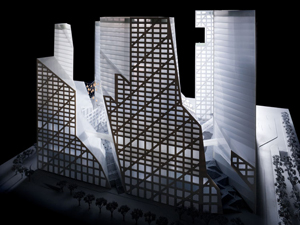
The Sliced Porosity Block represents Steven Holl’s 11 principles outlined in Urbanisms.

© Iwan Baan, courtesy Steven Holl Architects

In projects from Cambridge, MA, to China, Steven Holl, AIA, is bringing momentum to situations where few would be at ease. His first principle behind his forthcoming book Urbanisms: Working with Doubt (Princeton Architectural Press), “the geo-spatial,” explores environmental design in a context that is not just metropolitan but astronomical: he considers the 800-degree climate of Venus, which once had water before greenhouse effects made the planet inhospitable to life. Here on Earth, Holl blurs the borders between urban formations and landscapes so that “every work is an urban work.”

With the scale and the stakes thus raised, Holl proceeded through 10 more guidepoints — or Urbanisms — such as the new forms of space created by nighttime luminosity, the value of urban porosity to receive light and shadow, the downsides of ephemeral construction methods that lead to rationalized banality, the capacity for “working in the Z dimension, not just the X and Y dimensions,” and a new take on the Keatsian poetic concept of negative capability, emphasizing the importance of responding to potential uncertain occurrences (“negative capability is a modus operandi for the 21st century”).

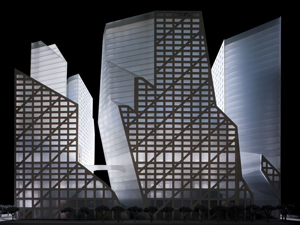
These principles are taking shape most dramatically in Holl’s projects in China. An elevated “city within the city” under construction in Beijing, the eight-tower Linked Hybrid housing complex organizes daily life around modular waffle forms, heated geothermically, and conjoined by skywalks to create “a cinematic space in the air.” Even more radical is the Sliced Porosity Block in Chengdu, a sun-sliced master plan that will incorporate pavilions by Lebbeus Woods and Ai Weiwei. The mixed-use Vanke Center in Shenzhen, is a nearly Empire State Building-sized “horizontal skyscraper” hovering on 9- to 14-meter legs to create shade and admit breezes while offering multiple perspectives on surrounding bodies of water.

Presenting the works and ideas behind Urbanisms, Holl was matter-of-fact, whether introducing abstract ideas or recalling the days when his practice occupied a small Sixth Avenue office, “where I slept on a plywood shelf over the entranceway and no one knew I lived there.” Urbanisms, the macro-scale companion to his previous volume, House: Black Swan Theory (2007), links six major projects with the 11 principles. “Today, working with doubt is unavoidable,” Holl asserted, proposing strategies that reckon with uncertain, intermittent, even ephemeral conditions as a necessary background for practice.

NYC Future Could Hold Green Space for All

Event: Public Architecture Conversation Series: NYC Department of City Planning
Location: Center for Architecture, 02.28.08
Speakers: Alexandros Washburn, AIA — Chief Urban Designer, NYC Department of City Planning & Partner/Principal, W Architecture and Landscape Architecture
Moderators: Michael Plottel, AIA, & Anna Torriani, AIA — Co-chairs, AIANY Public Architecture Committee
Organizers: AIANY Public Architecture Committee

The urban design discussion in NYC has long been dominated by two figures in the city’s history — Jane Jacobs and Robert Moses. Now, Alexandros Washburn, AIA, Chief Urban Planner at the NYC Department of City Planning, believes there is a third important individual whose vision of the city may provide insight for the future: Frederick Law Olmsted. At its core, Olmsted’s vision of a city included a common green space accessible to all citizens, providing a respite from the city’s intensity.

Washburn argues that urban design, good or bad, provides the most effective teaching tool for those who will shape our cities. Successful urban design maintains cultural diversity in gentrifying neighborhoods whose development is spurred by re-zoning projects. While his presentation emphasized pedestrian planning, the public realm, and a variety of uses, the audience pointed out a contradiction in the recent Department of City Planning’s re-zoning efforts that include the waterfront from Long Island City to Williamsburg, West Side Rail Yards, and Atlantic Yards.

Although these three projects include provisions for affordable housing and potential jobs, the scale of the developments as determined by the zoning appear to be too large for the neighborhoods in which they lie. New zoning along the water’s edge seems to create a wall between the waterfront and the community. Of particular concern were the gentrification and spate of new developments in Williamsburg and Harlem, with fears that the homogenization brought on by increasingly expensive apartments spells doom for the diverse character of these communities.

However, there are projects that respond to the community’s environment. The firm Washburn used to lead, W Architecture and Landscape Architecture, is close to completing Harlem Piers on the Hudson River, for example, that takes an ecological approach to the design of piers. Natural systems determined the piers’ forms and allow the waterfront to function in multiple ways, including water access for the neighborhood.

Perhaps NYC should demand more than a thin strip of green along the water’s edge from developers in charge of newly designated R8 lots. Re-built piers with water access, green roofs and urban farms, and expanded bicycle routes with bicycle sharing programs are possible solutions. PlaNYC could use the persuasive power of zoning to achieve its goals.

NYC’s Waterfront Awash in Change

Event: Lecture and Movie Screening: City of Water: Examining the Past and Future of New York’s Waterfront
Location: Museum of American Finance, 02.21.08
Speaker: Kent Barwick — President, Municipal Art Society & Secretary, Metropolitan Waterfront Alliance
Organizer: The Downtown Alliance

Hudson River Park

Hudson River Park may inhibit future growth of the NYC waterfront.

Jessica Sheridan

A combination of zoning changes, developer incentives, and a booming residential market have transformed NYC’s waterfront from a series of working docks to a string of recreation-driven promenades. Still, the best lesson to be learned from this recent transformation is that today’s planners should leave room for change, according to Kent Barwick, President of the Municipal Art Society and Secretary of the Metropolitan Waterfront Alliance (the organization that produced the documentary, City of Water). The city’s original waterfront gradually grew as an organic extension of ship-related industries; it should not be hastily re-envisioned by one or two city administrations as just an amenity for locals.

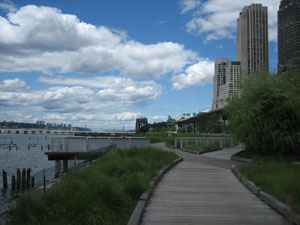
This recent transition to a more resident-friendly waterfront has been seen as an asset for NYC. Many communities, such as the South Bronx, are actively lobbying for better connections to their neighborhood waterfronts. But while communities derive benefits from these greened edges, establishment of a series of continuous waterfront parks actually serves to penalize the long-term economic flexibility of the city. For example, Barwick deemed the creation of Hudson River Park a potential mistake, since its location along the West Side of Manhattan precludes delivery of high value airfreight from the water. Though once unthinkable, there may be a time when NYC will again welcome a resurgence of commercial traffic in its ports.

While some future changes can be partially foreseen, others cannot. Asked how the city’s waterfront might fare in the face of global warming, Barwick responded that “no one has thought through yet what this will mean.” Many edges of the city would require radical adjustment to accommodate rising sea levels, proving that even today’s best-laid plans may be subject to unknown forces.

NYC: Surviving Those Rent Increases

Event: Quasi-Public: Paul Goldberger & Danny Meyer in Conversation — The Second Annual Design Trust Council Event
Location: The New Museum of Art, 02.26.08
Speakers: Paul Goldberger, Hon. AIA — Architecture Critic, The New Yorker; Danny Meyer — President, Union Square Hospitality Group
Introduction: Deborah Berke, FAIA — Co-Chair, Design Trust for Public Space
Organizers: The Design Trust for Public Space

Bank of America

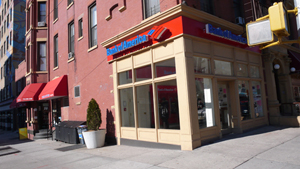
Rent hikes are responsible, for better or worse, for Starbucks and national banks taking over city street corners.

Gregory Haley

In the face of cries that NYC is losing its soul, Union Square Hospitality Group president Danny Meyer is upbeat. “The real character of my New York,” he explains, “comes from the human beings who choose to live here.” Paul Goldberger, Hon. AIA, architecture critic for The New Yorker, is not as positive, viewing the city’s ongoing transformation as a homogenization of the public realm, a “spreading of the qualities associated with Midtown throughout the rest of Manhattan.” While acknowledging the promise of the city’s rebuilding over the last decades — it is a safer and more vibrant place — both Goldberger and Meyer believe that this growth has come at certain costs.

Meyer fears that ever-increasing rents prohibit small local businesses with “a point of view” from opening shop, as he did with the Union Square Café in 1985. Instead, banks and chain stores that can afford the rent have proliferated. Yet, he sees emerging new retail models that provide space to hook up with the public realm, such as his Shake Shack in Madison Square Park or even Starbucks. Describing these businesses as “ventures into the real in a virtual world,” Goldberger credits their success to a rising desire for “face-to-face interaction.”

New Yorkers “believe change is in our DNA,” claims Goldberger, but they also want to “keep things the way they are.” A vibrant public realm thrives on diversity of use and place. In the face of current real estate pressures, however, sustaining this diversity requires a balance between change and preservation. City dwellers must act to ensure that what once happened naturally in Manhattan will continue, states Goldberger. If NYC were to stabilize, he warns, it would “be the equivalent of death”.

New View of Modernism: America the Irreducible

Event: Debate and Book Launch: USA: Modern Architectures in History (London: Reaktion Books, 2008)
Location: Columbia University, 02.18.08
Speakers: Gwendolyn Wright — Professor of Architecture, Planning and Preservation & Author, USA; Reinhold Martin — Associate Professor of Architecture, Director, Ph.D. Program in Architecture, Director, Master of Science Program in Advanced Architectural Design; Felicity Scott — Assistant Professor of Architecture; Joan Ockman — Adjunct Associate Professor of Architecture & Director, Temple Hoyne Buell Center for the Study of American Architecture; Andrew Dolkart — James Marston Fitch Professor of Historic Preservation, Columbia University Graduate School of Architecture, Planning and Preservation (GSAPP)
Moderator: Jorge Otero-Pailos — Assistant Professor of Historic Preservation, Columbia University GSAPP
Organizers: Columbia University GSAPP; Temple Hoyne Buell Center for the Study of American Architecture

USA

In USA, a contribution to the British Modern Architectures in History series grounding the recent heritages of 14 nations in cultural and social perspectives, Gwendolyn Wright takes on the task of explaining American architectural history since the Civil War for an international audience. The argument she recounted before this panel of Columbia University colleagues takes a relatively familiar narrative — too often reduced to a major-figures parade, a greatest-hits collection chiefly based in three cities, and a set of formulas delivered by critical authorities — and expands it into a more nuanced palimpsest of forces. With an understanding of the ties between culture and the built environment, she reframes American Modernism as a broad-based, nationwide project of what she calls “radical incrementalism,” a more diffused, democratic form of progressive development rather than a top-down revolution by a select few, and much more than a simple translation of European Modernism.

Analyzing Modernism, modernization, and modernity (terms that Wright scrupulously defines in the book’s introduction) along national lines raises a contradiction for universalist theoreticians who saw Modernism in terms transcending national identities. Wright prefers a more inclusive view of actual building practices, influenced by distinct “national imaginaries,” or patterns of belief and self-awareness, as well as by each nation’s distinct material history.

America’s Modernism, as Wright sees it, combines broad cultural diversity with frank commercial influences, an active role for communications media shaping its public reception, and a longstanding environmental awareness. She tones down the conventional emphasis on supposedly pivotal events like the 1932 Museum of Modern Art exhibition, for example, finding that the social changes and specific programs ensuing from that same year’s election of President Franklin Roosevelt had greater effects on the public acceptance of modern architecture than the pronouncements of Philip Johnson and Henry-Russell Hitchcock. While not shortchanging major figures (Frank Lloyd Wright appears in every chapter until his death), she looks further afield to consider significant work by underappreciated architects, some female, many outside the Chicago-New York-Los Angeles metropolitan axis.

Her interlocutors, with few points of dissent (e.g., Felicity Scott’s objection that USA marginalizes Post-Modernism), provided opportunities for Wright to clarify her reasons for departing from received ideas, particularly ones assigning Modernism any decisive endpoint. Joan Ockman’s broad question — “What is modern, and when is modern? At the end of the book we’re back in modern, again, somehow” — challenged Wright to reposition the Modernist response as something more than momentary, beyond the implications of hyphenated styles. Wright’s book, sure to be incorporated into architecture school syllabi nationwide, indicates that she’s up to the challenge.

Expose Architecture School in New Documentary

Archiculture

Archiculture documents architecture students’ lives during their final semester.

Courtesy Archiculture

While in architecture school, we realized how unique the design process is and what a great story it would make. We struggled to convey to non-architect friends why we dedicated so much time and energy in the studio. Once we began working in the field, the idea led us to quit our jobs and pursue the film full-time. Today our team has expanded to include architects and filmmakers with a mission to educate the public about contemporary issues in the architecture profession through the lens of thesis students. On Friday, March 14, the team behind Archiculture will host a Trailer Kickoff party at the Center for Architecture, which will feature the premiere screening of the film’s trailer, guest speakers, and a Q&A with the film’s creators. For more information on the event, information about the project, student blog, directors’ blog, webcam, and photos, go to the film’s website.

When we decided to embark on producing a film documenting architectural education two years ago, we were designers a few years out of school with no formal training in filmmaking. All we had to draw upon was our love for photography, our design degrees in architecture and landscape architecture, and our passion for documentaries. Now, two months into production of the feature length Archiculture, we are beginning to share our experiences with the design community and beyond.

The story is told through the eyes and lives of architecture students at Pratt Institute as they undergo their final thesis projects. Since the semester is currently underway, the outcome is still to be determined, but as one can see from the website, the trials and triumphs are coming to light. Tyler discusses his “breaking point.” Giancarlo debates the value of pulling all-nighters. Asta weighs the pros and cons of doing a group thesis project. Stan wonders what life will be like after school (“Is it time to put on my black pants and shirt, carry my little laptop in my black bag and seem to forget what color looks like?”). And Mollie voices her dissatisfaction with the perception of what a thesis is and her advisor’s role in the process. “Is anyone else as frustrated as I am?” she calls out.

Grassroots Sound Greener

Frances Hesselbein

Frances Hesselbein speaks at Grassroots about breaking down hierarchies.

Karen Plunkett, AIA

“I don’t know what to say, I have no speech,” were the opening words of Renzo Piano, Hon. FAIA’s short remarks at Accent on Architecture. Perhaps Piano had heard earlier remarks by Frances Hesselbein, who called for architects to “throw out the dead hierarchical language of the past.” During a Grassroots keynote speech, Hesselbein, the Chairman of the Leader to Leader Institute that helps social sector organizations achieve excellence in performance and community building, said, “There is no time to negotiate with nostalgia.” Her speech, punctuated by personal stories about collaborations that had changed people’s lives, moved several sitting in the back rows of the thousand-seat auditorium to tears. She spoke of diversity, inclusiveness, and non-hierarchic organizational structures in ways that made people listen.

Grassroots is the annual leadership and legislative conference of the AIA, which takes place over four days every February in D.C. With Congress recessed, this year there were no Capitol Hill visits, so the risk of hot air was diminished as a dusting of snow confined the speechifying largely to the Grand Hyatt. Awards were conferred, including a Component Excellence award to the AIA New York Chapter for the Model Code collaborative effort that resulted in the adoption of the International Building Code.

The biggest change this year was the greening of the conference: hard copy press releases were nowhere to be found. But there were many speeches. One of the best was the workshop given by author Gary Rifkin on how to “Speak like a Pro.” His 90 minutes of cogent advice included the importance of a dramatic start — don’t bother with “Good Morning!” or immediately thanking the introducer. Rifkin said that practicing your remarks is important, preferably 20 times, and at least once with someone other than your pet listening. He also counseled against relying on a teleprompter, stressing the importance of connecting with the audience more directly, with just key word notes left where they can jog memory when needed. Having just used a teleprompter for the first time — yes, there is someone behind the curtain — I heartily agree.

Continues…

A Call for Support of Architecture Interns

When I signed up for this year’s national AIA convention in Boston (May 15-17), I was pleased to see so many programs for emerging professionals. This, and the short distance from NYC, should help attract local interns and young architects who usually can’t afford such events. Still, there’s more to be done to encourage them to take advantage of the learning and networking opportunities the convention offers.

At every convention I’ve attended I am asked why more young designers do not attend. The answer is simple: money, time, and deadline pressure. Even though getting to Boston is relatively cheap, basic registration fees are $475 ($425 if you register before April 4), and hotels are approximately $150 per night. This is more than one week’s salary for most interns. Considering they usually spend half their monthly pay on rent, this is a significant cost. The AIA has relieved some of the burden by offering attendees who are new members or associate members within the last year free registration, but this fails to cover everyone. Also, many firms pay for employees to go to conventions; yet, often interns are not included in this list.

On top of that, young architects usually get 10 days of vacation. To take two off for the convention cuts into this time considerably. Also, there’s pressure to work long overtime hours and weekends to meet tough deadlines. Although the stress is universal in the profession, many times young designers stay the latest and work the most hours — often because they are trying to make a good impression on their bosses.

I agree with many previous convention attendees that it is important for emerging architects to get more involved with AIA events. And I have found the conventions not just educational, but also fun because I have met so many different professionals in the field. I hope principals of firms will do more to help persuade their interns to attend this year, whether it is by sponsoring a few of their interns or by allowing them to take a couple of days off to attend (and letting them know that it is alright to do so). Likewise, I hope that interns reach out to each other and carpool or share rooms together to lessen the expense. Perhaps the Emerging NY Architects (ENYA) committee could reach out to young architects to help form these connections before the event. With that, a young demographic might breathe new life into this year’s convention.

In this issue:
· P.S.1 to Provide Shade, Sustenance
· Parsons Student Work is On Public View
· Where the Money is: Museum of American Finance Opens Downtown
· Industrial Meets Green at Brooklyn Navy Yard
· LTL Designs Arthouse at Jones Center
· Holl in China: Chengdu Awaits Rockefeller-Sized Shopping Center
· SHCA Plans Heady Brew for Moscow
· Intelligent Building Aids Athens Media


P.S.1 to Provide Shade, Sustenance
PF1

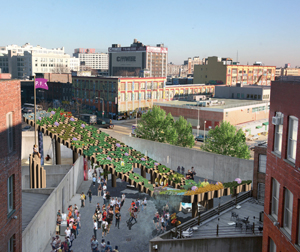
PF1 (Public Farm One).

Rendering courtesy WORK AC

Out of five finalists, NY-based WORK AC was selected as the winner of the ninth annual MoMA/P.S.1 Young Architects Program with PF1 (Public Farm One), a temporary installation at P.S.1 Contemporary Art Center. Departing from the program’s usual beach theme, WORK AC proposed an urban farm. Constructed from large cardboard tubes, its top surface will be a working farm, complete with a variety of vegetables and plants that will also provide shade for multiple zones of activity below, including swings, fans, sound effects, seating areas, waterfall, and a pool. Inexpensive and sustainable, recyclable materials will be used. In addition to WORK AC, the other finalists are Matter Architecture Practice, su11 architecture+design, and THEM/Lynch+Crembil from NY, and Miami-based Monad Architects. The installation will open June 26 at P.S.1, and an exhibition of the finalist entries will be on view at MoMA June 15-October 20.


Parsons Student Work is On Public View
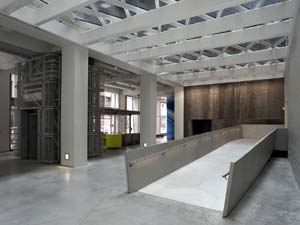
Parsons Lobby

Sheila C. Johnson Design Center, designed by Lyn Rice Architects: the glazed-roof Quad with aluminum hex-ramp connector to the Aronson Galleries and mesh-wrapped elevator (left).

Noah Sheldon

Merging the ground level of four buildings to form a contemporary “urban quad,” the 32,800-square-foot Sheila C. Johnson Design Center at Parsons The New School for Design is now open. The new campus center, designed by Lyn Rice Architects, combines learning and public program spaces with exhibition galleries to create a dynamic street-front presence for the school. The project, at Fifth Avenue and 13th Street, includes a 3,200-square-foot gallery, 89-seat bamboo auditorium, additional gallery space, learning and meeting spaces, student critique area, and a 900-square-foot home for the Anna-Maria and Stephen Kellen Archives, a significant collection of drawings, photographs, letters, and objects documenting 20th-century design.

By opening up the existing spaces, the design team created a double-height, skylight-covered public space of aluminum, glass, and raw concrete that connects the center’s main spaces. A cantilevered, mezzanine-level meeting pod overlooks the quad. The student critique area is located in a highly visible corner, and a pivoting wall with pin-up surfaces and two sliding monitors opens the space placing the design process on view to passersby on the street. The building, which received a 2007 Project Merit Award from AIANY, is part a larger planning effort underway at the university to create a world-class campus.


Where the Money is: Museum of American Finance Opens Downtown
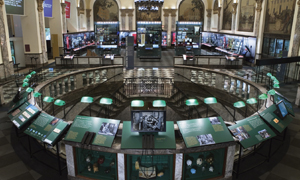
MoAF

The Museum of American Finance.

C&G Partners

The Museum of American Finance (MoAF), an affiliate of the Smithsonian Institution, has re-opened in a new home at 48 Wall Street, one block east of the New York Stock Exchange. The 7,000 square feet of exhibitions, designed by C&G Partners, is set on the mezzanine of the 36-story, 1927 Benjamin Wistar Morris-designed landmark building home to the Bank of New York through 1998. While treading lightly on the historic structure, the interactive exhibits are designed to appear permanent, yet they can be rolled away to return the space to its original state for special events. The space also includes a theater, galleries for changing exhibitions, and a room honoring Alexander Hamilton as a pioneer of the U.S. economic system. The Lower Manhattan Development Corporation funded $1 million towards construction of the museum from a community block development grand from HUD.


Industrial Meets Green at Brooklyn Navy Yard
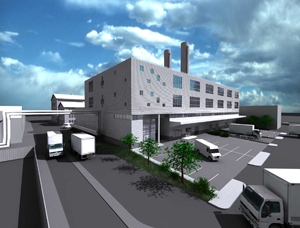
SurroundArt

Perry Avenue building on the Museum Resource Campus for SurroundArt.

Stantec

With an emphasis on green design, the Perry Avenue building is aiming to be the first multi-story, multi-tenanted LEED CS Silver industrial building in the U.S. The new Museum Resource Campus, designed by Stantec (design architect and architect-of-record for the core and shell) and Steven Kratchman Architect (tenant fit-out) for SurroundArt, a fine arts services provider, is under construction at the Brooklyn Navy Yard. Expected to open this fall, the three-building campus includes a new 89,000-square-foot building on Perry Avenue, a 71,000-square-foot building in the Navy Yard, and an adaptive re-use of the century-old Paymaster Building.


LTL Designs Arthouse at the Jones Center
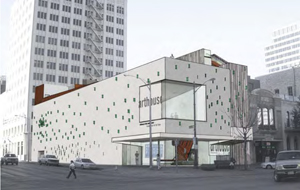
Arthouse

Arthouse at the Jones Center.

LTL Architects

The existing Arthouse at the Jones Center in Austin, TX, is a hybrid of a 1920s theater and 1950s department store. NY-based Lewis.Tsurumaki.Lewis (LTL Architects) sought to intensify the accumulation of history by augmenting its features, such as the trusses, concrete frame, and ornamental painting from the 1920s, and the awning, storefont, and upper-level display window from the 1950s. The façade incorporates laminated glass blocks aggregated where light is needed on the interior. The central stair is suspended from the wood roof deck providing the primary spatial connection from ground floor to the roof, with the first tread extending to become the reception desk. The 23,800-square-foot renovation also includes an entry lounge marked by sheared and distorted letters, video/projects room, open gallery, multipurpose room, two artists’ studios, art preparation areas, and roof deck.


Holl in China: Chengdu Awaits Rockefeller-Sized Shopping Center
Sliced Porosity Block

The Sliced Porosity Block.

© Iwan Baan, courtesy Steven Holl Architects

Steven Holl Architects’ Sliced Porosity Block in Chengdu, China, scheduled to open in late 2010, is a 105,000-square-foot site that will house a hybrid complex of public spaces and five towers with offices, serviced apartments, retail, hotel, cafés, and restaurants. Intended to maximize public open space and stimulate micro-urbanism, high-performance glazing, energy-efficient equipment, and regional materials are a few of the methods employed to attempt to reach LEED Gold. Five entrances lead visitors through a shopping center to an elevated plaza. Multi-level terraces at the scale of Rockefeller Center will incorporate stone steps, ramps, trees, and ponds. The project will be heated and cooled geo-thermally, and the ponds will harvest recycled rainwater in addition to functioning as skylights to the six-story shopping precinct below.


SHCA Plans Heady Brew for Moscow
Park City

Park City, Moscow.

Swanke Hayden Connell Architects

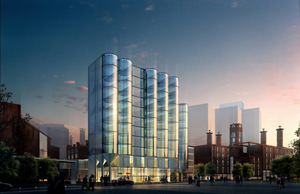
Swanke Hayden Connell Architects (SHCA) will design four buildings within the Park City development in downtown Moscow, occupying the historic center within a 36-acre mixed-use master plan. Two of the buildings will be adaptive re-uses of existing late 19th century Badaevsky Beer Brewery buildings, which will house an entertainment, spa, and retail center. The other two buildings will be newly constructed, consisting of a high-end, mid-rise residential tower, and a two-story restaurant and retail pavilion, intended to act as connector between a central public square and the riverfront. This is the third major assignment for SHCA in Moscow. The firm is currently also designing Project Slava, a five million-square-foot mixed-use complex, and Moscow International Business Center, a 70-story mixed-use tower.


Intelligent Building Aids Athens Media

Elephtros Typos

Elephtros Typos.

Archronica Architects

NY-based Archronica Architects has completed a new building for Elepthros Typos, a converged media company in Athens, Greece, best known for its daily newspaper. The new building houses the company’s radio, television, online, and newspaper outlets, includes unassigned seating permitting journalists to occupy space as needed for their daily assignments. The overall design champions the idea of the intelligent building — it remembers lighting and temperature settings defined by users, and it locates books and files for the users with bar code technology.
In this issue:
· Zoning Code Amendment Update
· AIANY Policy Update: Domino Sugar Factory
· Mayor Plans to Reduce Tropical Hardwood Consumption
· Foundation Hosts Benefit Tour of New York Times Building
· Family Day @ the Center
· AIA Reveals Strategic Partnership Program


Zoning Code Amendment Update
AIANY, which helped to convene a Zoning Task Force, has withdrawn the seven Zoning Text Amendments that were scheduled to be considered by the City Planning Commission later this month. The withdrawal was at the suggestion of City Planning Department staff to allow time for more public discussion of the portions of the Zoning Resolution that limit the ability of architects to create good design. The goal of those who participated in the development of the proposed Zoning Text Amendments is the creation of livable and sustainable communities through process change, along with revisions to the Building Code and Zoning Resolution. To read the formal withdrawal, please click here.


AIANY Policy Update: Domino Sugar Factory

On 02.05.08, AIANY testified at the Landmarks Preservation Commission on the redevelopment of the Domino Sugar Factory on Williamsburg waterfront, Brooklyn. Beyer Blinder Belle Architects & Planners’ design consists of a rectangular glass addition, the restoration of the factory walls and windows, and the preservation of the iconic chimney that stands out against the industrial waterfront.

AIANY supports this project for multiple reasons. First, an affordable housing developer, Community Preservation Corporation, with private developer Isaac Katan, are undertaking the factory’s redevelopment. Additionally, the architects are taking care to create a link between the waterfront and neighborhood residents by extending streets and public space throughout the site. Finally, AIANY feels that the simple design of the rooftop addition is respectful to the scale of the factory building. The refinery chimney “helps link the new and old portions of the structure and allows the detailing of the new floors to be simple and elegant, anchored by the mass of the vertical tower,” according to the AIANY position statement.

The Commission has not yet voted on this issue.


Mayor Plans to Reduce Tropical Hardwood Consumption
During an address at the United Nations on February 11, Mayor Bloomberg announced a plan to reduce tropical hardwood consumption by NYC agencies, and released the Tropical Hardwood Reduction Report, developed by a group of city agencies, the Mayor’s Office of Long-Term Planning and Sustainability, and directed by Deputy Mayor for Operations Edward Skyler. The report outlines strategies to move NYC away from tropical hardwoods to more sustainable alternatives. The short-term plan will reduce hardwood usage by 20%, eliminating these woods for construction and maintenance, and any new waterfront promenades. The long-term plans include studies to evaluate alternative designs and materials for marine transfer stations, Brooklyn Bridge Promenade, maintenance of existing boardwalks, and Staten Island Ferry docks.


Foundation Hosts Benefit Tour of New York Times Building

Event: Center for Architecture Foundation benefit tour: New York Times Building
Location: New York Times Building, 01.23.08
Tour Guides: David Thurm — Vice President & Chief Information Officer, New York Times; Dan Kaplan, AIA — Senior Principal, FXFOWLE Architects; Rocco Giannetti, AIA — Project Leader, Gensler; Hussain Ali-Khan — Vice President of Real Estate Development, New York Times; Angelo Salvatore — Group Director, New York Times
Organizers: New York Times Company; Center for Architecture Foundation
Sponsors: The New York Times Company

NY Times Building

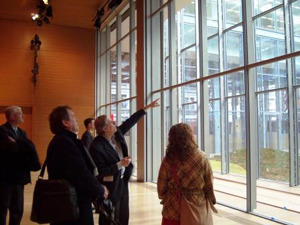
Architecture enthusiasts tour NY Times Building.

Grace Hwang

The Center for Architecture Foundation held its first benefit tour, hosted by the New York Times Company, at the newly opened New York Times Building. Organized and led by David Thurm, Vice President and Chief Information Officer of the New York Times, 60 architecture enthusiasts joined members from the FXFOWLE Architects (the architect with Renzo Piano Building Workshop) and Gensler (the interior architects) teams who joined Thurm as tour guides.

Even though the Times decided not to pursue LEED certification, the project team presented the building’s numerous sustainable features. The integration of natural daylight, automated artificial lighting, and perimeter shades were most noticeable to the visitors. Although less visible but equally important, the team pointed out, are the under-floor air distribution system (the largest in the city), and the gas fired co-generation plant which supplies up to 40% of the power for the building.

Other than the newsroom, the most dynamic floor is the translucent lobby. With the installation of the site-specific Moveable Type, by artist Ben Rubin and statistician Mark Hansen, the incorporation of a landscaped courtyard filled with birch trees, and views extending from Eighth Avenue through the building, the lobby represents corporate transparency at the civic level.

The Foundation is planning up to four tours every year focusing on neighborhoods undergoing redevelopment, as well as interesting new buildings and landscapes. Thanks to all those who made this reception possible, especially the New York Times Company and tour guides. Contact the Foundation with suggestions and contributions to support programs that use architecture and design as vehicles to foster visual literacy in local schools and the general public.


Family Day @ the Center

Event: FamilyDay@theCenter: Green Light Go!
Location: Center for Architecture, 02.09.08
Speakers: Grace Hwang — Program Coordinator, Center for Architecture Foundation; James Long — Principal, Studio James Long
Volunteers: Kathleen Casanta, Eunice Kim, Tyler Vigil, Jennifer Kim, and Winnie Yen from Robert A.M. Stern Architects; Kristen Blake from Holzman Moss Architecture; Jeff Geisinger from Polshek Partnership Architects
Organizer: Center for Architecture Foundation
Sponsors: The Illuminating Engineering Society of New York (IESNY); Materials for the Arts. Materials made possible by donations from Studio James Long and IESNY, and purchased at Materials for the Arts.

Green Light Go!

One participant shows off the blue glow emanating from her light fixture.

Courtesy Center for Architecture Foundation

The Green Light Go! Family Day, a monthly workshop for children ages 5-12, began with a slide show presented by Grace Hwang, the Center for Architecture Foundation’s Program Coordinator, and guest lighting designer James Long. An image of a lit paper lantern covered in Styrofoam packing peanuts generated oohs and ahhs from workshop participants impressed with the light quality despite mundane materials, while a lamp covered in synthetic hair, called Miss Wiggy, designed by “Mr. James” created a ripple of discomfort.

At the slide show’s conclusion, parent-child design teams sketched out their own lighting design ideas on rolls of brown butcher paper. Some participants chose to forgo this step, heading straight for the heaping piles of tin foils, plastic tubing, and textured paper. Young and old hands alike explored color, texture, and shadow to create their fixtures. At one point, a girl no taller than Long’s waist held up her work-in-progress and asked for help. Long examined her construction and dug into a box of green plastic mesh and colorful paper to help her move past her creative roadblock. Long, who has taught on and off for the last 15 years, discussed how he hoped workshop participants would take home a new respect for how light functions in space.

Finally, designers displayed their work, plugging them in to test the effects of what they created. One mother-daughter team delighted in the color and quality of light their fixture projected into the space. A father-daughter team created an oceanic composition of wave-like folds, accented by beaded strings and foil.

Family Days are held at the Center for Architecture designed for children to engage with adults in open-ended activities that vary from art-making to walking tours to design challenges. If you and your child/children would like to participate, go to the Foundation’s website for more information.


AIA Reveals Strategic Partnership Program
In an effort to provide members with greater access to cutting edge decision making tools for their practice, the AIA has announced an agreement with Reed Construction Data to become the first company under the new Strategic Partnership Program. This initiative is be limited to eight companies that closely align with the Institute’s strategic initiatives and mission. The AIA and Reed will release more information regarding their partnership at the upcoming AIA National Convention in Boston, May 15-17.