Critique: What the Other 90% Needs

Event: Design for the Other 90%
Location: Cooper-Hewitt, National Design Museum, Smithsonian Institution, through 09.23.07
Curator: Cynthia E. Smith

Bamboo Treadle Pump

The Bamboo Treadle Pump, designed by Gunnar Barnes of Rangpur/Dinajpur Rural Service and IDE Nepal, is used in Bangladesh, Nepal, India, Mayanmar, Cambodia, and Zambia to allow farmers to access groundwater during the dry season.

©2003 International Development Enterprises, courtesy Cooper-Hewitt, National Design Museum

Both provocative and critical to the well being of individuals and their communities, the innovations presented in Design for the Other 90% at the Cooper-Hewitt, National Design Museum aims for relevancy in our current aesthetics-obsessed environment. The exhibition offers a glimpse into how design may encourage growth and prosperity for those who have compromised access to basic human needs. The show addresses categories such as shelter, water, health, and energy, presenting a small collection of products meant to improve the quality of life for those in developing countries. For example, the MoneyMaker Block Press, designed by Martin Fisher and used in various African locations, allows 5-8 workers to produce up to 800 bricks a day. The increased productivity speaks for itself; these are designs that are being put to good use.

For an exhibition striving to emphasize the power of design, however, there is a serious lack of visual media depicting these items actually in use, or even in the context in which the other 90% live. While some products, including the Water Storage System, designed by International Development Enterprises (IDE) India, or Bamboo Treadle Pump, designed by Gunnar Barnes of Rangpur/Dinajpur Rural Service and IDE Nepal, are easily imagined in rural towns, the Solar Dish Kitchen, designed by BASIC Initiative Mexico Program of the University of Texas and University of Washington, or Nicholas Negroponte’s One Laptop Per Child look out of place, provoking issues of regional and cultural specificity that are no stranger to most architects and beg the question: what position are we in as designers to anticipate what the “other” really needs?

The few items shown in action are illuminating on the design level, but also highlight another drastic shortcoming of the exhibition: the definition of design has been limited to mean “objects” — gadgets that, while useful and important, are more like emergency tactics rather than long-term strategies for change. For instance, The LifeStraw, designed by Torben Vestergaard Frandsen and used in Ghana, Nigeria, Pakistan, and Uganda, is an invention that can filter typhoid and cholera bacteria to provide adequate drinking water. Yet, imagining the straw as a lifetime solution reveals its own improbability as anything but a temporary fix to a much larger and significant environmental and economic problem. Designers are surely capable of imagining more complex strategies, and not just topical Band-Aids.

Both the vital need for designers to step outside the high-end design world of the privileged 10%, and the potential for creativity are reasons enough to make Design for the Other 90% worthy of conversation and debate, whatever its shortcomings may be. The tools on display offer interesting ideas, but are only the first step, and understandably so; the design process can be long and tedious, and rarely generates a perfect first attempt. Hopefully, if more designers are inspired to participate, better and more enduring solutions may be around the corner.
Students Launch Dialogue in Green

Event: Sustainable Design Review
Organizers: Students at Parsons The New School for Design: Rishi Desai, Justine Abu-Haidar, Patricia Ormaza, Tanye Prive (Design and Management); Aritz Bermudez Monfort (Communication Design)
Winners: First Place: Caroline Pham (Integrated Design); Second Place: Hae Jeong Choi (Product Design)

Sustainable Design Review

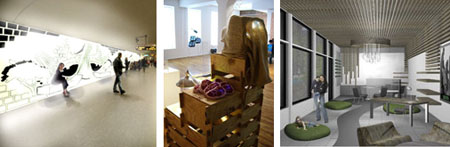
(l-r): “Subway Light Project” lights up commuters’ days; “Holon A.” is an interactive industrial agricultural information booth; “Why Sustain?” is a learning and information center made from sustainable materials maximizing natural light.

(l-r): Caroline Pham; Becky Stern; Amanda Gilbert

The first annual Sustainable Design Review, a student-led green initiative at Parsons The New School for Design, asked students to define sustainability. “Our mission is to foster an overall awareness and dialogue relating to social, environmental, and other forms of sustainability in school projects and consequently student perceptions,” according to founder and chairperson Rishi Desai, who conceived of the project with other Design and Management and Communication Design students at Parsons.

The winning entry, called the “Subway Light Project,” submitted by Caroline Pham of the Integrated Design Curriculum, introduces natural light into subway stations by incorporating fiber optic technology and sunlight collection panels. Windows and seating areas illustrating natural and urban landscapes are illuminated with full spectrum light to benefit sun-deprived city residents. “Terra Bites,” the second place entry by Product Design major Hae Jeong Choi, is a mobile cart that acts as a delivery and vending truck for local, fresh food.

Jury members, who sifted through more than 100 submissions and chose 10 finalists, included: Susan Szensay, editor-in-chief of Metropolis; Majora Carter, founder and executive director of Sustainable South Bronx; Kira Gould, Assoc. AIA, AIA Committee on the Environment (COTE) chair; Chelsea Holden Baker, assistant editor of DWELL; Douglas Diaz and Loretta Staples, professors at Parsons; Jackie Brookner, ecological artist; and students Ryan Wood and Tracy Chow.

“Word of mouth was the weapon to get this idea the support it needed. Now it is all about the dialogue,” the website background statement declares. After being in contact with some of the students who entered the competition, and in an effort to continue the discussion, they wrote to me about their experiences participating in the Sustainable Design Review:

[This competition] contributes to the argument that design should not only be about beauty and creativity, but should also be about responsibility. Winning this competition has taught me the importance of responsible design. I believe that the idea of sustainability can be beneficial to a new way of thinking, not as an alternative to normal life, but as a trigger for innovation.

[The Sustainable Design Review] initiative provides peer and industry review outside the classroom environment for projects with a nontraditional goal. Experiencing the process helped me put my project in a larger perspective.

By entering this competition, I wanted to increase the recognition of interior design as paramount to sustainability. I hope to focus my career on creating sustainable interior spaces and increase awareness that sustainability can be beautiful and effective on many levels.

Syracuse University Takes the First Amendment Seriously

S.I. Newhouse School of Public Communications

S.I. Newhouse School of Public Communications

(l-r): Steve Sartori; Kristen Richards

On a sizzling August day, a small group of journalists were treated to a day trip to a much cooler Syracuse for a hard hat tour of Newhouse III, the latest addition to Syracuse University’s S.I. Newhouse School of Public Communications complex. Designed by Polshek Partnership Architects, the $31.6 million, 74,000-square-foot addition is the final step of I.M. Pei, FAIA’s master plan begun with the completion his 1964 building; the second building by Skidmore, Owings & Merrill, opened in 1974. For James Polshek, FAIA, and Tomas Rossant, AIA, the challenges included respecting the period architecture while creating a vibrant, new face for the campus (the school is located at one of the university’s main entrances). “My belief is that any building with an intellectual purpose has to tell a story,” Polshek said. Newhouse III tells its story with an undulating, fritted glass façade with the words of the First Amendment etched in letters six feet high along the base. Inside, a soaring, skylit atrium fills the interior spaces with natural light.

With the rapid evolution of the digital age, communal spaces in the two older buildings had been cannibalized for computer and media labs. According to Rossant, the new building will become “the missing social heart” of the communications school, with lounges, casual gathering spaces, a 350-seat auditorium, and a Food.com dining area, along with high-tech labs and classrooms that bring together the communications disciplines. Opening celebrations for Newhouse III, made possible by a $15 million grant from the S.I. Newhouse Foundation and the Newhouse family, will kick off on September 19 with a keynote speech by U.S. Chief Justice John G. Roberts, Jr.

Beyond Barriers in Chicago

Access Living Headquarters

Access Living’s new headquarters in Chicago.

Courtesy www.accessliving.org

In describing the building he designed in Chicago for Access Living, a national accessibility rights public interest group, architect John H. Catlin, FAIA, of LCM Architects noted: “Accessible design is good for everyone, not just the people who use Access Living’s building everyday.” The occasion of his remarks was the presentation of the 2007 Barrier-Free America Design Award of the Paralyzed Veterans of America to Catlin and his client, Marca Bristo, President and CEO of Access Living of Metropolitan Chicago. Catlin continued: “Through this new building, and through the Barrier-Free America Award, we will deliver the message that accessibility benefits everyone from wheelchair users, to parents with strollers, to shoppers returning home with groceries.” Bristo spoke of how the LEED Silver headquarters will enable Access Living “to build our services and activities as we continue working to create an inclusive, integrated, and independent disability community.”

Access Living’s Headquarters, described as “a model of Universal and Green Design,” is located at 115 West Chicago Avenue. Less than a mile north of AIA Chicago’s new space at 35 East Wacker Drive, it was the setting for a celebration in August attended by previous Barrier-Free America Award winners including Edward K. Uhlir, FAIA, responsible for the creation of Chicago’s Millennium Park. During a tour, Access Living staff members pointed out some of the Universal Design features that make the building distinct. Those that especially impressed this visitor included:

· Easily adjustable desk counter heights to accommodate users with varying seating needs, including different wheelchair heights
· Oversized elevators with doors both front and back on all floors to enhance wheelchair maneuverability in crowded cabs
· Hallway carpeting with darker-colored borders to help those with visual impairment
· Computer screens linked to telephone and video cameras to enable telephonic signing
· Areas of rescue assistance on each floor also usable as lounge space

Access Living is a cross-disability organization governed and staffed by a majority of people with disabilities. Through its programs, services, and now its Chicago headquarters, it fosters dignity and self-esteem of people with disabilities and enhances their options so they may choose and maintain individualized and satisfying lifestyles. The 115 West Chicago Avenue building exemplifies the seven principles of Universal Design developed in 1997 by the Center for Universal Design at North Carolina State University: Equitable Use, Flexibility in Use, Simple and Intuitive, Perceptible Information, Tolerance for Errors, Low Physical Effort, and Space for Approach & Use. The implementation of these principles makes for good design accessible to all.

Other attendees at the award ceremony included AIA Chicago’s Executive Vice President, Zurich Esposito, and AIA Milwaukee President-elect Karen Plunkett, AIA. The Paralyzed Veterans of America, represented by National Vice President Gregory A. Joyce, National Director Gary E. McDermott, and Director of Architecture Carol Peredo Lopez, AIA, also has a design project underway in Milwaukee.

Capitol Improvements

I have been following the discussion about the Architect of the Capitol (AOC) vacancy in Washington D.C. The hiring process is as follows: Congress’s Architect of the Capitol Commission recommends three potential individuals from which the President may or may not choose one to be appointed for the 10-year position. Controversy has sprouted because these names have not been released to the public, and because of the spreading rumor that someone who is not a registered architect may fill the position.

According to the Architect of the Capitol website, the AOC is responsible for the maintenance, operation, development, and preservation of the U.S. Capitol Complex, which includes the Capitol, congressional offices, Library of Congress, Supreme Court, U.S. Botanic Garden, Capitol Power Plant, and other facilities. Duties include mechanical and structural maintenance, upkeep and improvement of the Capitol grounds, and arrangement of inaugural and other ceremonies. Current projects range from the replacement of worn Minton tile in the Senate corridors to the installation of security devices and the development of a Capitol Complex Master Plan. The AOC must also serve as a member of eight governing or advisory bodies including the D.C. Zoning Commission, Advisory Council on Historic Preservation, and the Capitol Police Board.

To be expected, the AIA has been voicing its collective opinion that the position must be filled by a licensed, registered architect — see The Architect of the Capitol Should be an Architect website. The website includes links to the AIA Board of Directors’ letter to the President, a letter supporting the AIA’s position from former AOC George M. White, FAIA, ongoing coverage in the Angle, and commentary on the AIA Archiblog. There is also a petition to Congress.

I agree that for a job called “Architect,” a registered architect must fill the position. This has been established by law. However, in reviewing the many responsibilities of the AOC, I see that it would be difficult to find one person who can successfully fill the vacancy. On the AIA Archiblog, Desiree Sheehan asks, “Wouldn’t appointing a design team be a better choice?” Collaboration and specialization is a trend in the architecture profession. Here is an opportunity to redefine the AOC, giving a team of individuals with diverse experiences the chance to successfully shape the future of the nation’s capital.

In this issue:
·Kaufman Undergoes Renewal
·Birds Sing in Battery Park City
·Austrian Hills are Alive with the Sound of Construction
·Old Tracks Lead to New Cultural Center in Oslo
·Triangular Building Sails Downtown


Kaufman Undergoes Renewal

Kaufman Center

The Kaufman Center.

Rendering by Augustus Wendell for Robert A.M. Stern Architects

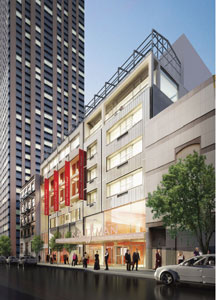
The Kaufman Center, an arts and educational institution in an award-winning Brutalist building designed by Ashok Bhavnani, AIA, in 1978, is undergoing a $17 million restoration and renovation designed by Robert A.M. Stern Architects. Located a block from Lincoln Center, The Kaufman is composed of three divisions — two educational facilities (Special Music School (P.S. 859) and Lucy Moses School) and Merkin Concert Hall. Plans call for respecting the building’s original form while enhancing its functionality and appearance, physically and conceptually uniting the three divisions with one entrance and lobby for the facility.

Channel glass will replace corroding metal rods on the main floor and balcony levels, while other façade elements will be restored in keeping with the original architectural intent. The interior transformation will include a renovation of public spaces with new materials, signage, lighting, and furnishings. The concert hall will be refurbished, and its technical functions will be updated while preserving the hall’s much admired acoustical capabilities. The project will be completed in time for a January 8 celebration.


Birds Sing in Battery Park City

Battery Park City Community Center

Battery Park City Community Center.

hanrahanMeyers architects

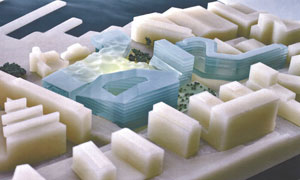
hanrahanMeyers architects is in the process of designing a new 55,000-square-foot LEED Platinum rated community center north of Ground Zero. The project will feature a 540-foot-long glass “bird wall” featuring songbird sounds. The architects are working in collaboration with NY-based composer, performer, and installation artist Michael Schumacher, who specializes in computer-generated sound environments. The wall will demonstrate passive energy systems fueling the new community center. Facing inside the center, the wall unifies swimming pools, a gymnasium, theater, classrooms, and recreation and dance spaces while bringing natural light into the primary spaces. The project is scheduled to be completed by 2010.


Austrian Hills are Alive with the Sound of Construction

Sternbrauerei Salzburg

Sternbrauerei Salzburg.

Hariri & Hariri Architecture

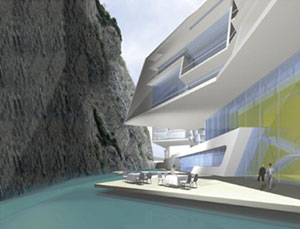
Coinciding with the Salzburg Festival, ground will be broken on the $80-million Sternbrauerei Salzburg designed by NY-based Hariri & Hariri Architecture later this month. The firm won a competition to create a luxury residential and mixed-use complex on the five-acre site of an abandoned brewery at the foot of the Rainberg Mountain, close to the historical center of the city. Eight residences will occupy six new structures on the site, none of which reach more than eight stories. The scale of the site is intended to be a microcosm of Salzburg, complete with manmade canal representing the river Salzach. The site’s changing levels produce views for the spa, restaurant, and public promenade. The program also includes exhibition space for the House of Architecture, a gallery and lecture space in the brewery’s underground vaults to be run by Initiative Architektur Salzburg and covered by a green public space. The project is scheduled for completion in late 2009.


Old Tracks Lead to New Cultural Center in Oslo

Vestbanen

Deichmanske Library and Stenersen Museum.

REX

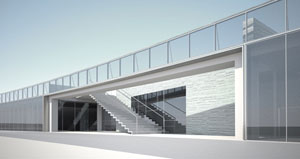
The City of Oslo has commissioned NYC-based REX, in collaboration with Oslo-based Space Group, to initiate design studies for the new Deichmanske Library and the Stenersen Museum. The site is located in the historic Vestbanen section of the city, home to the Nobel Peace Center designed by Adjaye/Associates. City plans call for preserving the old railway station buildings; the track area, currently used as a car park, will be the site of the 300,000-square-meter library and museum. Intended to be part of the city’s new cultural center, the master plan allows for the construction of more cultural spaces, offices, and residential developments. Construction is scheduled to begin in 2009, with the opening projected for early 2012.


Triangular Building Sails Downtown

One 7th

One 7th.

Rogers Marvel Architects

Located on a triangular-shaped site of a former 1950s gas station, One 7th (Avenue South), designed by Rogers Marvel Architects, is a mixed-use development housing commercial space on the ground level and residential units above. One 7th’s signature element resembles the prow of a ship with a façade composed of floor-to-ceiling glass interspersed with Manganese Ironspot brick. The rhythm and materiality of the façade is intended to respond to the scale of the neighboring buildings, creating a transition from the industrial loft buildings across the street to the smaller buildings adjacent to the site. Projected date of occupancy is next month.

In this issue:
·Two Years Later: AIA National Still Contributes to Katrina Relief
·Thinking Outside the IDP Box
·OHNY Opens Doors This October


Two Years Later: AIA National Still Contributes to Katrina Relief
Marking the two-year anniversary of Hurricane Katrina, the AIA unveiled a proposal to reform the Stafford Act, the key law that provides for federal relief to states and localities after a disaster. Under this proposal, federal emergency funds would be provided for temporary and transitional housing.

In addition, the AIA, along with the engineering and contracting industries, is continuing its efforts to enact a federal Good Samaritan statute. In April, Rep. Dave Reichert (R-WA) introduced legislation, H.R.2067, to provide licensed architects with qualified immunity from liability in times of a declared emergency or disaster. The AIA worked closely with Reichert and his staff to draft this bill.

For more information on the AIA’s disaster assistance resources, visit the Communities by Design website.


Thinking Outside the IDP Box

Announced earlier this summer, the National Council on Architectural Registration Board (NCARB) has made a number of important changes to its Intern Development Program (IDP) policies, notably exam timing. The AIANY Chapter’s Professional Practice and Emerging NY Architects (ENYA) Committees, with the American Institute of Architecture Students (AIAS), will jointly hold a panel discussion at the Center for Architecture on September 14 called IDP: Inside Out to help acquaint interns and architects about these changes and how they can affect the path to licensure. A special focus will be placed on current implementation in New York State.

Panelists will include NYS IDP Coordinator Thom Penn, AIA, and Regional Associate Director Shanntina Moore, Assoc. AIA, LEED AP, who will represent Cannon Design , the 2006 IDP Firm of the Year. The panel is organized in association with the exhibition arch schools: r(each)ing out, on view at the Center through October 19.

This seminar has been designed as the first in a series of discussions geared towards students, recent graduates, and emerging professionals who may have been enrolled in IDP for a number of years. A future session that will address the questions of IDP mentors and supervisors is also in the works.


OHNY Opens Doors This October
openhousenewyork (OHNY) will celebrate its fifth annual OHNY Weekend this October 6 and 7. Free access will be provided to nearly 200 sites of architecture and design significance throughout the five boroughs, including many usually closed to the public, as well as nearly 150 tours, talks, performances, and family activities and workshops. The Center for Architecture will again serve as the OHNY Welcome Center. All site and program information will be available online on September 28. Guides will also be distributed at key venues throughout the city and in the September 28 city edition of The New York Times.

Some of the new and returning sites include: the High Line; Morgan Library & Museum; 7 WTC; Chrysler Building; United Nations; and an MTA Substation. In addition, AIANY’s Emerging NY Architects (ENYA) Committee competitions program is hosting two sites — Southpoint, the abandoned ruins of the Renwick-designed smallpox hospital on Roosevelt Island and site of the 2006 ENYA competition, and the new biennial competition location, to be announced in September.

Anticipating upwards of 100,000 visitors, OHNY is offering two ways for you and a guest to bypass the lines. One is to volunteer, assisting tour guides and building owners on-site, supervising visitor admission, greeting the public, and answering queries about OHNY. For more information, e-mail volunteer@ohny.org. The other way is to purchase one of three types of commemorative tickets (ranging in price from $150-$250). For more information or to purchase tickets, please click here.

Artist Draws Line

High Water Line

Artist Eve S. Mosher is marking the 10-foot flood line around the city.

Courtesy High Water Line

High Water Line is a public artwork conceived by artist Eve S. Mosher. Throughout the summer she has been marking the 10-foot-above-sea-level line by drawing a blue chalk line and installing illuminated beacons in parks. The line marks the extent of increased flood trends and is intended to create an immediate visual and local understanding of climate change. Mosher will be covering Red Hook to Williamsburg throughout September. Check out the website for updates and neighborhood locations.

AIA New York State announced the 2007 Honor Awards. Mark Strauss, FAIA, AICP, AIANY Immediate Past President, is the recipient of the Fellows Award. Rick Bell, FAIA, AIANY Executive Director, is the James William Kideney Gold Medal Award winner. Peter J. Arsenault, AIA, NCARB, LEED AP, AIA Central New York Chapter, and Stuart B. Chait Sr., AIA, AIA Rochester Chapter, are recipients of The Matthew W. Del Gaudio Service Award. David Burney, AIA, Commissioner of the NYC Department of Design + Construction, received the President’s Award. The Firm Award was given to Helfand Architecture. Sustainable South Bronx won the Community Development Award. Ryan Clarke, Assoc. AIA, AIANY and At-Large-Member of AIA’s Community Committee, is the recipient of the Intern-Associate Award. Evan Lepore, AIANY, won the Student Award. A President’s Citation has been given to the Strong National Museum of Play in Rochester…

BusinessWeek and Architectural Record magazines announced the winners of their 10th annual “Good Design is Good Business” international competition. The 2007 Award of Excellence winners include IAC/InterActive Corporation, designed by Gehry Partners/STUDIOS Architecture, and United States Census Bureau Headquarters, designed by Skidmore, Owings & Merrill; Hearst Tower interior, designed by Gensler in collaboration with Foster and Partners received a Citation for Excellence…

The Royal Institute of British Architects (RIBA) announced its shortlist for a new office building in Preston. Among the four finalists chosen is NYC-based Stephen Yablon Architect.

Bus Time

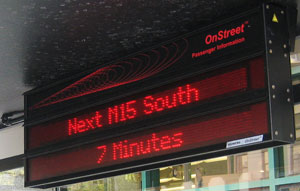
Real time electronic information boards are being tested on 15 bus lines throughout the city notifying riders when the next bus will be arriving. This one is on the M15 line on 2nd Avenue at 57th Street. Not much information about the initiative is available on the MTA’s website, but keep checking as more pop up around the city.

Jessica Sheridan

Polshek

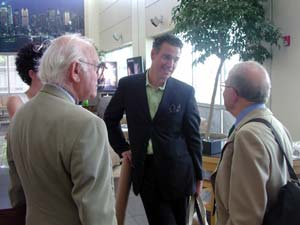
(l-r) Polshek Partnership’s James Polshek, FAIA, and Tomas Rossant, AIA, with Donald Newhouse ready to head to Syracuse University to tour Newhouse III.

Kristen Richards

08.23.07: Society for Marketing Professional Services (SMPS) Conference in Washington, DC

Michael Graves, FAIA

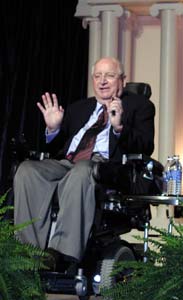
Amid columns and ferns, Michael Graves, FAIA, was animated and humorous during his keynote speech at “Build Business: Politics at Work;” Butler Rogers Baskett Architects was the only NYC firm to win 2007 Marketing Communications Award — in the category of Holiday Piece.

Kristen Richards

SMPS

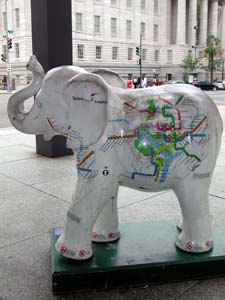
SMPS Conference: Wayfinding — D.C.-style (will it be donkeys if Democrats win?).

Kristen Richards