Convention Impressions

Deep in the heart of Texas…
My personal highlight was escaping late on Saturday night to Austin, where I was able to see, again, the Charles Moore Center for the Study of Place, and, the next morning, the new storefront Center for Architecture of AIA Austin. If what happens in San Antonio, stays in San Antonio (at least according to Mark Strauss, FAIA, AICP), what happens in Austin, thanks to Moore Center director Kevin Keim, and AIA Austin Executive Director Sally Ann Fly, should be broadcast to all ends of the U.S. The house where Charles Moore lived his last years is phenomenal, and Kevin keeps his spirit alive. The newest Center for Architecture — Austin’s opened just a few months ago — was a former gasoline station, and it keeps just the right balance between designed sophistication, and greasy grit.

I’m ready to move to Austin (and San Antonio), and have my Molly Ivins’ books packed in the Oculus tote bag, which was the hit of the show.

– Rick Bell, FAIA, AIANY Executive Director

AIA New York State Reception, Aztec on the River, San Antonio
A majestic movie palace was the site of this year’s AIANYS reception, bringing San Antonio’s history into focus for visitors from NY. The ornate styling of the theater was a reminder of the legacy that 1920s deco extremes left on San Antonio. A multi-media presentation with staged special effects — thunder, fog, and a levitating serpent — enacted portions of Meso-American history for guests. At the reception AIANYS President Russell Davidson, AIA, greeted familiar faces from Chapters around the state. The gathering celebrated the 10 New York firms whose projects received 2007 AIA Honor Awards. Also acknowledged were the state’s nine new Fellows, AIA Topaz Medallion recipient Lance Jay Brown, FAIA, and Associate AIA Member of the Year Finalist Jeremy Edmunds, PE, Assoc. AIA, LEED AP.

– Carolyn Sponza, AIA, AIANY Chapter Vice President of Professional Development

And one recollection from slightly off the convention trail
I happened to be walking by the Westin Hotel when an Airstream trailer parked in a lot across the street caught my attention. Called aloft a-go-go, the module is the latest PR tool developed by W Hotels to bring the design of a new line of inexpensive boutique hotels to the public. Besides literally taking their new show on the road, parent company Starwood has also launched aloft in cyberspace for design feedback on the Second Life website. NY-based The Rockwell Group is behind design of the new chain, proving you can bring a little New York to San Antonio. Aloft a-go-go captain Corbin Kappler also assured me that the PR-vehicle will be making an appearance on Union Square sometime in the next few weeks.

– Carolyn Sponza, AIA, AIANY Chapter Vice President of Professional Development

Overall a good time
My general observations were positive. It was the most walkable convention I’ve attended (others included Philadelphia, San Diego, Chicago, Las Vegas, and Los Angeles). Locals were friendly. Riverwalk was a sweet urban amenity. The meta-theme — green — is always relevant. I was thrilled to see the AIANY “New Practices New York” exhibition. Our chapter had real presence this year, and I believe the highest number of associates attended, too. I really liked the beer factory-turned-art-museum, and the red ochre public library rocked (especially the Chihuly glass sculpture in the atrium).

– Jeremy Edmunds, PE, Assoc. AIA, LEED AP, AIANY Director of Programs and Strategic Planning

But not flawless
One of the major flaws in the convention catalogue was not listing the speakers under the description, as is commonly done at most conferences. I encourage folks to tell the AIA that speakers should be listed with the panel information. I complained and was not given much encouragement. If enough people speak up maybe they will change it next year.

– Concerned attendee

Send an e-mail with your thoughts about the convention.
Bloomberg Bets Prosperous Future

James Estrin/The New York Times/Redux

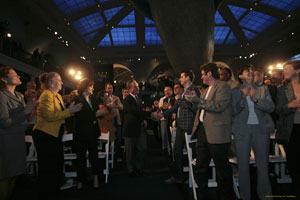
Mayor Bloomberg shakes hands with Chris Garvin, AIA, LEED AP, COTE co-chair at his Earth Day presentation of plaNYC 2030.

James Estrin/The New York Times/Redux

With a record population, a booming economy, and an aging infrastructure, Mayor Bloomberg’s PlaNYC 2030 proposals unveiled on Earth Day constitute a comprehensive, ambitious vision for the city’s future. On par with earlier civic investments that built New York’s parks, subways, bridges, and waterworks, the Mayor’s plan represents the kind of long-range planning the city needs to prosper in the 21st century.

New York’s existing buildings are the source of 79% of our carbon dioxide emissions, and account for more than half of our energy demands, according to the Inventory of NYC Greenhouse Gas Emissions recently completed by the Mayor’s office. For the building community, the plan’s most far-reaching proposal is to upgrade the energy efficiency of large existing buildings — most of which would not meet today’s energy code — with mandates and incentives. This may include upgrades for lighting and mechanical retrofits, improvements to wall and roof insulation, and replacement of old components with high performance windows and high-efficiency condensing boilers.

As we upgrade our existing buildings, it is also critical to address new construction. The new building code that will take effect this summer includes many green improvements, but the Mayor’s plan identifies even more impressive targets for the next update. The proposals include financial incentives for buildings that exceed state energy codes and water efficiency requirements by 30% to 40%, making them some of the greenest buildings in the country. Through pilot programs, the city can play a vital role in introducing such leading-edge technologies.

By taking a comprehensive, integrated approach to intertwined issues — affordable housing, environmental justice, mass transit, environmental quality, green job creation, and climate change — Mayor Bloomberg’s plan is a bold step toward sustainable prosperity. AIA members should encourage their local and state leaders to support PlaNYC as a vision for a greener future. As important as its specific goals are, the overall benefit of the Mayor’s plan is that it creates a critical mechanism to protect the environmental and economic engine of our city for future generations.

NYNV Extols plaNYC

Event: Mayor Bloomberg’s Plan for NYC 2030 New York New Visions: Exploring Implementation
Location: Center for Architecture, 05.07.07
Speakers: Ariella Rosenberg and Laurie Kerr, RA — Long Term Sustainability Respondents, Mayor’s Office of Planning and Long Term Sustainability; Ethel Sheffer — President, American Planning Association NYC Metro Chapter; Bruce Fowle, AIA, LEED AP — FXFOWLE Architects; Jeffrey Zupan — Senior Fellow, Transportation, Regional Plan Association; Rick Bell, FAIA — Executive Director, AIANY
Moderator: Ernest Hutton, Assoc. AIA, AICP — New York New Visions
Organizers & Sponsors: New York New Visions; AIANY Housing Committee; in conjuction with the AIANY Planning & Urban Design Committee; AIANY Transportation & Infrastructure Committee; and AIANY Committee on the Environment (COTE)

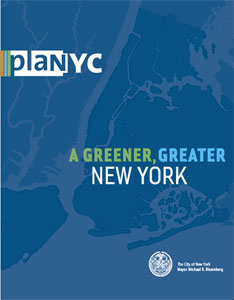
plaNYC

Courtesy nyc.gov

Panelists representing New York New Visions — a coalition of major design and planning organizations — expressed much enthusiasm for plaNYC 2030, although many were concerned about the plan’s longevity after Bloomberg’s mayoral term ends. The many improvements throughout the city over the last 30 years have inspired the mayor to aim high environmentally. With a goal to boost livability and sustainability, his unprecedented plaNYC 2030 targets land, housing, green space, water, air, transportation, and energy.

As an additional 900,000 residents are expected by 2030, there’s a demand for smart planning. To accommodate the 265,000 new housing units needed, more efficient use of government land, revitalized brownfields, and even decking over unused railways and highways are a few of the 127 proposals on the boards. Furthermore, 99% of New Yorkers will live within a ten-minute walk from a park and a subway entrance if the mayor has his way; a public plaza will be incorporated in every community, and one million new trees will be planted by 2017. All of the revenue from congestion pricing will be used to improve mass transit. In addition to these initiatives, panelists suggested the city implement a monitoring system to analyze progress that would be regularly disclosed to the public.

Without mitigation, the city’s annual energy bill will increase $3 billion by 2015, not to mention the effects on air quality and global warming. New York’s aging grid can’t handle 21st century demands, and many of the issues addressed in plaNYC are relevant globally as well as locally. If all goes well, New York has hopes of being not only the nation’s safest, but also its first truly sustainable city.

Beauty Pushes de Botton

Event: The Architecture of Happiness: How Our Surroundings Affect Our Emotional Well-being
Location: Grace Rainey Rogers Auditorium, Metropolitan Museum of Art, 05.01.07
Speaker: Alain de Botton — author, The Architecture of Happiness (Pantheon, 2006)
Organizers: World Monuments Fund; Metropolitan Museum of Art

The Architecture of Happiness

Courtesy alaindebotton.com

Author, philosopher, and television personality Alain de Botton has turned to architectural commentary after popular discourses on love, Proust, status anxiety, among others; his wit and erudition are unmistakable. He brings a degree of common sense to many of the buildings he discusses. If his project to reintroduce beauty unapologetically into architectural discourse were not as laudable as I believe it is, it would not be so painful to note how often his observations recall clichés. He informed us, for example, that good buildings demonstrate a sense of place and respect the natural features that they are replacing. This is not a news flash.

The goal that de Botton strives to help his listeners realize is admirable: connecting one’s attraction to visual beauty (something everyone senses but few articulate) with the more explainable aspects of one’s life. Much of his theory expands on a quotation from Stendhal (“Beauty is the promise of happiness”), and he recognizes a broad variety of definitions of happiness to provide a range of beauties, tailored to the elements people find missing from their lives. His appreciation of a placid minimalist kitchen by John Pawson, for example, expresses his own need for calm; the alarming Deconstructivist planes of a French government building, he says, imply that the bureaucrats within live in mortal terror of becoming any more boring than they already are. These observations ring true but rarely explore fresh territory.

De Botton takes seriously a question that he admits risks naïveté: just how important architecture is at all. He does not automatically assume an answer that will flatter architects. Offering a polarity between “Catholic” and “Protestant” views of architecture — the belief that ordered environs can bring people closer to the deity and a good life vs. the belief that divinity renders physical settings irrelevant — he says, “From an entirely secular point of view, I’m a ‘Catholic,'” and proceeds to anatomize ways that buildings can elevate, debase, defend, or confuse the psyche. Given the limited choice, who wouldn’t line up behind de Botton for communion wafers? The problem is that using this particular binary schism as an organizing metaphor omits most of the range and nuance of architectural debates (not to mention questions of functionality, ecology, and scale).

He also indulges a tendency to use negative examples that are absurd, scoring easy points off a mogul’s effort to mimic Amsterdam near Nagasaki, and a dreary mirror-glass box from one of New Jersey’s most soul-sapping corporate parks. Decoding the more challenging messages of today’s architectural provocateurs would have tested de Botton’s subjectivism in vital ways: what would he make of the atonalities, asymmetries, improvisations, and provocations of love-it-or-hate-it works by, say, Robert Venturi, FAIA, Zaha Hadid, Hon. FAIA, or Frank Gehry, FAIA? He offers many observations that are worth engaging, if he’s willing to push himself past the elementary.

Gopnik Calls New York “Mono-Cultural Desert of Sameness”

Event: Gothamitis: Malcom Gladwell & Adam Gopnik in Conversation — The Inaugural Event of the Design Trust Council
Location: Museum of Modern Art, 05.02.07
Speakers: Adam Gopnik — author, Through the Children’s Gate, Paris to the Moon (Random House, 2000); Malcolm Gladwell — author, The Tipping Point, Blink; Deborah Berke, AIA — Co–Chair, Design Trust Council (Introduction)
Organizers: Design Trust for Public Space

Central Park

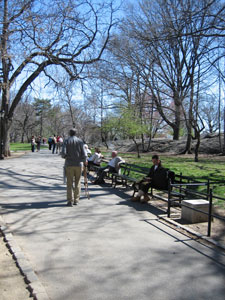
Central Park is necessary to preserve a unique sense of place in NYC, according to Adam Gopnik.

Jessica Sheridan

New York City has lost “a part of its identity,” bemoans Adam Gopnik in his article entitled “Gothamitis” (The New Yorker, 01.08.07). Although the city has drastically reduced crime, lowered unemployment, and cleaned up its streets since the 1970s, he describes the NYC of today as “an old lover who has gone for a facelift and come out looking like no one in particular.” Author Malcom Gladwell agrees that the city has changed drastically, but he believes the city has more subtle diversity than ever.

What NYC has maintained in density, it has lost in variety, according to Gopnik. The result is a “mono-cultural desert of sameness.” Gladwell, in contrast, posits that this loss of “physical diversity” has made way for “a more profound human diversity.” Conjuring an image of a coffee shop populated with young people working on laptops, he points out that these people are engaged in “highly varied pursuits, but the outward appearance of their production is the same.” Likewise, many of the city’s loft buildings that once housed the garment industry now support a variety of uses, from housing to commercial businesses. They may be “similar people with similar salaries,” Gladwell admits, but “they are doing very different things.”

While global economic trends have resulted in economic variety, Gopnik worries that, for the first time, Manhattan has no “Bohemian frontier.” While acknowledging the transfer of this activity to locations such a Williamsburg and Red Hook, NYC’s nature has changed from a compact and cosmopolitan place where varied socio-economic groups are in constant interface to a model of a city more akin to London, with far-flung and largely isolated neighborhoods of cultural generation.

Dismissing accusations of nostalgia, Gopnik sees the vernacular form of memory as defining “cultural values.” If global economic shifts affect NY, they cannot be left unquestioned. Looking to zoning codes, Central Park, and landmark preservation, Gopnik believes that similar interventions within the free market are necessary to maintain a desirable and valued city.

Combating the Cultural Energy Hog

Event: “Green Design: We’re All in This Together” (Sally Henderson Memorial Lecture)
Location: Arthur King Satz Hall, New York School of Interior Design, 04.18.07
Speaker: Hugh Hardy, FAIA — H3 Hardy Collaboration Architecture
Organizer: New York School of Interior Design

Theater for a New Audience

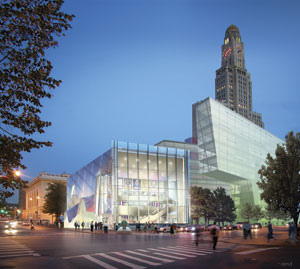
The Theater for a New Audience in Brooklyn incorporates solar power and wind heating based on its siting.

Studioamd courtesy H3 Hardy Collaboration Architecture

Building with ecological values in mind begins with local knowledge, a detailed sense of specific places, and their climates, flora, and other features. In Hugh Hardy, FAIA, and colleagues’ experience with arts infrastructure, resorts, courthouses, and even parking lots, the local applications of these principles prove their resilience. Hardy included data about buildings accounting for 48% of national energy use (cf. 27% for transportation and 25% for industry); the urgency of reducing this burden is hard to dispute. He proceeded to describe an array of projects where sensitivity to site and program afforded a range of sustainable strategies.

Sometimes a useful discovery begins with knowing when to say no: when to foreclose an expected option and replace it with something humble, unorthodox, or both. The Glimmerglass Opera’s Alice Busch Opera Theater in Cooperstown, NY, with its rustic references and dramatic sliding panels, is a case in point. Mechanical ventilation would have been too expensive, as Hardy says, to serve a rarely-needed function: “moving large volumes of air v-e-r-y s-l-o-w-l-y to avoid acoustical problems… to control temperatures for just a few days out of the 365.” With no winter opera season, conventional heating and cooling weren’t worth the expense; instead, financial necessity gave Glimmerglass audiences a literal breath of fresh air. The theater inspired later projects employing passive green strategies, such as the renovated Bear Mountain Inn’s highly cost-effective geothermal system.

The new LEED Gold-rated headquarters of the Botanical Research Institute of Texas recycles pulverized material from existing buildings and employs a tilt-up construction technique. Concrete walls are poured on-site and then lifted 90 degrees into place (standard for local warehouses), making the site itself a factory of sorts and minimizing costly transportation of finished panels. Plantings on the concrete walls and roof provide shade and thermal control as well as visual variety. In the parking lot permeable paving contributes to water management and returns rainwater to the soil. “Any institution devoted to the natural world,” asserted Hardy, “should be a leader in sustainable design.”

Cultural facilities pose particular challenges. Hardy recognizes that any theater is “an inherent energy hog” because it requires acoustic isolation, artificial light, and other obstacles to sustainability. The new headquarters for the Theater for a New Audience in the Brooklyn Academy of Music Cultural District will use the new site’s western orientation of a four-story curtain wall for solar power and winter heating. A new master plan for the Santa Fe Opera adapts a former dude ranch’s open-air pavilions as rehearsal spaces, with rammed-earth walls and subterranean passages maximizing airflow through the complex.

“It would be naïve to think we’re now all suddenly going to pledge allegiance to an eco-friendly existence,” concedes Hardy. Each site-specific choice, however, can help break down a national belief that he finds dangerously counterproductive: the assumption that every building must present an internal environment of identical, constant temperature and humidity. He envisions, instead, a future where people realistically allow for “nature’s variety and fecundity.”

No Impact Man Has Quite an Impact On Me

Finally there’s someone trying to practice what’s been preached at us. I’ve been following the blog of Colin Beavan, aka No Impact Man, over the last couple of months, and while I continue to be inundated with new rules for a more sustainable life, his proactive approach touches on what the many government initiatives, Powerpoint presentations, guidelines, and new incentives lack: solutions put into action.

Beaven, along with his wife, 2-year-old daughter, and dog are attempting to live without making a net impact on the environment for one year. According to his website, “When we’re done, we can reenter the world of normal consumerdom equipped to decide which parts of our no impact lifestyle we’re willing to keep and which ones we’re not.” As he attempts to phase out all impactful aspects of his life — he consumes only locally-grown food, bikes or walks everywhere, and now borrows solar power from SolarOne to power his laptop as he eliminates the use of electricity — he approaches his experiment without pretense. He is simply searching for a better way of living and, through his blog, he shares his findings. The blog also serves as a means for readers to respond and write in with their own ideas about living a greener life.

At this point Beaven is half way through his year. While I become more aware of my daily impact, I am also becoming aware of how easy and rewarding it can be to make simple lifestyle changes. As Beaven’s wife, Michelle, wrote on the blog, “No Impact is a great ritual imploder. It’s about a lifestyle redesign, giving up what I think I can’t to see if something different, something better, emerges.”

Beaven seems to be making an impact beyond his blog as well. He has been on television several times, from “The Colbert Report” to “Good Morning America”; he makes guest appearances at environmental events (he moderated a mediabistro course and appeared at the LVHRD Bi-Fold Green celebration); he is on the radio (the “Brian Lehrer Show” and “Talk of the Nation” have featured his experiment). Ultimately, a book will be published and a movie will be produced. By providing suggestions and solutions, Beaven enables everyone with the knowledge of how they personally can make a difference. I look forward to the next six months and beyond.

In this issue:
·HPD Transforms Prison to Mixed-Use Development
·Audubon LEEDs in Design Again
·Mural Spans One and a Half Block at JFK
·Harlem’s Schomburg Center Enters New Phase; Bronx Library Wins LEED Silver
·Korea’s New Songdo City: Asia’s NYC?


HPD Transforms Prison to Mixed-Use Development

Brooklyn’s Navy Brig

Brooklyn’s Navy Brig.

Courtesy NYC HPD

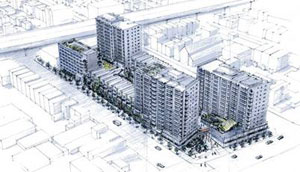
The NYC Department of Housing Preservation and Development (HPD) has selected Navy Green Joint Venture, a partnership of Dunn Development Corporation and L&M Equity Participants, which in turn has chosen the architectural team of FXFOWLE Architects, Curtis + Ginsberg Architects, and Architecture in Formation for the redevelopment of the Navy Brig site in Wallabout, Brooklyn. The redevelopment of this 103,000-square-foot former prison site will create a mixed-use, mixed income community consisting of 434 residential units, commercial space, open space, and a community facility. The Brig was built in the early 1940s and served as a naval prison. After the Brooklyn Navy Yard closed in 1966, the U.S. Immigration and Naturalization Service and later the city used the site as a minimum-security prison until it closed in 1994. Construction is anticipated to begin in the late spring or early summer of 2008.


Audubon LEEDs in Design Again
FXFOWLE Architects has been selected to design the 28,000-square-foot interiors of the National Audubon Society’s new national home office in a space formerly occupied by a printing plant. Located in Hudson Square, the new office is designed to be a certified LEED building with an integrated approach to sustainable design. A raised floor system will provide flexibility of electrical wiring while distributing under-floor air to workspaces. The National Audubon Society has long been a leader in green design, and its current office, renovated in the early 1990s, has served as a model for green office design.


Mural Spans One and a Half Block at JFK

“Skyline of the World”

“Skyline of the World” mural at JFK.

Courtesy Think Tank New York

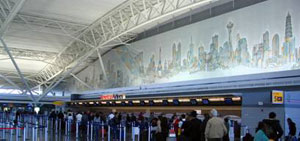
People can now see a panoramic depiction of 415 buildings from more than 70 international cities while waiting to check in at the new American Airlines Terminal 9 at JFK. Architect and artist Matteo Pericoli’s drawing spans the entire entry hall; running 397 feet long with a height varying from 30 to 52 feet, the monumental graphic is the world’s largest mural in an airline terminal. The mural was produced after photo-enlarging the original 12-foot-long “Skyline of the World” 32 times. International landmarks are juxtaposed not necessarily according to geography — the Hagia Sophia in Istanbul is shown next to the Burj Al Arab hotel in Abu Dhabi, and the Foshay Tower in Minneapolis is adjacent to a Venetian canal.


Harlem’s Schomburg Center Enters New Phase; Bronx Library Wins LEED Silver
At a recent open house, the internationally renowned Schomburg Center for Research in Black Culture unveiled its two-year, $11 million renovation. The New York Public Library selected Dattner Architects to update the library to give users more effective access to research resources on- and off-site. The renovation includes a new glass façade complete with a video wall viewable from Malcolm X Boulevard, and a new Scholars-in-Residence Center. Simultaneously, the library opened two new exhibitions, Stereotypes vs. Humantypes: Images of Blacks in the 19th and 20th Centuries and Black Art: Treasures from the Schomburg, selected from the Center’s Art and Artifacts Division with over 20,000 holdings.

And in the Bronx, the NYPL was awarded a LEED Silver certification for the Bronx Library Center, also designed by Dattner Architects. The center, which marks its first anniversary, is NYC’s first LEED certified municipal building.


Korea’s New Songdo City: Asia’s NYC?

New Songdo City

New Songdo City, Incheon, South Korea.

Hellmuth, Obata + Kassabaum

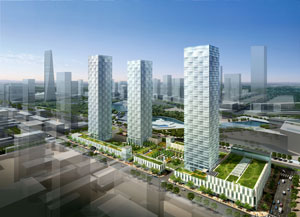
The NYC office of Hellmuth, Obata + Kassabaum (HOK) is designing seven new buildings in New Songdo City, Incheon, South Korea. New Songdo City, being built on 1,500 acres of reclaimed land along the Yellow Sea, is positioned to become the hub of Northeast Asia. The mixed-use towers and hotel will be part of the $25 billion international business district master planned by Kohn Pederson Fox Architects (KPF). The towers, built along south side of the city’s main public park on what is billed as the “5th Avenue of New Songdo City,” will accommodate housing, live-in work amenities, and retail space. Located on the south side of the park, and already under construction, is the HOK-designed 322-guestroom, 25-story hotel tower for the city’s convention center, and is hoping to be the first LEED certified hotel in Korea. The residential towers and the hotel are expected to be completed in 2009.

In this issue:
·Mayor Overhauls Building Codes
·AIA Members Receive Discount off Guggenheim Memberships
·AIANY Cruises NYC Waterways
·Survey Reveals Professional Growth
·Passing: Gregory Clement III, FAIA


Mayor Overhauls Building Codes
Mayor Bloomberg and Buildings Commissioner Patricia J. Lancaster, FAIA, submitted a landmark modernization of the City Building Code, the first since 1968, to the City Council for review and consideration. Fulfilling a promise made during the 2001 campaign, the Mayor’s proposal overhauls all aspects of the City’s construction codes, including the Building Code, setting new standards and rules that emphasize safety, efficiency, and sustainability. The proposal, to be called the NYC Construction Codes, draws on suggestions and input from hundreds of stakeholders the administration brought together for this effort, and is intended to simplify construction standards and foster long-term, environmentally-friendly growth.

The proposed Codes recognize electronic submissions and digital documents and will be organized according to the International Code Council format. To ensure the Codes never become dated, the proposed law will be tied to the national three-year revision cycle to take advantage of innovations in new materials and technology. The Department of Buildings (DOB) will also allow longer license durations. A cost study by the DOB has identified new code provisions for significant construction cost savings.

The Codes seeks to facilitate sustainable building by providing fee rebates for green design, requiring more efficient heating and cooling systems, requiring white roofs, and encouraging water conserving plumbing systems. The proposed Codes are available on the Buildings section of the New York City website. The website includes section-by-section documents that summarize each chapter and note key changes from the current Codes.


AIA Members Receive Discount off Guggenheim Memberships
AIANY is pleased to announce a partnership with the Solomon R. Guggenheim Foundation. AIA Members can redeem a 15% discount on memberships up to and including the Supporting Associate level by using the discount code “AIA” during online purchases and phone purchases (212-432-3535) or by showing the AIA Membership Card at the Solomon R. Guggenheim Museum membership desk.

The Guggenheim Foundation promotes an understanding and appreciation of art, architecture, and other manifestations of visual culture, primarily of the modern and contemporary periods. The Foundation realizes this mission through exhibitions, educational programs, research initiatives, publications, and its unique network of museums and cultural partnerships. For more information, visit the website.

Guggenheim members receive free admission to all Guggenheim museums, invitations to exclusive exhibition previews, 10% discount at the museum store and café, a free subscription to Guggenheim magazine, and more!


AIANY Cruises NYC Waterways
AIANY with NY Waterway Tours is launching the first cruise dedicated to the landmarks and skyline of NYC. The tour kicks off May 25 and will run every Thursday and Sunday at noon through the end of October. “Certified” tour guides will provide facts about numerous structures, and a visual presentation will play on flat-screen monitors to further enhance the experience. Bar service will be available on-board and a food menu will be offered by the “Original” NY Milkshake Company, located at Pier 78. Click here for schedules and to purchase tickets.


Survey Reveals Professional Growth
The 2007 Survey of Registered Architects by the National Council of Architectural Registration Boards (NCARB) indicates that there are currently 112,650 registered architects in the U.S., reflecting a 4.5% increase over last year. More than 3,800 initial licenses were granted to architects, an increase of 34.5% over last year.

The survey also reveals that there are 109,546 reciprocal (out-of-state) architects and 222,196 total registrations. This means, on average, an architect is registered in at least two different jurisdictions. CA has the most resident architects (16,894) and the highest number of total registrations (21,852). In comparison, NY has 8,356 resident architects and a total of 14,124 registrations.

The Council’s Quality Assurance division collects data for the survey from its 54 member boards, which includes all 50 states, D.C., Guam, Puerto Rico, and the Virgin Islands. NCARB makes this information available annually as a service to the profession.


Passing: Gregory Clement III, FAIA
Gregory Clement III, FAIA, died at home surrounded by family and friends on April 11, 2007. He was 56 and battled melanoma for nearly two years. Gregory served as a Managing Partner at Kohn Pedersen Fox Architects since 1993, overseeing numerous international and award-winning projects such as the Rodin Museum and the New Songdo City Master Plan, both in South Korea. He led the firm in its role as Executive Architect in the renovation and expansion of the Museum of Modern Art in NYC, working in tandem with Yoshio Taniguchi, Hon. FAIA.

Respected for his architectural contributions, Gregory was also admired for his personal relationships with clients and colleagues, his mentoring of young architects, and his warmth and integrity. He was inducted as a Fellow of the American Institute of Architects (FAIA) in 2005, and he actively participated in the AIA Large Firm Roundtable. He took part in student juries at Yale University, Princeton University, and Columbia University, among others. With his free time, he pursued painting and collage art, as well as golf.

Contributions in his memory may be made to the Gregory and Elizabeth Clement Melanoma Research Fund, Abramson Cancer Center of The University of Pennsylvania, 3535 Market St., Suite 750, Philadelphia, PA 19104. A memorial will be held June 1, 2007 at 4pm, the Church of the Heavenly Rest, 2 East 90th St. at Fifth Avenue.

2 Boats Teach about Solar Power — and More

Arriving in NY’s North Cove Marina on May 8, the Swiss vessel sun21 has completed the first solar-powered transatlantic voyage. The solar-powered catamaran left continental Europe on December 3, 2006 from Chipiona, Spain. It arrived in Martinique on February 2, completing its journey on the open seas and traveled along the U.S. East Coast through March and April. The transatlantic21 Association set out to prove the feasibility of clean energy vessels on open seas, as well as to showcase the wide spread applications of solar technology to transform the shipping and boating industry. Click the link to read the blog, learn more about the boat, and see pictures of the voyage.


Also on the shores of Manhattan is the Science Barge, a sustainable urban farm designed by New York Sun Works, an environmental nonprofit organization. Offering educational tours, the barge is a sustainable urban farm powered by solar, wind, and biofuels, and irrigated by rainwater and purified river water. Using recirculated greenhouse hydroponics (water collected from rain and the river), tomatoes, lettuce, cucumbers, and peppers are grown in a greenhouse. According to the website, “In a world of climate change, rapid urbanization, and endless pollution, sustainable urban agriculture can help.” Currently the barge is moored at Pier 84 in Hudson River Park. Click the link for more information and for schedules and directions.